




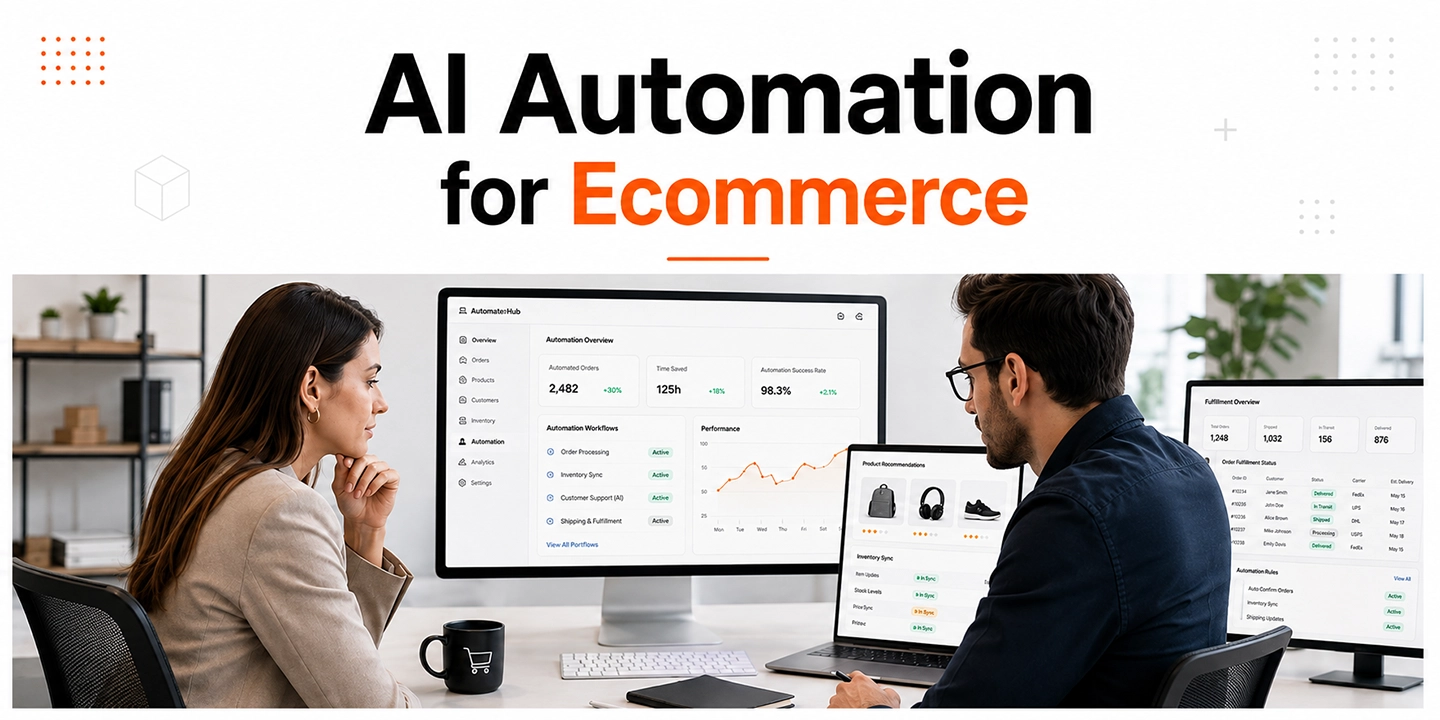
The use of AI automation in ecommerce today goes way beyond generating product descriptions or simple answers through chatbots.
In 2026, AI is used for customer support, categorizing of products, order inquiries, inventory management, reporting, merchandising, segmentation of customers, returning of goods, CRM operations, and workflows between ecommerce platforms and business systems.
For a US retailer using an ai automation agency in India, the key point here is not only to reduce manual labor but create workflows that can analyze the information, take limited decisions, trigger proper actions, and also include people into the process when the decisions have some financial or customer implications.
However, time is of essence.
Based on Shopify’s study on AI-referrals, the conversion rates of AI-referred visitors were almost 50% higher than those of organic search visits, while average order amounts of such visitors were 14% higher. Also, according to the report from Shopify, AI-referrals increased by almost 13 times YoY in Q1 2026.
This is a very useful signal. Not only the operations of ecommerce teams but also the purchasing process of customers is being transformed by AI.
What Is AI Automation in Ecommerce?
Ecommerce AI Automation is a process where the combination of artificial intelligence and processes, APIs, rules, and e-commerce data is used to do repetitive jobs or assist in decision making. Unlike simple automation, AI is capable of understanding unstructured data like customers’ correspondence, product descriptions, reviews, images, and reports before making its decision.
Actually, there are three levels of that.
| Type | Example |
| Rule-based automation | If inventory drops below 10, send an alert |
| AI-assisted automation | AI analyses sales and suggests which SKUs need attention |
| Agentic automation | AI analyses sales, inventory and demand, then prepares an approved replenishment action |
Honestly, most ecommerce businesses don’t need the third level everywhere.
Simple rules are still better when the process is predictable. AI becomes useful when interpretation or reasoning is involved.
Why Ecommerce Businesses Are Investing in AI Automation in 2026
There is fragmentation in ecommerce businesses.
A single retailer today could be operating out of Shopify or BigCommerce, an ERP system, CRM system, a warehouse management system, email marketing software, support tools, shipping systems, marketplaces, analytics tools, and spreadsheets.
Each separate system translates into more manual work.
The most recent research conducted by Salesforce on Connected Shoppers discovered that 75% of retailers expect AI agents to be indispensable by 2026. The same research revealed that 53% of shoppers today find their products through social media channels.
McKinsey expects the impact of AI in the future. According to its research, AI agents could manage up to $3-5 trillion of global consumer commerce by 2030.
In other words, AI agents can be useful for ecommerce players in two ways.
They can assist customers in making a purchase.
They can assist teams in managing the operation behind the purchase.

15 Ecommerce Tasks Businesses Can Automate With AI in 2026
1. Customer Support and FAQ Automation
AI can be used to answer any repetitive questions from customers based on their product details, FAQs, policies, CRM databases, and orders.
An example of a customer question would be:
“Is it possible for me to return this item since I have already opened it?”
This AI system will analyze the query and give a response based on the corresponding policy without having to search through the FAQ.
Escalation is the key issue here. Complaints, VIP customers, legal matters, and complex refund cases should be escalated to a human representative.
2. Order Status and WISMO Automation
“Where is my order?” is one of the most frequently asked questions in e-commerce support.
With an AI-powered workflow, you can identify your customer, find their order, look up the shipping service used and get the latest delivery status.
In case the delivery is late for some reason, you can automatically create a ticket.
This is where it gets interesting. You’re not only answering questions but finding problems as well.
3. Product Description and Catalog Content Automation
AI can generate first drafts for:
- Product Titles
- Descriptions
- Specs
- SEO Descriptions
- Bullet Points
- Meta Descriptions
- Feeds
It’s not just about writing text.
Big brands can leverage AI to create consistency from inconsistent data in their catalogs.
E.g. 5,000 SKUs provided by suppliers may have used five different ways to characterize the same material.
4. Product Categorization and Tagging
Products may be categorized using names, descriptions, specifications, and even images.
Suppose a clothing company is getting hundreds of products every month.
Whereas employees would have to tag products manually according to their gender, fit, color, fabric, type of sleeves, and occasion, AI could automatically categorize products for them.
A person could check doubtful cases as opposed to processing every single SKU.
5. AI Product Recommendations
Conventional recommendation systems rely extensively on purchase history and relationships.
AI can understand intent.
A customer may say:
“I require a lightweight jacket suitable for Seattle climate less than $150.”
The system can understand location, budget, features, and availability of the products to make a recommendation.
This sort of conversation-based recommendation works well for catalogs where customers require help and not just category browsing.
6. Ecommerce Search Automation
AI search understands meaning beyond keyword matching.
For example:
“Office shoes”
vs:
“Shoes that I can wear for standing for 8 hours.”
The searches may refer to the same items despite having different wording.
Conversational and semantic search can analyze product features, ratings, descriptions, and intention.
Based on my experience, search gains its significance when the number of products goes into hundreds or thousands, as poor search silently ruins sales.
7. Abandoned Cart Recovery
The conventional approach for dealing with carts is generally one-size-fits-all.
AI can aid in determining what makes carts unique.
For instance:
- Cart of a new visitor who doesn’t spend much on the cart
- Cart of a loyal VIP client
- Client checking shipping prices frequently
- High-value B2B cart
- Client abandoning the same product twice
Such carts can then go through separate email, SMS, and support flows.
Discounts don’t have to be an automatic response.
8. Customer Segmentation
AI is capable of segmenting consumers based on parameters which are hard to classify through filters.
These can be:
- Frequency of purchase
- Average transaction amount
- Interest in product categories
- Price sensitivity
- Return patterns
- Browsing patterns
- Days since last purchase
- Email activity
Then the ecommerce team can build different retention campaigns for loyal customers, at-risk customers, first time buyers and price-sensitive customers.
9. Email and CRM Automation
AI will help you perform the CRM tasks that are generally overlooked due to the team being too occupied.
The workflow could:
- Identify an important sale.
- Update the CRM.
- Provide a summary of the customer’s purchasing history.
- Appoint an account owner.
- Write up a follow-up email.
- Alert the sales team.
This can be especially helpful for B2B ecommerce.
10. Inventory Monitoring and Low-Stock Alerts
A simple system lets you know when inventory drops to a certain level.
An AI is contextual.
For instance, 20 pieces left might be absolutely fine for a slow-moving product but risky for one that moves 15 units per day.
A contextualized workflow of an AI system can take into account:
- Inventory on hand
- Sales velocity
- Lead time
- Coming promotions
- Seasonality
- Unfilled purchase orders
And then determine what needs your attention.
11. Demand Forecasting
AI can aid merchants in predicting demand from past sales, promotions, seasonal trends, inventory, and outside business indicators.
However, this is one place I would not leave to automation.
It’s possible that AI could recognize patterns, but it wouldn’t know, for example, if a supplier was having problems or a competitor had just run a promotion.
This should be AI working as an assistant, rather than a completely unsupervised buyer.
12. Review and Sentiment Analysis
A store with 50 reviews can analyze each review.
A company with 10,000 reviews spread out through multiple sources cannot.
Some topics include:
- Product quality
- Packaging
- Fit
- Delivery
- Instructions
- Support
- Defects
Now consider that a company gets 40 reviews about damage to the packaging.
An automated workflow would notice the pattern and notify the operations department.
13. Returns and Refund Workflow Automation
Regressions are surprisingly rife with repetitive decision-making.
Artificial Intelligence will allow us to analyze regression reasons and integrate those into our orders.
Here’s how it works:
Customer sends in return request >> system determines eligibility >> Artificial Intelligence analyzes reasons >> workflow creates return instructions >> warehouse gets predicted return >> finance system marks the status.
Big refunds, suspicious customers, and disputes will always need approval.
Blind automation leads to disaster.
14. Ecommerce Reporting and Analytics
Management wastes time on data gathering rather than on understanding.
The AI can provide daily or weekly reports on:
- Sales
- Orders
- Order values
- Conversions
- Returns
- Best selling items
- Inventory
- Marketing results
- Support trends
More advanced systems may highlight anomalies.
For instance:
“Sales grew by 12% but profit margin shrank because of high discount sales.”
This is more valuable than yet another dash board that nobody uses.
15. Cross-System Workflow Automation
This is where it usually gets more interesting to work with ai workflow automation agencies in India.
Actual ecommerce business does not fit into one platform.
One workflow may involve integration of Shopify, NetSuite, HubSpot, Gorgias, Slack and warehouse system.
For instance:
Order created → check for fraud conditions → create customer in ERP → inventory reserved → notify the warehouse → CRM update → identify high value customer → notify account team.
Tools like n8n, Make, Zapier can facilitate the workflow integration, while AI takes care of interpretation when there is no specific rule.
Quick Comparison of Ecommerce AI Automation Opportunities
| Ecommerce Task | AI Role | Human Review? | Main Benefit |
| Support | Interpret queries | Sometimes | Faster response |
| Order tracking | Retrieve and explain status | Rarely | Fewer tickets |
| Catalog content | Generate/classify | Yes | Time savings |
| Product tagging | Classification | Exceptions | Faster catalog entry |
| Recommendations | Intent matching | No | Better discovery |
| Search | Semantic understanding | No | Easier product finding |
| Cart recovery | Segmentation | Sometimes | Revenue recovery |
| CRM | Classification and summaries | Sometimes | Better follow-up |
| Inventory | Pattern detection | Yes | Fewer stock issues |
| Forecasting | Prediction | Yes | Better planning |
| Reviews | Sentiment analysis | No | Faster issue detection |
| Returns | Classification | High-value cases | Lower admin work |
| Reporting | Analysis | No | Faster decisions |
| Integrations | Decision support | Depends | Less manual data entry |
Which Tools Are Used for Ecommerce AI Automation?
Ecommerce AI applications are seldom developed with a single platform.
For workflow orchestration, there are platforms such as n8n, Make and Zapier. For commerce information, APIs from Shopify and BigCommerce are utilized. Language and reasoning functions can be fulfilled by OpenAI, Claude or Gemini. ERP, CRM, WMS and customer service software give the operational context.
However, choosing the tool first is generally counterproductive.
First, focus on the process.
Second, see which tools match the requirements for scale, security, price, API limitations and error handling.
A straightforward lead routing process would fit into Zapier nicely.
A complex order management process with multiple API calls, decision-making and coding would better suit n8n or a custom solution.
Rule-Based Automation vs AI Automation
| Rule-Based Automation | AI Automation |
| Uses predefined conditions | Can interpret context |
| Predictable output | Output can vary |
| Excellent for structured data | Useful with unstructured data |
| Easier to test | Requires stronger monitoring |
| Lower AI cost | Model/API costs apply |
| Best for fixed processes | Best for classification, analysis and decisions |
In most cases, businesses need both.
Use rules where certainty matters.
Use AI where interpretation adds value.
Which Ecommerce Tasks Shouldn’t Be Fully Automated?
Such risky business activities such as financial, legal, customer, and supplier should never fall entirely into AI’s hands. Organizations need to set approval levels that will allow AI to make or suggest certain recommendations while humans still have a decision-making authority on things that can cost them financially or their reputation.
Keep the human approval process going:
- Massive refunds
- Big price fluctuations
- Supplier purchase orders
- Expensive discounts
- Closing accounts due to fraud
- Legal claims
- Credit decisions for B2B
- Sensitivе information
- Expensive customer disputes
It is known that Salesforce researches show that only 42% of people believe businesses will use AI responsibly, compared to 58% in 2023.
How Should Ecommerce Businesses Decide What to Automate First?
Begin with repetitive, measurable, low-risk processes that take up employees’ time. Do not begin with your most technically advanced AI process. Begin where you know friction exists.
Such a process is:
- Identify repetitive tasks.
- Determine time spent per month.
- Identify the systems involved.
- Determine data quality.
- Determine cost of error.
- Automate a process.
- Add approvals if necessary.
- Measure impact.
- Extend after process becomes valuable.
Monitor metrics such as response time, support costs, time savings, order processing time, conversions, inventory errors, returns processing time, and customer satisfaction.
When Should You Work With an AI Automation Agency in India?
The following are some circumstances in which an ai automation agency in india should be involved in an ecommerce business. This is especially true in cases where multi-platform automation is needed as well as the incorporation of various tools such as APIs, AI agents, ERP or CRM integration, proprietary company information, and custom human intervention workflow process.
This is especially the case for US firms that already have skilled ecommerce professionals but do not wish to create an automation engineering team within their firm.
How to Choose the Best AI Automation Agency in India
There is no way to describe any ai automation agency in India as “the best” on the basis of its website alone.
What evidence do you have?
A good partner will be able to explain:
- Ecommerce APIs
- Webhooks
- Shopify or BigCommerce
- ERP and CRM integrations
- n8n, Make or Zapier
- AI APIs
- Authentication
- Data security
- Retry logic
- Error handling
- Human signoffs
- Monitoring
- Documentation
They need to be able to answer how they handle workflow failures.
This one question reveals a lot.
Any ai automation company in India is capable of making a demo work. However, production automation must be reliable enough to handle API timeouts, missing product data, credential expiration and unexpected AI model output.
In case you require anything special in terms of workflow logic and/or proprietary systems, a custom ai automation company in India would be a better fit than a general purpose no-code tool.
Moreover, in case your organization has architecture and product management capabilities internally, you might consider hiring AI automation developers in India and managing the delivery process yourself.
AI Automation Agency vs In-House Team
| Factor | Agency | In-House |
| Initial setup | Faster access to mixed skills | Recruitment required |
| Knowledge | Broader project exposure | Deeper company context |
| Cost | Project or retainer based | Ongoing salaries |
| Integration skills | Often stronger initially | Depends on team |
| Ownership | Must be defined contractually | Internal |
| Best fit | Multiple workflows quickly | Long-term automation program |
Neither model is automatically better.
Large companies often end up using both.
Conclusion
AI automation in ecommerce is not about trying to take humans out of the process wherever possible.
It’s about identifying those areas where employees have been endlessly repeating themselves – copying information, responding to frequently asked questions, looking at the same reports, or making small decisions that can be done through software anyway.
In considering an ai automation agency in India for your US ecommerce company, begin with a measurable process before embarking on a massive AI project.
Quality data, quality APIs, business rules, and human decision-making matter.
Do one valuable task, see how much has changed, improve upon your weaknesses and continue from there.