




Category: BigCommerce

Frequently Asked Questions
BigCommerce website development in India can start around ₹80,000 for a relatively simple implementation and exceed ₹20 lakh for enterprise, headless, B2B, or integration-heavy projects. A custom mid-market store commonly requires a budget of roughly ₹2 lakh to ₹5 lakh, depending on design, migration, catalog complexity, apps, and integrations.
It depends on the project. Platform subscription prices are only one part of total ecommerce cost. BigCommerce can become attractive for businesses needing B2B functionality, complex catalogs, APIs, multi-storefront capabilities, or integrations. Development costs for both platforms rise significantly once custom architecture, ERP systems, headless frontends, or complicated business rules are involved.
A straightforward BigCommerce store may take around four to eight weeks. A custom mid-market project can take eight to sixteen weeks, while B2B, headless, migration-heavy, or enterprise implementations may require several months. Timelines depend on design approvals, data quality, integrations, third-party dependencies, testing, and how quickly business requirements are finalized.
Rates vary considerably by skill and engagement model. Rather than comparing only hourly rates, businesses should compare total project scope and experience. A developer capable of complex API, B2B, headless, or ERP work will generally cost more than someone configuring themes, but may require far fewer hours to solve technically difficult problems correctly.
Yes. Products, customers, categories, images, orders and other data can be migrated from platforms such as Shopify, Magento, WooCommerce and custom ecommerce systems. The difficult part is usually preserving custom data, URL structures, integrations and business rules. A proper migration should also include redirects, data validation, testing, and an SEO transition plan.
Yes. BigCommerce offers B2B capabilities around company accounts, buyer experiences, pricing, quotes, APIs, and related workflows. B2B projects still need careful implementation because every wholesaler has different pricing, approval, ordering, payment, and ERP requirements. The platform provides the foundation, while development connects it to the company's actual processes.
Use a custom theme when your brand, merchandising, UX, or conversion requirements can't be met effectively with an existing theme. Smaller brands can often launch faster with a commercial theme and focused modifications. Growing retailers may benefit from custom UX once they understand customer behaviour and have enough sales volume to justify the development investment.
Yes, generally. Headless BigCommerce introduces a separate frontend application and requires API integration, frontend hosting, development, testing, monitoring, and ongoing maintenance. It can make sense for businesses with unusual content or commerce requirements, but choosing headless simply because it's fashionable usually creates unnecessary cost.
A good quote should define design, theme development, templates, catalog work, migration, integrations, apps, payment setup, shipping configuration, responsive development, QA, SEO redirects, deployment, documentation, warranty support, exclusions, third-party costs, and assumptions. If the proposal simply says "BigCommerce website development" with one price, ask for more detail.
Review its actual BigCommerce experience, technical capability, migration knowledge, API experience, B2B understanding, QA process, communication, and ongoing support model. Ask the agency to explain how it would approach your specific requirements. A technically credible team should be able to discuss risks and limitations, not just promise that every requested feature is easy.
Frequently Asked Questions
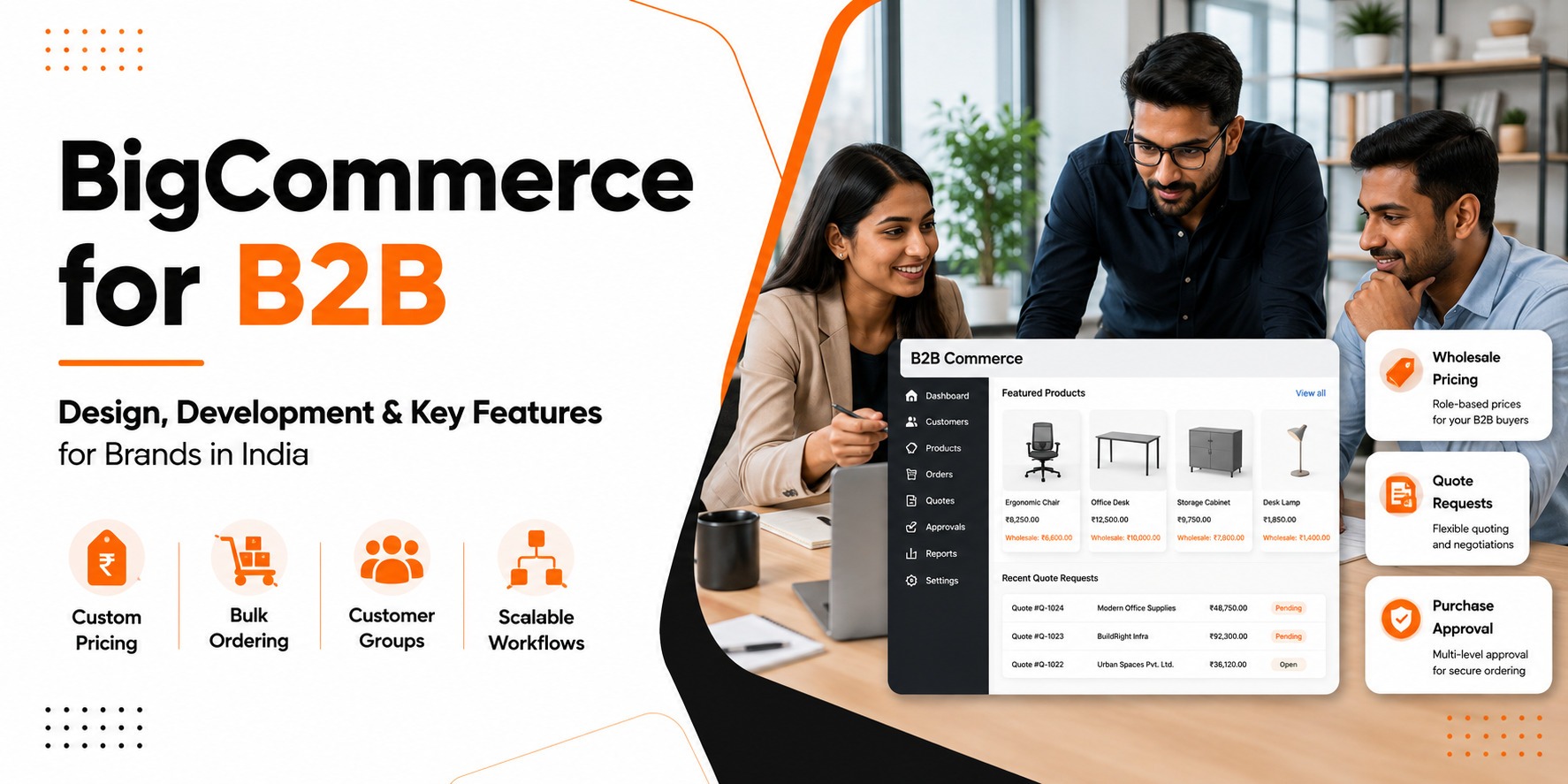
Yes. BigCommerce can support company accounts, buyer roles, custom pricing, quotes, invoices, bulk ordering, multiple storefronts, and integrations required by wholesalers, manufacturers, and distributors.
BigCommerce B2B Edition extends the platform with business purchasing features such as company accounts, buyer permissions, quote workflows, invoices, order history, and a dedicated buyer portal.
Yes. Pricing can be structured around customer groups, price lists, company agreements, volume, and integrations. The final approach depends on the store plan, catalogue, and source of pricing data.
Yes. B2B workflows can support quote requests, seller responses, negotiated pricing, and conversion into orders. The process should be configured around the company’s existing sales and approval rules.
BigCommerce B2B setups can support purchase-order and invoice-based workflows for approved buyers. Credit terms, limits, and payment status may also need integration with accounting or ERP systems.
Yes. BigCommerce APIs and integration tools can connect the store with ERP, PIM, CRM, accounting, warehouse, and fulfilment systems. Data ownership and synchronization rules should be defined first.
A basic storefront may take several weeks. A larger B2B project involving custom pricing, buyer portals, quotes, data migration, multiple storefronts, and ERP integrations generally requires more time.
A custom theme is useful when standard themes cannot support the required catalogue, ordering workflow, brand design, or account experience. Businesses should customize only where there is a clear need.
Frequently Asked Questions
A BigCommerce development company may provide store setup, custom design, Stencil theme development, platform migration, application development, API integration, performance optimisation and maintenance.
Yes. BigCommerce can support company accounts, customer-specific pricing, bulk ordering, quotations, custom catalogues and integrations with business systems.
Yes. Businesses can hire BigCommerce developers in India for theme customisation, bug fixes, application development, integrations, migration and performance improvements.
A BigCommerce Stencil developer customises storefront templates, page layouts, product pages, category pages and reusable theme components.
BigCommerce design services in India may include custom storefront layouts, mobile-responsive design, navigation planning, product-page design, category-page design and theme development.
Review their live projects, mobile layouts, product-page design, catalogue navigation and understanding of B2B customer journeys. Avoid selecting a company based only on homepage designs.
Yes. A BigCommerce agency can migrate products, customers, orders, categories, images, custom fields and other store data from an existing platform.
The proposal should include discovery, design, development, migration, integrations, testing, deployment, documentation, support and project timelines.