




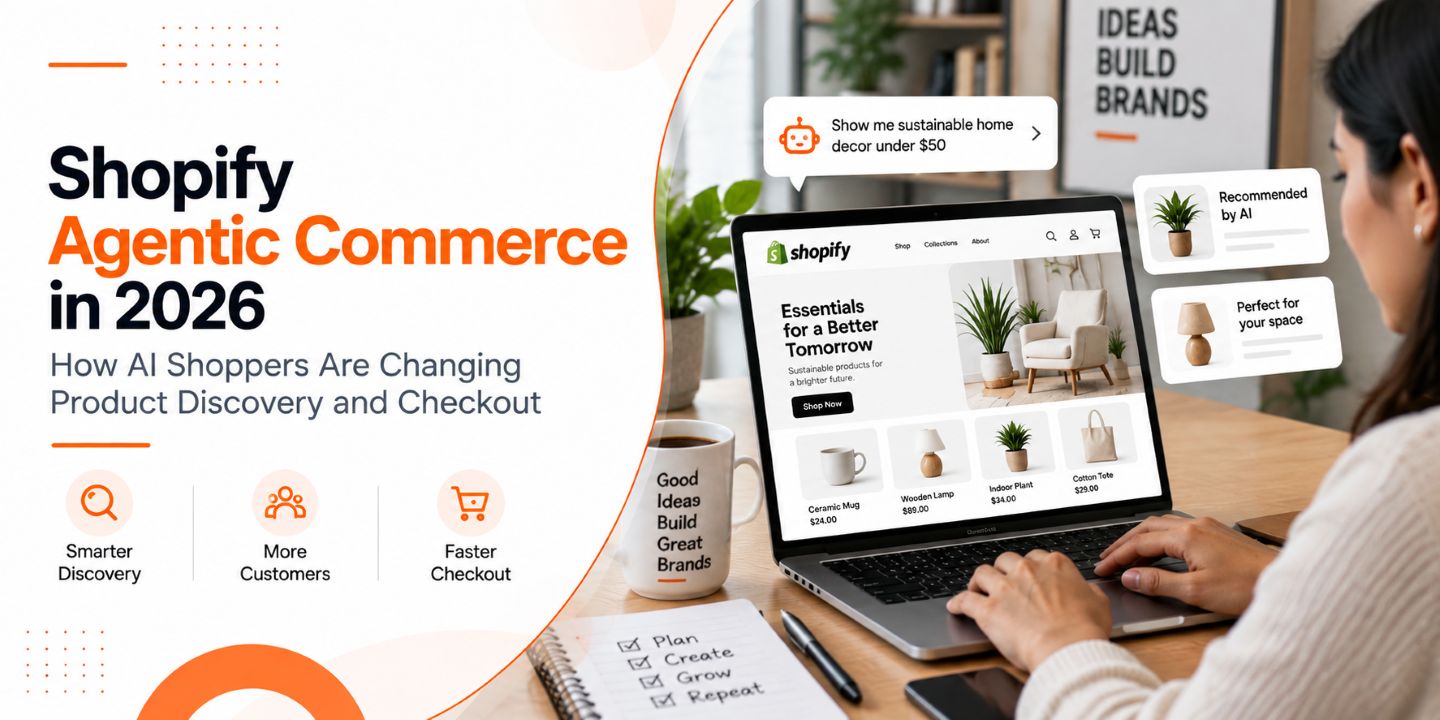
Here’s something bizarre that’s occurring in ecommerce.
People are continuing to shop online, but they’re no longer beginning their search journey from a store, a marketplace, or even Google.
They begin from AI.
They consult ChatGPT on which laptop to purchase. They turn to Gemini for comparisons of skincare products. They seek out advice from an AI assistant about finding a suitable gift under a specific budget and doing comparisons, etc., in order to finally complete the purchase.
This affects the role of the ecommerce site.
For years, brands have done their best to lure people to their product pages. The big question in 2026 is turning into:
Can an AI system understand your products well enough to recommend them?
This is where agentic commerce on Shopify enters the picture.
It’s not just an additional AI chatbot capability. This is a completely new paradigm of interaction between consumers, AI agents, and ecommerce systems.
For Shopify merchants, it may have an impact on everything from product information and SEO to checkout and customer acquisition.

What Is Shopify Agentic Commerce?
Agentic commerce on Shopify is the concept of letting the AI agents facilitate consumers during the majority of the purchase process.
Unlike just answering their questions, the AI can perform such actions as:
- figuring out customer needs
- looking for the appropriate products
- comparing products
- checking product information
- adding selected products to a cart
- preparing the checkout stage
- facilitating the purchase itself.
This change is significantly greater than one may imagine at first.
In traditional e-commerce, consumers do most of the work themselves.
Consumers search, filter, compare, open multiple tabs, read descriptions, check shipping, and choose what to buy.
From Search Bar to Shopping Assistant
Consider a regular ecommerce search.
A customer searches:
“Black running shoes”
The store will give back a list.
But how would an AI search go?
“I am looking for black running shoes that cost less than $130. I run three times a week and mostly run on concrete surfaces. Preferably something with extra padding.”
This is not just a keyword search anymore.
It is an online shopping brief.
The AI needs to comprehend the intent, preferences, budget, and use case of the user.
And this is exactly what Shopify is gearing up for.
Why Shopify Is Betting on AI Shopping
Shopify finds itself in an interesting place.
It runs millions of merchants; therefore, it already has a tremendous amount of structured commerce data to tap into.
- Products.
- Prices.
- Inventory.
- Variants.
- Collections.
- Checkout rules.
- Shipping information.
This gives Shopify a natural platform to facilitate agentic shopping.
The platform does not have to create ecommerce all over again. All it has to do is make its current commerce data intelligible to AI agents.
That’s precisely why Shopify has been working on areas such as:
- Shopify Catalog
- Agentic Storefronts
- AI commerce integrations
- Universal Commerce Protocol
- cart and checkout tools for agents
- It’s pretty obvious what the end goal is.
If customers will be using more AI to shop, Shopify wants to be present within that shopping experience.
The Biggest Change Is Not Checkout. It’s Discovery.
Checkout is hyped because it is futuristic.
However, product discovery is the true revolution here.
The process of discovery for years now was determined by SEO and marketplaces.
- Your aim was to have your product ranked.
- You needed visibility.
- You needed the click.
With agentic shopping, things are done in an entirely different way.
An AI helper might analyze hundreds of products and present only three to the customer.
In case the product is not understood well enough, it will never make the cut.
This becomes a different ecommerce visibility issue altogether.
AI Needs Context, Not Just Keywords
For instance, consider two stores that are selling office chairs of the same kind.
Store A says:
“Designed for modern workplaces. Comfort never felt before.”
Store B says:
“Ergonomic mesh office chair with lumbar support adjustment, up to 120 kg weight capacity, adjustable armrests, 3D headrest, and seat height between 45 cm and 55 cm.”
Which would help an AI respond to:
“Find an ergonomic chair below ₹20,000 for long days at work with lumbar support?”
It will be Store B.
The former may sound better.
But the latter is clearer.
This clarity will have greater significance in the future of AI-powered products discovery.
Product Data Is Becoming a Marketing Asset
Historically, product data often felt like backend housekeeping.
- SKUs
- Dimensions
- Attributes
- Variants
- Compatibility
- Materials
Now that information can directly influence whether an AI system recommends a product.
This is one of the most practical lessons of agentic commerce.
Merchants Need Better Product Information
Good product information should answer things like:
- What exactly is this?
- Who is it for?
- What problem does it solve?
- What sizes or variants exist?
- What material is it made from?
- What is it compatible with?
- What does it cost?
- Is it available?
- How quickly can it ship?
- What makes it different?
This is good ecommerce anyway.
AI just makes weak product data harder to hide.
What Shopify Catalog Changes
Shopify Catalog plays a key role in the AI commerce strategies of the company.
The basic premise of the concept is quite straightforward.
Instead of having to train an artificial intelligence system separately on each website individually, the data regarding products can be exposed in a more structured manner.
Why Structured Commerce Data Matters
Let’s take the example of an AI attempting to find similarities between headphones from ten different stores.
The first store describes its battery life in the product description.
The second includes it in the image.
The third includes it in a tab.
The fourth doesn’t even mention it.
This is not very systematic.
Structured product information makes comparisons easier.
This may increase the chance of surfacing a relevant product.
From the merchant’s perspective, this means that the quality of their catalog matters a lot.
Agentic Storefronts Could Become a New Sales Channel
One of the more interesting Shopify developments is Agentic Storefronts.
The concept is that merchants can make products available through AI-powered shopping experiences without building a separate store for each AI platform.
This matters because ecommerce has already been through channel fragmentation.
Brands have had to manage:
- websites
- marketplaces
- social commerce
- Google Shopping
- mobile apps
- retail feeds
Now add AI assistants.
Without a common commerce layer, each AI platform could become another technical integration.
Shopify is trying to reduce that complexity.
What This Could Mean for Merchants
And from a practical point of view, the buyer might come across the product on Shopify without ever having been in the store.
This would seem awkward if you rely entirely on website visitors for all your development efforts.
However, it does not have to be a bad thing.
If the AI introduces potential clients, then you need less traffic for more successful transactions.
How AI Shoppers Are Changing Checkout
Checkout involves the shopper having to go through each process personally.
Add product to the cart.
Provide shipping information.
Choose mode of delivery.
Discount applied.
Payment made.
Confirmation.
AI-based shopping alters the entire process.
In this case, the shopping agent may complete most of the process even before the control is transferred back to the shopper.
The Checkout Still Needs Merchant Rules
This part is important.
AI agents can’t just invent checkout behavior.
The merchant still has rules around:
- taxes
- shipping
- discounts
- stock
- delivery locations
- payment methods
- customer identity
- age restrictions
- product eligibility
The AI needs to interact with those rules rather than ignore them.
That’s one reason Shopify’s commerce infrastructure matters.
The merchant remains the system of record.
AI Can Reduce Checkout Friction
Think about how the consumer has already made clear to the AI that:
“I want this delivered to Chicago by Friday.”
That is information which could be used at an earlier stage in the process.
Instead of recommending an item and only finding out after that it cannot be delivered in time, the constraint could be incorporated into the recommendation process.
This makes sense for a lot of reasons.
What Is the Universal Commerce Protocol?
The Universal Commerce Protocol is one of the less spectacular yet essential elements of agentic commerce.
This protocol aims to create a universal standard for communication between AI agents and commerce platforms.
Why does it matter?
- As the ecommerce industry is rather multifaceted,
- the product can have
- different versions of itself,
- geographical price differences,
- different delivery options,
- inventory limitations,
- discounts, etc.
It is necessary for an AI agent to be able to request the necessary information and perform appropriate actions.
Otherwise, there would be a need to design a completely new logic for each commerce platform.
This problem is quickly getting out of control.
Shopify SEO Is Changing Too
Traditional Shopify SEO still matters.
Google is not disappearing.
Category pages still matter.
Product pages still matter.
Internal links still matter.
But AI discovery adds another layer.
The question is no longer only:
“Can this page rank?”
It becomes:
“Can a machine understand this product well enough to recommend it?”
Product Titles Should Be More Informative
A product name like:
“Cloud Nine”
may be memorable.
But:
“Cloud Nine Lightweight Waterproof Hiking Jacket”
gives an AI much more context.
You don’t have to destroy your branding.
You just need enough supporting information around the branded name.
Descriptions Should Answer Real Questions
A lot of ecommerce descriptions are filled with generic language.
“Premium quality.”
“Designed for modern lifestyles.”
“Built with care.”
Those phrases don’t tell an AI much.
Useful product descriptions should explain:
- use cases
- specifications
- limitations
- sizing
- materials
- compatibility
- care instructions
- delivery details
That makes the product more useful for humans too.
Conversational Search Is Creating New Search Intent
One of the biggest differences between traditional search and AI shopping is how much information customers provide upfront.
A Google search might be:
“best coffee machine”
An AI shopping query could be:
“I want a coffee machine under $400 that makes espresso and cappuccino, doesn’t take too much counter space, and is easy to clean.”
That query contains multiple filters.
Budget.
Use case.
Features.
Size.
Maintenance preference.
AI shopping systems can turn all of those into product selection criteria.
For brands, that means long-tail product attributes matter more than ever.
A Realistic Example of AI Shopping
Imagine someone is buying a monitor for remote work.
They tell an AI assistant:
“I need a 27-inch monitor under $350. I work in design, so color accuracy matters. It should connect to my MacBook through USB-C.”
The AI can now filter based on:
Size
27 inches.
Budget
Below $350.
Use Case
Design work.
Technical Requirement
USB-C.
Priority
Color accuracy.
A traditional ecommerce site might make the customer filter manually.
The AI can reduce the options before the shopper even sees them.
This is where good catalog data directly affects visibility.
What Shopify Merchants Should Do Now
You don’t need to completely redesign your store because agentic commerce exists.
That would probably be an overreaction.
There are simpler things worth doing first.
Fix Incomplete Product Data
Check whether your products have accurate:
- titles
- descriptions
- specifications
- sizes
- variants
- prices
- availability
- images
- shipping information
Missing attributes could become lost discovery opportunities.
Remove Vague Product Copy
Marketing copy is fine.
But make sure it sits alongside useful information.
Don’t make customers or AI systems guess what a product actually does.
Keep Inventory Accurate
A recommendation is useless if the product is unavailable.
Inventory accuracy becomes even more important when AI agents are helping shoppers make faster decisions.
Make Shipping Information Clear
Delivery speed can influence product selection.
If your shipping information is vague, an AI may struggle to confidently recommend your product for time-sensitive purchases.
Improve Your FAQs
FAQs can become useful sources of merchant knowledge.
Think about questions customers actually ask before buying.
Sizing.
Returns.
Compatibility.
Warranty.
Shipping.
Care instructions.
Those answers may eventually play a bigger role in AI-assisted commerce.
What Shopify Developers Should Be Learning
This shift affects developers too.
A Shopify developer used to focus mainly on:
- theme development
- Liquid
- apps
- APIs
- checkout extensions
- integrations
Now there’s another layer.
AI agents.
Developers working on future-facing Shopify projects should understand how commerce data can be exposed to AI systems.
Areas Worth Watching
Developers should pay attention to:
- Shopify Catalog
- Agentic Storefronts
- MCP
- UCP
- cart APIs
- checkout APIs
- authentication
- structured product data
- agent permissions
- product availability
This could become a meaningful new area of Shopify development.
Will AI Replace Shopify Storefronts?
Probably not.
Some people will definitely say it will.
But ecommerce rarely works in such a clean, dramatic way.
Customers still care about:
- branding
- photography
- storytelling
- reviews
- trust
- browsing
- emotional buying
An AI assistant is useful when the customer wants efficiency.
It may be less important when shopping itself is part of the experience.
Buying printer cartridges and buying luxury fashion are not the same behavior.
So Shopify stores aren’t disappearing.
They’re just gaining another layer of interaction.
What Could Go Wrong With Agentic Commerce?
This part deserves more attention.
AI shopping sounds convenient, but there are real risks.
Wrong Product Recommendations
AI can misunderstand preferences.
A technically suitable product may still be wrong for the customer.
Outdated Data
Incorrect price or stock information can quickly damage trust.
Payment Trust
Customers may not be comfortable giving AI systems too much transaction authority.
Returns Could Increase
If shoppers delegate too much decision-making, poorly matched products could lead to more returns.
Brand Relationships Could Weaken
If the AI becomes the main interface, brands may lose some direct interaction with customers.
That’s probably one of the biggest strategic questions.
Who owns the customer relationship when the AI controls discovery?
Does Agentic Commerce Change Conversion Rate Optimization?
Yes, potentially.
Traditional CRO focuses on things like:
- button placement
- product page layout
- navigation
- checkout steps
- trust badges
- imagery
Those things still matter for human visitors.
But AI-assisted commerce introduces another conversion layer.
The conversion might happen before the customer reaches your storefront.
So merchants may eventually need to optimize for both:
human conversion
and
machine understanding
That’s a very different ecommerce mindset.
What Does This Mean for Ecommerce Marketing?
For years, ecommerce marketing has largely been about traffic acquisition.
Get more clicks.
Get more visitors.
Get more sessions.
Agentic commerce could shift some attention toward product eligibility.
Instead of asking only:
“How do we get this customer to our store?”
brands may start asking:
“How do we make sure our product is considered by the AI?”
That means product data quality, merchant reputation, pricing, availability, shipping and customer feedback may become even more important.
Is Shopify Agentic Commerce Just Hype?
There’s definitely hype around it.
Anything involving AI gets hype.
But the underlying behavior change is real.
Customers already use AI for:
- research
- comparisons
- recommendations
- planning
Shopping is a natural extension.
The important question isn’t whether every purchase will become agent-driven.
It won’t.
The important question is whether AI becomes a meaningful discovery and transaction channel.
That seems increasingly plausible.
The New Ecommerce Funnel
The classic ecommerce funnel looked something like this:
Ad or search result → Website → Product page → Cart → Checkout
The new version could look like:
Customer request → AI assistant → Product shortlist → Merchant data → Checkout
That changes where brands need to compete.
The website is still important.
But it may not always be the first touchpoint.
That’s the part Shopify merchants should take seriously.
Final Thoughts
Shopify agentic commerce in 2026 is less about robots buying products and more about removing unnecessary work from the shopping journey.
Customers can describe what they want in natural language.
AI systems can narrow the options.
Shopify can provide the commerce data.
The shopper can then move toward checkout without manually searching through dozens of products.
For merchants, the lesson is simple.
Your product data needs to become clearer.
Your inventory needs to be accurate.
Your policies need to be understandable.
Your store needs to work well for humans, but increasingly, it also needs to make sense to AI systems.
That doesn’t mean traditional ecommerce is ending.
It means product discovery is getting another door.
And in 2026, that door is starting to matter.