




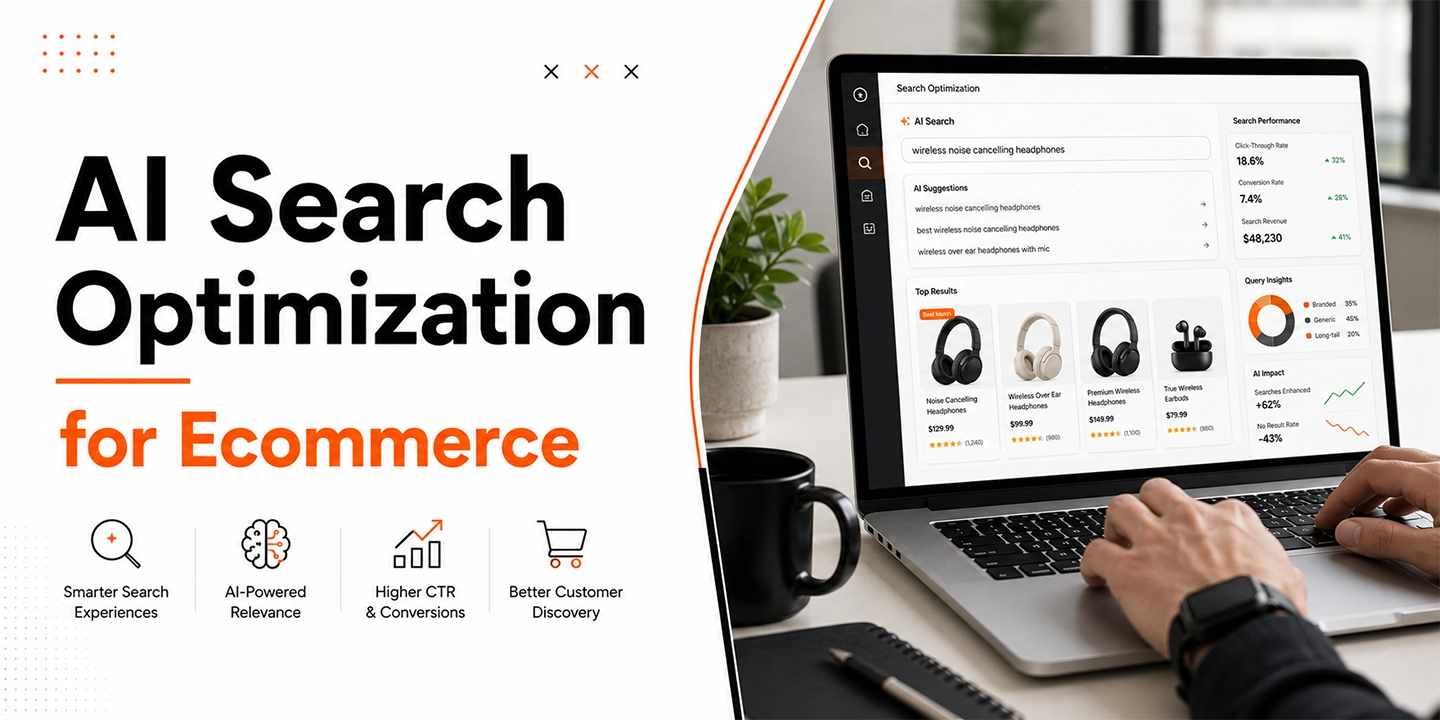
A shopper used to type “running shoes flat feet” into Google, scroll through ten blue links, and open a few tabs to compare. Now that same shopper might ask, in one sentence, “what running shoes are good for flat feet if I walk 10,000 steps a day and want something under $150,” and get a synthesized answer with a handful of product suggestions attached. No tabs. No scrolling through category pages.
That shift is real, and it’s changing how people discover, compare, and buy products. Google AI Overviews and AI Mode, ChatGPT, Gemini, Perplexity, and Copilot are all now part of the ecommerce discovery journey, alongside traditional search. This raises a real visibility question: if an AI system answers the question before a shopper reaches a results page, how does a product, category, or brand get included in that answer at all?
Nobody, including the platforms themselves, has this fully figured out. But there’s enough confirmed guidance and observable behavior to build a reasonable strategy. This isn’t about replacing SEO. It’s about extending it.
What Is AI Search Optimization for Ecommerce?
AI Search Optimization for ecommerce is the practice of making product, category, and brand information easy for AI-powered search systems to understand, verify, and reference when answering shopping-related questions. It builds on traditional SEO with stronger product data, clearer entities, structured content, and credible external signals, rather than replacing any of it.
You’ll often see this broken into AEO (answer engine optimization), focused on making content easy to extract direct answers from, and GEO (generative engine optimization), focused on how content and entities get understood and cited by generative AI. In practice, these aren’t separate disciplines from SEO. Google’s Search Central documentation states plainly that optimizing for generative AI search is still optimizing for the search experience, and therefore still SEO.

How Is AI Search Different From Traditional Search?
| Traditional Search | AI-Powered Search |
| Returns a ranked list of links | Often synthesizes a direct answer |
| Optimizes for page ranking | Also rewards easily extractable information |
| Queries tend to be short | Queries can be long and conversational |
| User compares multiple pages themselves | AI may summarize several sources for the user |
| Click-through rate is the main outcome | Mentions and citations inside answers also matter |
| Keyword matching drives relevance | Entities, context, and answer quality drive relevance |
People still click through to websites, especially once they’re ready to compare specifics or complete a purchase. What’s changing is the research phase: more of it now happens inside a conversational interface before a click occurs, which means a brand can lose visibility at a stage it never used to have to fight for.
Does Traditional SEO Still Matter in 2026?
Yes. Google has been explicit: AI features in Search are built on the same core ranking and quality systems as regular search, with no special files, markup, or separate optimizations required to appear in AI Overviews or AI Mode. Crawlability, indexability, page quality, internal linking, backlinks, and helpful content all remain foundational, because these systems still retrieve and reference content from the same web index traditional search draws on.
What changes is emphasis. Non-commodity content (information that says something beyond what every competitor already says) tends to matter more, because generative systems synthesize from multiple sources and favor pages that add something distinct.
What Does AI Search Mean Specifically for Ecommerce?
Informational publishers mostly need AI systems to understand a topic. Ecommerce sites need AI systems to understand entities: brand, product, category, manufacturer, SKU, price, availability, rating, reviews, shipping terms, return policy, materials, variants, and use case. If that information is inconsistent, buried in images, or only rendered through JavaScript, the product becomes harder for any system, human or AI, to confidently recommend.
There’s also a second, ecommerce-specific track worth knowing about: Google’s Shopping Graph, the dataset behind Google’s shopping features and product panels, built primarily from Merchant Center feeds rather than crawled web pages. Getting cited in an AI Overview’s text and getting a product surfaced in a shopping panel are related but not identical goals, and they depend on different inputs: content quality and crawlability for the former, clean structured feed data for the latter.
The Ecommerce AI Search Playbook for 2026
1. Strengthen Product Entity Information
State the name, brand, category, SKU, price, availability, features, specifications, materials, size, compatibility, use case, shipping, and returns in crawlable text. Details buried only in an image or JavaScript widget are effectively invisible to most systems reading the page.
2. Go Beyond Manufacturer Copy
Duplicate manufacturer descriptions, repeated across dozens of retailers, give AI systems nothing to differentiate one seller from another. A useful page answers who the product is for, what it solves, what makes it different, and how it compares to alternatives, without padding.
3. Build Category Pages That Actually Help
Category pages earn their place when they explain what the category contains, how the main options differ, who each suits, and what to check before buying, rather than generic filler below the product grid.
4. Create Buyer-Decision Content
Comparisons, buying guides, “best for” pages, alternative-to pages, size guides, and material explainers give AI systems and shoppers something concrete to reference when a question requires judgment, not just a listing.
5. Answer the Way Shoppers Actually Ask
“Best running shoes” doesn’t reflect how someone phrases a question to an AI system. “What running shoes work for flat feet if I walk 10,000 steps a day” does. Content built around specific, contextual questions matches how people actually ask now.
6. Use Structured Data Correctly
Product, Offer, AggregateRating, Review, Organization, BreadcrumbList, and FAQPage schema help machines parse a page. This matters most for Merchant Center eligibility and rich results. Google has stated no special schema is required specifically for AI Overviews, so treat structured data as a shopping and rich-result lever, not a guaranteed AI-citation one.
7. Keep Product Data Consistent Everywhere
Price, availability, currency, and variant details should match across the product page, structured data, and the Merchant Center feed. Conflicting numbers are a common cause of feed disapprovals and a sign the data can’t be fully trusted.
8. Strengthen Brand Entity Signals
A consistent organization name, a real About page, verifiable contact information, visible social profiles, genuine reviews, and industry mentions establish a brand as real rather than a thin storefront. This is slower to build than adding a page, and it can’t be faked convincingly.
9. Build Topical Authority Around the Category
A store that only lists products gives systems less to work with than one that demonstrates category expertise. A coffee equipment retailer covering grinder types, brewing temperatures, and water quality gives shoppers and AI systems more context about what the business knows, not just what it sells.
10. Strengthen Internal Linking and Architecture
Clear relationships between category, subcategory, product, guide, comparison, and FAQ content help crawlers and generative systems understand how information connects. A comparison page linking to the products it discusses makes that structure visible.
11. Make Important Information Easy to Extract
Descriptive headings, concise answer paragraphs, tables, specification lists, and FAQs all help. Content still has to read naturally for the customer reading it; formatting that helps extraction should be a byproduct of clarity, not a replacement for it.
12. Build External Trust Signals
Editorial mentions, genuine third-party reviews, industry publications, and relevant backlinks contribute to how credible a brand looks from outside its own website. A brand with no external footprint gives any system less reason to trust what it says about itself.
AI Search Readiness by Element
| Ecommerce Element | Traditional SEO Importance | AI Search Importance |
| Product titles | High | High |
| Product descriptions | High | High |
| Structured data | High | High |
| Reviews | Medium/High | High |
| Category content | High | High |
| Brand mentions | High | High |
| Product feeds | High | High |
| Buying guides | High | High |
| Entity consistency | Medium | High |
| FAQs | Medium | High |
Almost nothing on this list is new to SEO. What’s changed is that entity consistency and FAQs, previously “nice to have,” now carry more weight because generative systems lean on them more directly when assembling an answer.
How Should Product Pages Change for AI Search?
In short: keep everything already essential for Good SEO, and make sure none of it is hidden. A practical checklist includes an accurate title, a clear summary, real use cases, key benefits, full specifications, honest comparison context, limitations where relevant, FAQs, genuine reviews, Product and Offer schema, current availability, links to supporting guides, and internal links to related products. None of this involves stuffing keywords; it involves not leaving gaps that force a system to guess.
How Should Ecommerce Content Change?
The underlying shift is from writing for keywords to building useful answers around entities, real questions, and buying decisions. That still requires clear intent, factual accuracy, original insight, relevant examples, and current information. Retrieval-based AI systems tend to favor content that’s specific and verifiable over content that’s broad and generic, which happens to be the same content that has always performed better with human readers.
What About ChatGPT, Gemini, and Perplexity?
These platforms don’t operate identically, and there’s no single confirmed “AI ranking algorithm” that applies across all of them the way there’s a documented Google ranking system. Some rely more heavily on live retrieval and citation; others blend training data with search results. What’s consistently useful across all of them is crawlable content, clear entities, genuinely helpful answers, credible sourcing, original information, and accurate product data. Chasing platform-specific hacks is a weaker bet than getting these fundamentals right, since they hold up regardless of which platform gains ground.
Mistakes Ecommerce Brands Should Avoid
- Publishing hundreds of AI-generated articles to “cover more queries.” Volume without originality doesn’t build authority.
- Stuffing content with “AI search,” “AEO,” or “GEO” as target keywords.
- Leaving generic manufacturer descriptions untouched across every product.
- Ignoring the product feed while focusing only on on-site content.
- Skipping structured data because “AI search doesn’t need it,” conflating AI Overview citations with Shopping Graph eligibility.
- Hiding key product details inside images or unrendered scripts.
- Inventing expert quotes or statistics to sound more authoritative.
- Copying competitor comparison pages instead of writing an original one.
- Adding FAQ sections that don’t answer anything a real customer would ask.
- Assuming schema guarantees a citation. It improves eligibility; it doesn’t guarantee placement.
How Do You Measure AI Search Visibility?
This is still the least mature part of the discipline. Reasonable metrics include organic traffic and impressions as a baseline, branded search growth, AI referral traffic where platforms make it identifiable, brand mention tracking through manual checks or monitoring tools, product visibility inside Merchant Center’s own reporting, and assisted conversions where attribution allows. Search Console has begun rolling out separate reporting for impressions within generative AI features, a meaningful step, but AI-search measurement overall remains rougher than traditional SEO analytics. Treat any tool claiming precise, guaranteed visibility numbers with some skepticism.
A 90-Day Ecommerce AI Search Action Plan
Days 1-30: Foundation. Fix crawlability issues, audit and clean product data, implement or correct Product and Offer structured data, verify the Merchant Center feed matches on-site data, and confirm analytics can track what you’ll want to measure later.
Days 31-60: Content. Rebuild weak category pages, rewrite generic product descriptions, add genuine FAQs, build comparison and buying-guide content, and strengthen internal linking between all of it.
Days 61-90: Authority and Measurement. Pursue genuine digital PR and third-party mentions, encourage real customer reviews, monitor Search Console’s AI-feature reporting, check for brand mentions across AI platforms, and revisit content that isn’t performing.
Is an SEO and AI-Search Readiness Audit Worth It?
If a site already has solid traditional SEO but product data, category content, or structured information hasn’t been reviewed with AI-driven discovery in mind, an audit is usually the fastest way to find out which area needs attention first, rather than guessing.
Conclusion
Ecommerce brands don’t need to abandon SEO services for a separate “AI search” discipline. They need to extend what already works: clean product data, structured information, useful content, clear entities, and real brand credibility, with an awareness that more of the research phase now happens inside AI-generated answers before a shopper lands on a website. The businesses handling this well aren’t the ones publishing the most content about “AI search optimization.” They’re the ones whose product and brand information was already trustworthy enough for a system, or a person, to confidently recommend.