




AI technology is transforming the way consumers shop online.
Previously, ecommerce experience consisted of a well-known process. A consumer performed a search on Google, navigated to a website, went through different categories, visited product pages, did comparisons, put something in their cart and completed the process.
However, AI shopping agents are starting to transform this experience.
A consumer can now ask the exact things they need to buy by using natural language, like:
“Get me a light waterproof jacket under $150 that I can get by Friday.”
An AI system could potentially be able to read these needs, find appropriate products, do comparisons, verify current data and assist a customer in making a decision.
This development brings some changes to ecommerce architecture.
The website developed exclusively for people exploring web pages might be difficult for an AI system to understand and access information about the products and commerce processes. The agent-ready architecture of ecommerce should make products, pricing, inventory, searching and other features available in structured and controlled systems.
That’s when headless commerce truly shines.
Indian companies considering headless ecommerce platforms must move on from just thinking about speed and agility in their storefronts. The real question now is how prepared their commerce architecture is for consumers researching products using AI.

What Is Headless Commerce for AI Agents?
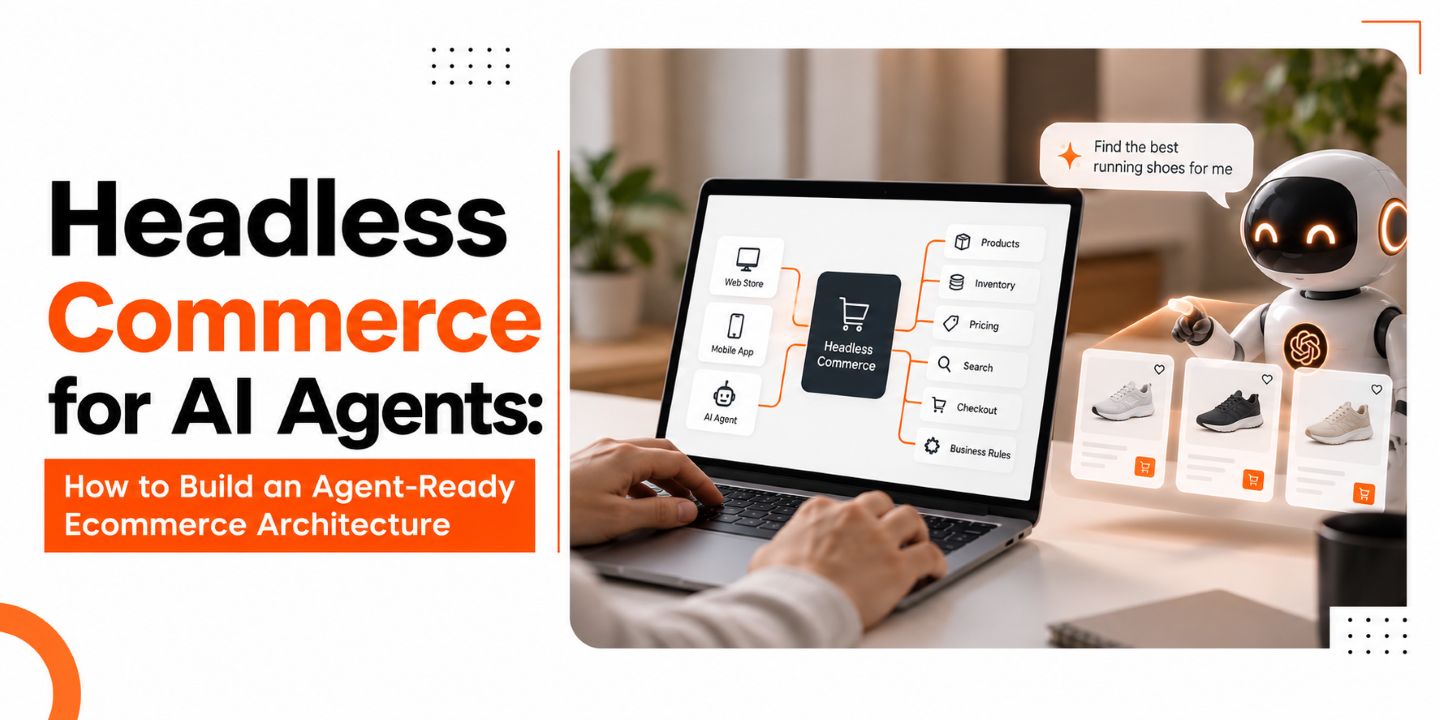
Headless commerce separates the front-end of the shop from the back-end of the ecommerce system. All products, prices, inventory, shopping carts, customers, and orders stay within the ecommerce platform, whereas webpages, apps, and other experiences use APIs to get the data.
For AI agents, this separation is important since the website is not the only point of interaction anymore.
Think of it this way:
Traditional ecommerce
Customer → Website → Ecommerce Platform
Headless ecommerce
Customer → Website or App → APIs → Ecommerce Platform
Agent-ready headless commerce
Customer → Website, App or AI Agent → Commerce APIs → Ecommerce Platform
It is important not to let the AI model have unlimited access to the store.
On the contrary, it is up to the firm to determine which information and capabilities are accessible.
An AI agent may be granted permission to look for products and stock check without access to any personal data of customers. An authorized shopping agent may be allowed to make a shopping cart or check order status.
This is the key to the usefulness of this architecture.
Why AI Agents Matter for Ecommerce
AI-enhanced shopping isn’t just an experimental concept anymore.
As per Connected Shoppers research done by Salesforce, 39% of the shoppers were utilizing AI technology for product discovery in 2025. According to Salesforce’s findings, 75% of the retailers would expect AI agents to become crucial by 2026.
The trend has been observed similarly by Adobe in terms of ecommerce traffic. In 2025, during the holiday shopping season in the U.S., generative AI traffic to retail websites went up by 693.4% from the previous year. The analysis done by Adobe was based on one trillion visits to the websites of the retailers in the U.S.
It doesn’t mean that websites are becoming irrelevant for ecommerce businesses.
Not really.
What’s changing is that the website will become one of the several channels via which the shoppers will discover and engage with the products.
This means that the commerce solution needs to have the capability to provide consistent information across websites, apps, marketplaces, and AI-enhanced shopping journeys.
This becomes much more critical for commerce solutions being evaluated in the Indian context today.
What Makes an Ecommerce Store “Agent-Ready”?
An agent-ready ecommerce store makes important commerce information available in a structured, accurate, and controlled way.
An AI agent should be able to understand basic questions such as:
- What products are available?
- What does this product cost?
- Which sizes or colors are available?
- Is this item currently in stock?
- What are the product specifications?
- Can it be delivered to a particular location?
- What similar products are available?
- Can a cart be created?
- What is the current order status?
The architecture behind the store determines whether these questions can be answered reliably.
Five areas matter particularly:
| Area | What an AI Agent Needs |
| Product Data | Structured descriptions, attributes and variants |
| Search | A reliable way to find relevant products |
| Pricing & Inventory | Current information from authoritative systems |
| Commerce APIs | Controlled access to carts, products and other functions |
| Security | Clear authentication and permissions |
A business does not necessarily need to replace its entire ecommerce platform to achieve this.
Often, the first step is identifying where the existing architecture falls short.
1. Start With Clean, Structured Product Data
Good product data is one of the most important foundations of AI-ready ecommerce.
Imagine an online furniture store selling a dining table.
The product page visually tells a human customer that the table:
- Is made from solid oak
- Seats six people
- Measures 180 cm × 90 cm
- Comes in natural and dark finishes
- Requires assembly
- Is available for delivery
If this information exists only inside paragraphs, images, or PDFs, another system has to interpret it.
It is much better when important information is also stored as structured product attributes.
For example:
Material: Solid oak
Length: 180 cm
Width: 90 cm
Seating capacity: 6
Available finishes: Natural, Dark
Assembly required: Yes
Now search engines, filters, mobile applications, product feeds, and AI agents can understand the product more reliably.
Businesses working with a headless ecommerce development company in India should therefore treat product-data architecture as part of the project, not simply focus on frontend development.
2. Make Commerce Functions Available Through APIs
APIs allow different systems to communicate with the ecommerce platform.
In a conventional store, a customer might click a product, choose a size, add it to the cart, and proceed to checkout.
An AI shopping experience may need to request those same functions programmatically.
For example, it may need to:
- Search for matching products.
- Retrieve product details.
- Check available variants.
- Confirm the current price.
- Check inventory.
- Create a cart.
- Add the selected product.
- Send the customer to a secure checkout.
This is one of the areas where headless architecture becomes valuable.
For example, Shopify’s Storefront API documentation explains that its API provides commerce capabilities including products, collections, carts, and contextual pricing across different customer experiences.
A good headless commerce development company in India should therefore understand API architecture as well as frontend frameworks.
3. Give AI Agents Accurate Product Search
Traditional ecommerce navigation depends heavily on categories and filters.
Customers might browse:
Men → Shoes → Running Shoes → Size 10
AI shopping often starts differently.
A customer might simply ask:
“I need comfortable running shoes under $120 for daily road running.”
The AI system has to translate that intent into product criteria.
For this to work well, the store needs searchable product information with useful attributes such as:
- Product category
- Price
- Size
- Color
- Material
- Brand
- Features
- Compatibility
- Availability
The search system should also be accessible independently from the visual website.
This gives both the storefront and other authorized shopping experiences access to the same product catalog.
For businesses considering headless ecommerce development services in India, product search should therefore be discussed early in the project rather than treated as a minor feature added near launch.
4. Keep Price and Inventory Information Current
The assistance rendered by any AI assistant can only be helpful if the information provided is accurate.
Imagine a customer inquiring about something like:
“Is this sofa available and do you have delivery available this week?”
The information regarding the product details may not have been updated in months, but the inventory information might have just been updated.
This implies that ecommerce platforms must be able to differentiate between information that is eligible to be cached and information that needs real-time checking.
Information such as the product details and image can be cached, whereas inventory, pricing, promotions, shipping details, and customer information require fresh information.
This is because an AI agent should never recommend a product which is currently unavailable based on stale information.
Hence, a good headless ecommerce platform in India must have its source of truth for price, inventory, product information, and order data.
5. Separate Business Rules From the Storefront
One thing many businesses overlook is where their ecommerce rules actually live.
Suppose free shipping is available only when:
- The order exceeds ₹5,000
- The delivery location is eligible
- The product is not oversized
If that logic exists only inside frontend JavaScript, the website understands it, but another channel may not.
Important business rules should live in systems or services that can be used consistently across different customer experiences.
This applies to:
- Product availability
- Customer-specific pricing
- Discounts
- Shipping eligibility
- Delivery calculations
- B2B purchasing rules
- Minimum order quantities
- Promotions
A website, mobile application, and authorized AI agent should receive consistent answers from the same underlying business logic.
This is an important architectural consideration when choosing headless commerce development services in India.
6. Give AI Agents Limited Permissions
Agent-ready does not mean giving AI complete control over an ecommerce system.
Permissions should depend on the action being performed.
For example, an anonymous AI shopping assistant might be allowed to:
Read: products, descriptions, public prices and availability.
It might also be allowed to:
Search: categories, products and attributes.
Creating or changing something should require stricter controls.
For example:
Create: a temporary shopping cart.
Customer-specific actions might require authentication:
Authenticated: order history, saved addresses or account-specific pricing.
Sensitive administrative functions should remain restricted.
This principle is particularly important for B2B ecommerce, where customers may have negotiated pricing, payment terms, purchasing permissions, and company-specific catalogs.
A well-designed headless solution in India should therefore include authentication and permission planning from the beginning.
7. Keep Checkout Controlled by the Commerce Platform
AI can help customers find products and make decisions, but the commerce platform should remain responsible for transactional accuracy.
An AI agent should not invent:
- Product prices
- Discounts
- Taxes
- Shipping charges
- Inventory availability
- Payment requirements
- Final order totals
Those calculations should come from authoritative commerce systems.
The AI layer can ask the commerce system for the current information and present it to the customer.
This distinction keeps the conversational experience flexible while making the transaction predictable.
Shopify’s current agentic commerce infrastructure demonstrates this direction clearly. Its Storefront MCP can expose real-time commerce information to AI assistants, while Shopify’s agentic storefront capabilities support product discovery and different checkout paths depending on the AI channel.
8. Connect the Systems Behind the Ecommerce Store
For many established businesses, the ecommerce platform is only one part of the technology stack.
Product information may come from a PIM.
Inventory may come from an ERP.
Orders may flow into an OMS.
Customer information may be stored in a CRM.
Search may be handled by a dedicated search platform.
A typical architecture may therefore include:
Storefront / AI Agent
↓
API & Commerce Layer
↓
Ecommerce Platform
↓
ERP | PIM | OMS | CRM | Search | Payments | Shipping
The customer does not need to know where the information comes from.
Neither should the AI agent.
The architecture should retrieve information from the correct system and return a reliable answer.
This is one reason experienced headless ecommerce development services in India often involve integration work in addition to storefront development.
9. Monitor What AI Agents Are Doing
When AI agents begin interacting with commerce systems, companies will require transparency into such activities.
For instance:
What kinds of products are customers looking for using AI?
Which searches don’t yield any meaningful results?
Are agents making requests for unavailable products?
Is there an error in API calls?
Are customers making carts using AI but not completing the checkout process?
Which AI channels are responsible for conversions?
Such information might be useful to improve product data, search engines, integrations, and customer journey in general.
The importance of monitoring grows even further in case of action-permitting agents.
All significant actions must be logged in order to see what was done if anything went wrong.
What Does an Agent-Ready Ecommerce Architecture Look Like?
A practical architecture does not need to be unnecessarily complicated.
At a high level, it can look like this:
Customer
↓
Website / Mobile App / AI Shopping Agent
↓
API & Authentication Layer
↓
Commerce Platform
↓
Product | Search | Cart | Checkout | Customer
↓
ERP | PIM | OMS | CRM | Payments | Shipping
The key principle is separation.
The storefront controls how information is presented.
The commerce platform controls commerce.
Business systems remain responsible for their own authoritative data.
AI agents receive only the information and actions they are permitted to use.
That makes it possible to introduce new customer experiences without rebuilding the complete ecommerce backend each time.
Headless Commerce vs Agent-Ready Headless Commerce
Headless commerce and agent-ready commerce are closely related, but they are not exactly the same.
| Area | Traditional Headless Commerce | Agent-Ready Headless Commerce |
| Main Interfaces | Website and mobile apps | Website, apps and AI agents |
| Product Data | API accessible | Structured for machine understanding |
| Search | Customer-driven | Customer and AI-driven |
| Inventory | Used by storefront | Available to authorized agents |
| APIs | Mainly frontend focused | Designed for multiple consumers |
| Permissions | User/application based | Includes agent-level controls |
| Checkout | Website or app | Website, app or controlled agent flow |
| Monitoring | Customer and application | Customer, application and AI activity |
A business that already uses headless commerce may therefore have much of the required foundation.
The next step is usually making the architecture more accessible, structured, controlled, and observable for AI interactions.
Do You Need to Rebuild Your Ecommerce Platform?
Not in most situations.
It is far more sensible to begin with an architecture audit.
The enterprise needs to determine if the present ecommerce system already offers such features like structured product information, APIs, inventory management, independent search, cart APIs, authentication, and integrations.
If such features already exist in the present platform, then preparation for AI agents would be about enhancing the existing architecture rather than implementing a new one.
For instance, an enterprise would have to enhance the product attributes, allow search via APIs, implement enhanced permissions, or have improved integration capabilities.
That is why it makes sense for a good headless commerce firm in India to conduct such an audit first.
A Practical Roadmap for Building Agent-Ready Commerce
Businesses do not need to make every commerce function available to AI on day one.
A staged approach is usually safer.
Stage 1: Organize product data
Make sure important product information exists as structured fields rather than only text and images.
Stage 2: Review APIs
Identify whether products, search, pricing, inventory, carts, customers, and orders can be accessed programmatically.
Stage 3: Connect business systems
Make sure ecommerce, ERP, PIM, CRM, OMS, search, and other important systems exchange reliable information.
Stage 4: Enable AI product discovery
Start with low-risk use cases where AI can search and recommend products using approved information.
Stage 5: Introduce controlled actions
Allow actions such as creating a cart only after permissions, validation, and monitoring are in place.
Stage 6: Expand authenticated experiences
Customer-specific information and transactional functionality can be introduced after identity and authorization are properly handled.
This approach gives businesses room to learn how customers actually use AI shopping experiences before committing to more complex automation.
Why This Matters for Ecommerce Businesses Now
E-commerce built on AI is a nascent field, but customer behavior is changing.
According to Salesforce, 39% of people leverage AI for product discovery, and 75% of retailers expect that AI agents will become a necessity by 2026.
The Adobe 2025 holiday study reveals a valuable insight in this regard. The increase in generative AI referral traffic to U.S. retail sites was 693.4% year over year. Adobe later revealed that the AI referred visits performed 31% better in conversion compared to non-AI traffic during the holidays.
The next step was made by Shopify which now offers agentic commerce infrastructure. Its Storefront MCP allows access to real-time commerce data for AI assistants and its current agentic storefront technology allows eligible merchants to take part in AI commerce channels.
However, this information does not suggest that enterprises should immediately replace their ecommerce tech stack.
What it does suggest is that any architectural choices made today must accommodate a future when customers will engage in commerce via AI in addition to websites.
Conclusion
The initial attractiveness of headless commerce resided in the separation of the storefront from the backend of ecommerce. The increasing popularity of AI agents makes the separation even more appealing.
An architecture built for agents enables websites, mobile applications, and other certified AI services to have access to the same robust commerce functionality without having complete autonomy.
The basics are fairly simple: structured product data, reliable APIs, accurate search, real-time inventory and pricing, centralized business rules, security and permissions, secure checkout, integration of business systems, and proper monitoring.
When developing a headless commerce solution for ecommerce in India, the choice of development approach is much more than just building a great-looking frontend. A competent headless commerce development partner will assist you in creating a platform where commerce data is always accurate, available, secure, and consistent.
What matters in essence is the capability of your ecommerce architecture to provide reliable commerce information to any customer interface.
Now it might be your website, but tomorrow it could be an AI shopping assistant.