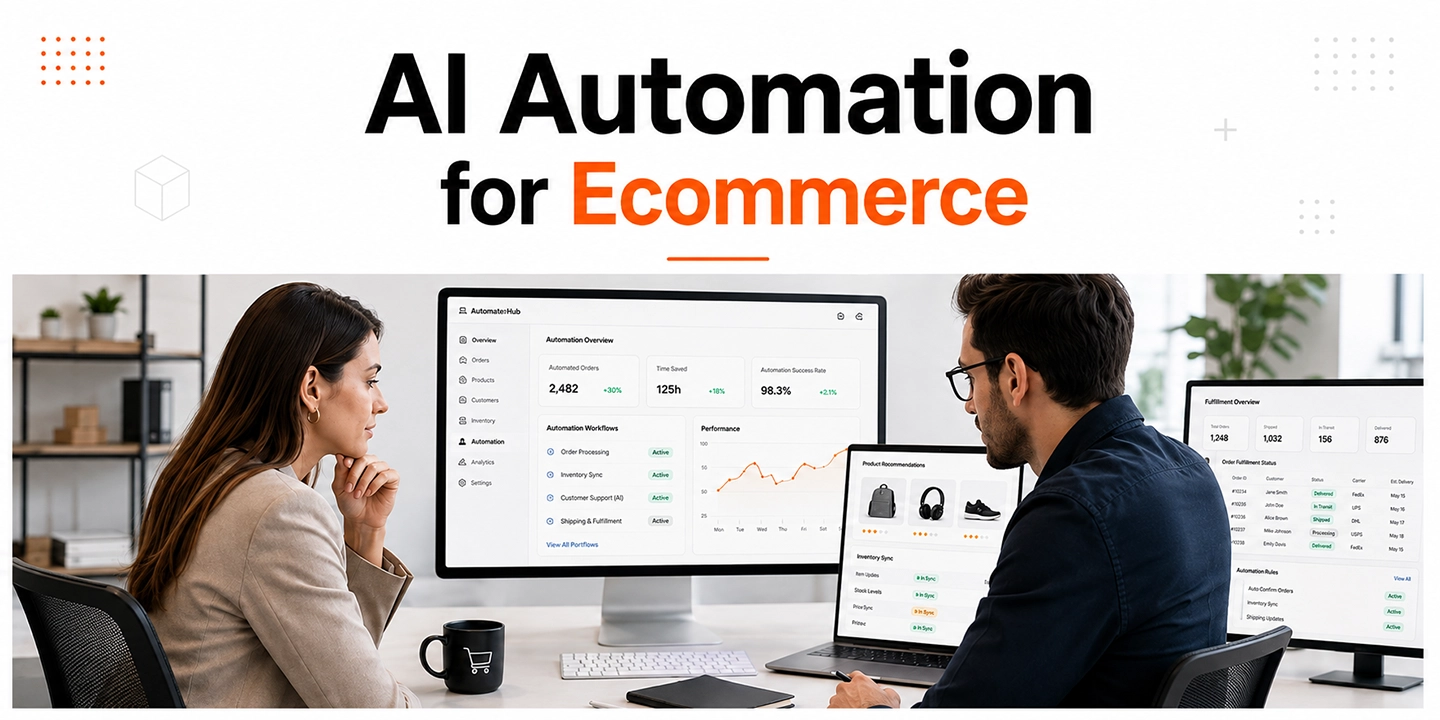





The advent of artificial intelligence is transforming Shopify from a mere platform for operating an online store into a commerce system that can help with merchandising, customer support, marketing, reporting, inventory management, product discovery, and other routine tasks.
And the importance of this evolution for Indian brands goes beyond what meets the eye. Ecommerce companies are working with ever-larger catalogues, more customer communication, various payment systems, marketplaces, regional customer segments, and rising customer acquisition costs. It becomes impossible to hire people to do each repetitive task.
With AI, merchants get another way out.
But the main benefit of AI goes beyond creating product copy or integrating chatbots. The real potential lies in creating systems where AI will know what’s going on in the store, will be able to provide recommendations and automate certain processes based on those recommendations.
And this is where agentic Shopify web development services come into play.
Rather than asking, “Where do we integrate AI?”, the evolving brands should start asking themselves:
Which decisions and repetitive processes inside our Shopify business can software safely handle for us?
That change in thinking can have a major effect on how an ecommerce company scales.
What Does AI in Shopify Actually Mean?
AI in Shopify refers to the application of artificial intelligence to help or enable processes in merchandising, customer service, marketing, operations, analytics, search, inventory management, and customer experience. Contemporary AI applications are capable of working on Shopify data, connected apps, APIs, business rules, and customer signals rather than standalone chat apps.
There are about three tiers of AI usage in e-commerce.
| Level | Example | Business Value |
| AI assistance | Writing descriptions or summarising sales reports | Saves employee time |
| AI automation | Tagging customers or routing support tickets automatically | Reduces repetitive work |
| Agentic commerce | AI identifies a situation, decides what action is required, and executes an approved workflow | Helps operations scale |
This is the third area that Shopify development will be moving toward.
An AI agent will be able to see that an SKU is selling unexpectedly quickly, review the inventory position, compare it with previous demand, inform the merchandising department, and make recommendations for replenishing.
Some other AI agent will spot a highly-valuable customer who left the checkout page, look at their purchasing history, decide on the right message, and start the marketing workflow.
The aim is not to eliminate the human element.
The aim is to eliminate the human step in the process.
Why AI Matters for Indian Shopify Brands Right Now
India already has the second-largest digital consumer base in the world, and ecommerce penetration only keeps growing beyond the main metros.
According to IBEF, there were over 270 million online shoppers in India in 2024, making India the second-largest e-retail market in terms of number of shoppers in the world. According to research published by IBEF, GMV of e-retailing in India may reach $170 billion to $190 billion by 2030.
This implies new requirements for operations.
When you sell 40 orders per day, many things can be done manually.
400 orders per day make manual tasks too expensive.
But when you sell 4,000 orders per day, they can become real bottlenecks.
The challenges faced by Indian Shopify merchants are the following:
- High mobile traffic
- COD order management
- Reducing RTOs
- Differentiation of deliveries in regions
- Multilingual customer service
- Customer journey on WhatsApp
- Increased order volume during festivals
- Catalogs with a large number of SKUs
- Integration of marketplaces and direct-to-consumer inventories
- Price-sensitive customers
- Different payment methods
This is precisely where automation comes into play.
AI is not a magic wand that automatically solves bad ecommerce operations. However, when an ecommerce site has all its systems in order, AI will make those systems work much better.
Shopify Itself Is Moving Toward AI-Driven Commerce
Now, AI is not an experimental function for Shopify anymore.
The Sidekick AI assistant operates inside the Shopify admin and allows for analyzing data, managing products and orders, creating content, working with apps and performing some other tasks with voice commands. It is said that proposed actions will be checked before any changes are made.
That human check is essential.
AI functions in commerce better when permissions are controlled, not unlimited.
For instance, an AI system may be authorized to:
- Create a discount campaign
- Propose inventory changes
- Create customer segments
- Create product content
- Check suspicious orders
But the company may ask for a checkup from its employees before giving a refund, changing major prices or publishing promotions.
That approach is much more reasonable than an access of an AI system to everything in the store.
Finally, Shopify notices a change in customer acquisition.
According to the first quarter of 2026 commerce data, AI referrals have grown almost 13 times year over year, and visitors referred by AI convert almost 50% faster than organic-search visitors.
For sellers, it implies that AI impacts both the internal and external parts of e-commerce:
AI within the company, which makes operations run smoothly.
AI external to the company, which could be manifested in the form of ChatGPT, Gemini, Perplexity, Copilot, and other assistants that can impact product discovery.
From Shopify Automation to Agentic Shopify
Automation processes follow set guidelines:
If this occurs, then perform that.
Agents will behave in another way:
Comprehend the occurrence, determine what has to be done, pick from available actions, and execute them based on specific guidelines.
Take the example of inventory management.
Traditionally, you will have a process like:
“If the inventory goes down to ten items, send an email.”
But an agent will assess the sales speed, lead time, seasonality, promotions, stock available, and expected demands before coming to the conclusion whether the team has to order.
This is far more effective.
That is the reason why organizations assessing agentic Shopify web development services must move past themes and simple installations of apps.
They will be incorporating elements such as data architecture, Shopify API’s, workflow engines, AI models, permissions control, CRM systems, ERP systems, customer service solutions, analytics, and custom apps.
The store front is just one piece of the puzzle.
7 Practical Ways Indian Shopify Stores Can Use AI
1. AI Customer Support
Customer support can be considered one of the easiest sectors to begin in.
AI can provide answers to some of the following questions:
Where is my order?
Can I change my address?
When would this product come back?
What is your return policy?
Is this product good for my skin type?
Which size shall I order?
Do you have delivery options to my PIN code?
It’s possible for a correctly integrated assistant to get the actual store data rather than providing generic answers.
For example, an apparel company can integrate its Shopify orders, shipping details, FAQ, size chart, return policy, and CRM history.
An AI assistant would be able to give answers to regular questions and refer non-routine inquiries to an employee.
One of the issues that many businesses often neglect is the aspect of escalation.
Automating 100 percent of support results in an inferior customer experience most of the time.
2. AI Product Recommendations
Typically, traditional recommendation engines work on the basis of rules like ‘customers who bought this also bought…’
With AI, however, recommendation can take into account factors like context and user intent as well.
For example, let’s say a skincare user asks:
“I have oily skin with spots and pigmentation. I want a regimen that’s easy in the mornings and costs me less than ₹3,000.”
An efficient algorithm could understand the customer’s query, sift through appropriate products, rule out incompatible ingredients, and also take into account the budget to suggest a regimen.
This is quite a bit more helpful than showing four random products under ‘You may also like.’
Based on my personal experience, such recommendations can prove extremely valuable for sectors that require users to seek advice before buying products. These include beauty, wellness, fashion, electronics, furniture, and specialized goods.
3. Smarter Search and Product Discovery
Not everyone will search in a way that mirrors your catalog’s vocabulary.
Somebody will type:
“Black office shoes less than 3000”
Other person would inquire:
“Shoes that I can stand in all day long”
Here the customer is asking about intention, not the characteristic.
AI-powered search is capable of deciphering meaning, characteristics, usage scenarios, product information, customer reviews, and customer terminology to give better results.
It also becomes important for AI search engines.
Product information needs to become increasingly comprehensible not only for people and Google’s crawlers but also for AI that is trying to answer product-specific questions.
All of these things include clean titles, specs, structured data, availability, pricing, FAQs, customer reviews, shipping info, and well-written product descriptions.
4. AI-Powered Merchandising
Merchandising becomes increasingly difficult as the size of the catalog increases.
For a store having 50 products, manual review is possible.
However, for a store with 10,000 SKUs, it is unrealistic for such attention.
With AI, one can:
- Find products on a trajectory
- Find products that have fallen off the track
- High-traffic products with low conversion
- Frequently bought products together
- Inventory that will run out soon
- Unusually high return rate products
- Products that require increased exposure
- For instance, an Indian apparels store during Diwali.
Rather than reviewing products manually, the merchandising department can have a small list each day that includes products with increasing traffic, falling inventory, good margins, and higher-than-normal conversions.
The employees make decisions on strategy.
What AI does is save time.
5. Marketing Automation and Customer Segmentation
However, while many Shopify stores have large customer data sets, they are only using a fraction of what they have available.
AI can be used for segmentation based on signals like:
- Purchasing frequency
- Average transaction size
- Product interest
- Use of discounts
- Latest browsing history
- Return behaviour
- Email engagement
- Lifetime customer value
- Days since last purchase
This makes it possible to create a more tailored campaign.
A store will not have to blast the same “10% off” message to everyone.
For an existing customer, a store can provide early access to a new collection.
For a first-time visitor, the education about products would be appropriate.
A customer buying once every 45 days would get a replenishment message after this period.
A dormant high-value customer could get a special retention sequence.
Here’s where AI combined with Shopify automation beats a simple scheduled campaign.
6. AI for Inventory and Demand Planning
Stock management has a direct impact on cash flow.
Too little stock means missing out on sales opportunities.
Too much stock ties up money in goods that can lie unused in warehouses for several months.
AI analysis of past sales, promotion activity, seasonality, product velocity, and stock management helps demand forecasting.
It is particularly valuable in India because the demand can change abruptly depending on the following events, among others:
- Diwali
- Holi
- Raksha Bandhan
- Eid
- Weddings
- End of season sales
- Regional festivals
The right system does not blindly place orders.
It provides decision makers with more informed choices.
In most cases, AI-supported planning is better than automated purchasing.
7. AI for Conversion and Checkout Analysis
AI can help analyse consumer behavior, facilitate communication, analytics, reviews, and funnel data to identify potential conversion issues.
However, technology by itself will not solve the checkout process friction.
In their checkout optimization research, the Baymard Institute estimates the average recorded cart abandonment rate for ecommerce at around 70.22% in 50 studies.
What does that mean?
A large amount of lost revenue is already left near the bottom of the funnel.
Even before investing in an expensive AI-based acquisition strategy, one should consider practical issues, including:
- Unexpected shipping fees
- Poor trust indicators
- Slow checkout process
- Limited payment options
- Mandatory registration
- Bad mobile optimization
- Unreliable delivery
- Confusing couponing
AI can help find trends, yet consumers still require a good purchase process.
AI Search Is Creating a New Ecommerce Discovery Channel
Internet search activity is moving away from traditional search engines.
Questions like these can now be asked to the AI assistant:
“What are the top Indian running shoe brands that cost less than ₹5,000?”
“Suggest a sulphate-free shampoo for curly hair that is available in India.”
“What shopify store carries sustainable office wear with return policy?”
The AI will do product research, gather information, summarize options and finally complete the transaction.
As per a study by McKinsey on agentic commerce, 44% of those who tried out AI-based search have made it their primary internet search activity. According to McKinsey, consumers are now using AI in internet search activity to the tune of 50%.
This does not imply the death of Google search.
It implies fragmentation of discovery.
Brands now have to be discoverable on search engines, marketplaces, social networks, AI assistants, and shopping agents.
How to Make a Shopify Store Easier for AI Search Engines to Understand
AI visibility starts with information quality.
A merchant cannot expect an AI assistant to confidently recommend a product when the product page barely explains what it is.
Start with six areas.
Clear product information
Every important product should clearly communicate:
- What the product is
- Who it is designed for
- Primary benefits
- Important specifications
- Materials or ingredients
- Sizes or variants
- Price
- Availability
- Shipping conditions
- Returns
- Common customer questions
Structured data
Product, offer, review, organization, breadcrumb, and FAQ structured data could help machines understand the content of the store.
The implementation should be reviewed carefully since themes and Shopify applications could cause duplications or inconsistencies in the markup.
Strong category pages
Collection pages must provide actual context instead of just showing product grids.
For instance, a collection page focusing on linen shirts for men can provide information about fit, fabric, occasion, size, and purchase.
Useful FAQs
FAQ content helps answer specific questions customers may ask through both traditional search and conversational AI.
Credible brand information
AI requires signals that identify who runs the store.
Proper company information, contact information, shipping policies, return policies, privacy information when necessary, information from experts, and customer reviews should be included.
Crawlable content
Critical information must not be confined to only those places where machines cannot reliably find it.
This is why a professional Shopify website development company in India can help you out. The AI-search optimization process requires both technological and copywriting skills.
What Agentic Shopify Development Might Look Like
A fully developed architecture with AI-powered capabilities in Shopify would have a number of connected systems.
Consider an Indian beauty brand.
A customer requests an AI-powered shopping assistant for a serum suitable for pigmentation and sensitive skin.
The system selects the products using structured data.
The customer purchases.
Shopify logs the transaction.
An automated process segments the customer.
After some time, another automated process confirms whether there was any product that should be replenished.
A helpful notification goes out.
On the other hand, the other system detects that the sales velocity of the serum increased substantially.
It reviews the inventory and notifies the merchandising team.
The support system finds out that there were more queries from customers on how to use the product.
A request is sent out to the content team to make the product FAQs better.
This is what connected commerce entails.
It is not just one AI chatbot.
It is a number of systems communicating dependable information.
AI Automation vs Traditional Shopify Automation
| Traditional Automation | AI Automation |
| Uses fixed rules | Can interpret context |
| Works best with predictable events | Can handle less structured information |
| “If X, then Y” | “Understand X, then determine Y” |
| Limited reasoning | Can compare several signals |
| Usually deterministic | Can produce variable results |
| Easier to control | Requires stronger governance |
Neither is inherently superior to the other.
Most times, the best approach involves both systems.
Apply deterministic automation in instances where certainty is necessary.
Apply artificial intelligence where interpretation, summarization, classification, recommendation, or decision-making is necessary.
Should You Build AI Features or Install Shopify Apps?
Apps are typically your fastest option when there’s an established product that does the job for your process perfectly.
Building a custom solution works well if:
- Your process is unique
- Systems are communicating with each other
- Current apps generate too many manual processes
- Your data is in Shopify, ERP, CRM, WMS, or somewhere else
- There’s a need for detailed permissioning
- Your artificial intelligence requires access to your business data
- It gives you an important strategic edge
That’s where choosing the right Shopify web development agency becomes very important.
Don’t work with any company just because their site talks about AI.
What have they done?
Your technical team should be able to talk about APIs, Shopify Functions, webhooks, customer data, permissions, data storage, workflow logic, model selection, security, error handling, monitoring, fallback logic, and human validation.
If the conversation stops at chatbots and product description generation, there probably is no technical depth involved.
When Should You Hire Shopify Developers for AI Projects?
You need to hire Shopify developers in case your AI feature entails any modification of your store, apps, API integration, checkout process, customer accounts, analytics, integration with ERP systems, or unique workflows.
The usual Shopify website design company might be completely adequate at building an appealing storefront.
- Projects utilizing AI tend to need more engineering.
- Before choosing your team, consider asking the following questions:
- Did you develop custom apps for Shopify?
- Are you able to work with Shopify Admin and Storefront APIs?
- How will you protect customers’ personal information?
- What actions will AI be able to perform?
- What will happen in case the model gives the wrong result?
- How will risky actions be approved by humans?
- Is there a possibility to audit the system?
- How will the costs of using AI be managed?
- How will the workflow function in case of failure of the external API?
- Whose is the ownership of the code and data?
While Shopify web design services are important even in the age of automation, their power is significantly amplified by commerce engineering, data, automation, and AI.
A Practical AI Roadmap for Shopify Brands
Do not begin by attempting to turn the entire company into an autonomous store.
Start with one business problem.
Phase 1: Identify repetitive work
List tasks that employees repeatedly perform every week.
Examples include support classification, product tagging, sales reporting, content preparation, inventory alerts, and order review.
Phase 2: Measure the current cost
Estimate employee hours, delays, mistakes, and lost sales associated with each workflow.
Phase 3: Fix your data
AI systems depend heavily on data quality.
Clean product attributes, SKUs, inventory records, policies, customer information, and integrations first.
Phase 4: Automate low-risk processes
Begin with tasks where mistakes have limited financial consequences.
Phase 5: Add human approval
Require employee review for important decisions.
Phase 6: Measure results
Track time saved, support resolution time, revenue, conversion, errors, customer satisfaction, and operating cost.
Phase 7: Expand gradually
Once a workflow proves useful, connect it to adjacent processes.
That’s where things change from an interesting AI experiment into operational infrastructure.
The Future: Shopify Stores Built for Humans and AI Agents
Ecommerce sites have always been built for people.
The future generation of these ecommerce sites will be used by both humans and software agents.
According to McKinsey, agentic commerce will be the shopping experience where AI agents will predict human wants, evaluate alternatives, coordinate actions, and do transactions based on human intent. The research of the company projects agentic commerce will orchestrate US$3 trillion to US$5 trillion in consumer-commerce revenues around the world by 2030.
Shopify has already started developing infrastructure that will allow AI agents to engage with the merchant catalogs and make a cart.
The consequence of this trend for Indian merchants is quite obvious.
Your catalog needs to talk to both customers and machines.
Product data needs to be structured.
Inventory needs to be accurate.
APIs need to be reliable.
Policies need to be clear.
Brand needs to be credible.
And the infrastructure behind your store needs to talk clearly.
The next best Shopify web development agency will do more than designing the pages for your business.
Final Thoughts
The implementation of AI in Shopify should not be seen as yet another trend of app installation.
The real value comes when it is tied into the process which currently influences ecommerce success: product discovery, customer service, inventory, merchandising, retention, marketing, reporting and conversion.
The Indian brands do not have to automate everything at once.
They should look for the places where people constantly move information between systems, make the same decision over and over again or waste hours looking for information which they already have in their data.
They should automate those things first.
With more and more people using AI-assisted discovery, the merchants should also start preparing their stores for the customers who might never visit them on a regular results page.
This is the reason why agentic Shopify website development might become one of the trends in ecommerce development.
The companies which would win in this situation are unlikely to be the ones installing the most amount of AI-based tools.
These would be the companies which create proper data, integration, workflows, customer experience and human control over AI.