





Shopify

Why Is My Shopify Store Getting Traffic but No Sales? 12 Issues to Check

Frequently Asked Questions

Your Shopify store may attract visitors who are not ready to buy, or it may have issues with pricing, product pages, mobile usability, delivery costs, trust, or checkout. Review your conversion funnel to identify where shoppers leave.

Improve product information, mobile usability, page speed, pricing transparency, customer trust, and payment options. Review Shopify Analytics to find where shoppers drop off, then test changes and measure completed orders rather than relying on traffic alone.

Open Shopify Analytics and review the conversion rate breakdown, then compare sessions that added items to carts, reached checkout, and completed purchases. Also check payment-provider reports, shipping costs, checkout errors, and abandoned checkout records.

Yes. Confusing navigation, unclear product information, weak mobile layouts, slow pages, and poorly placed purchase buttons can make shopping difficult. Improve usability and test the complete purchase journey to identify which changes help customers buy.

Consider customer preferences and your business model. UPI, cards, net banking, wallets, and cash on delivery may be relevant where supported. Verify gateway compatibility, transaction costs, delivery coverage, and operational risks before enabling each method.

Consider specialist help when technical errors, slow performance, difficult integrations, mobile usability issues, or checkout problems persist. Choose a company that can audit your store, explain its findings, test solutions, and measure results without promising guaranteed sales.

The timeline depends on the underlying issues, implementation effort, traffic volume, and testing requirements. Technical fixes may be implemented quickly, while measuring the impact of design or checkout changes can require more time and sufficient customer data.

BigCommerce

7 BigCommerce Experts in India for Marketplace and Omnichannel Integrations

Frequently Asked Questions

BigCommerce experts serving businesses in India include DIT India, 9eCommerce, DIT Interactive, Webkul, Dynamic Dreamz, Elsner Technologies, and Folio3. Their capabilities vary across storefront development, marketplaces, APIs, enterprise integrations, B2B, migration, and omnichannel ecommerce.

Start with the systems and sales channels involved in your project. Look for developers with relevant BigCommerce experience and check their capabilities around APIs, marketplace integrations, ERP/PIM/OMS connectivity, inventory synchronization, migration, custom development, and ongoing technical support.

Yes. BigCommerce can form part of a multi-channel setup involving marketplaces, advertising channels, social commerce, and other sales destinations. Depending on the channel and business requirements, connectivity may use native functionality, third-party technology, feeds, applications, or custom integrations.

Yes. BigCommerce can connect with ERP, PIM, OMS, CRM, WMS, and other business systems through APIs, connectors, middleware, and integration platforms. The architecture should clearly define which system owns products, inventory, pricing, orders, customers, and other data.

An omnichannel integration connects BigCommerce with the systems and channels involved in selling and fulfilling products. This can include marketplaces, physical stores, ERP, inventory, warehouses, PIM, OMS, shipping platforms, and marketing channels.

Yes, but the approach depends on where inventory is managed. Inventory may originate from an ERP, OMS, WMS, BigCommerce, or another central system and then synchronize with storefronts and marketplaces through APIs, middleware, or specialized integration tools.

Ask about relevant BigCommerce projects, APIs, marketplace integrations, ERP/PIM/OMS experience, inventory and order synchronization, error handling, monitoring, migration, and post-launch support. For integration-heavy projects, ask the developers to explain their proposed data flow before development starts.

BigCommerce can support B2B commerce while participating in a broader multi-channel architecture. The exact implementation depends on catalogs, pricing, customer accounts, marketplaces, inventory sources, fulfillment systems, and integrations required by the business.

Uncategorized

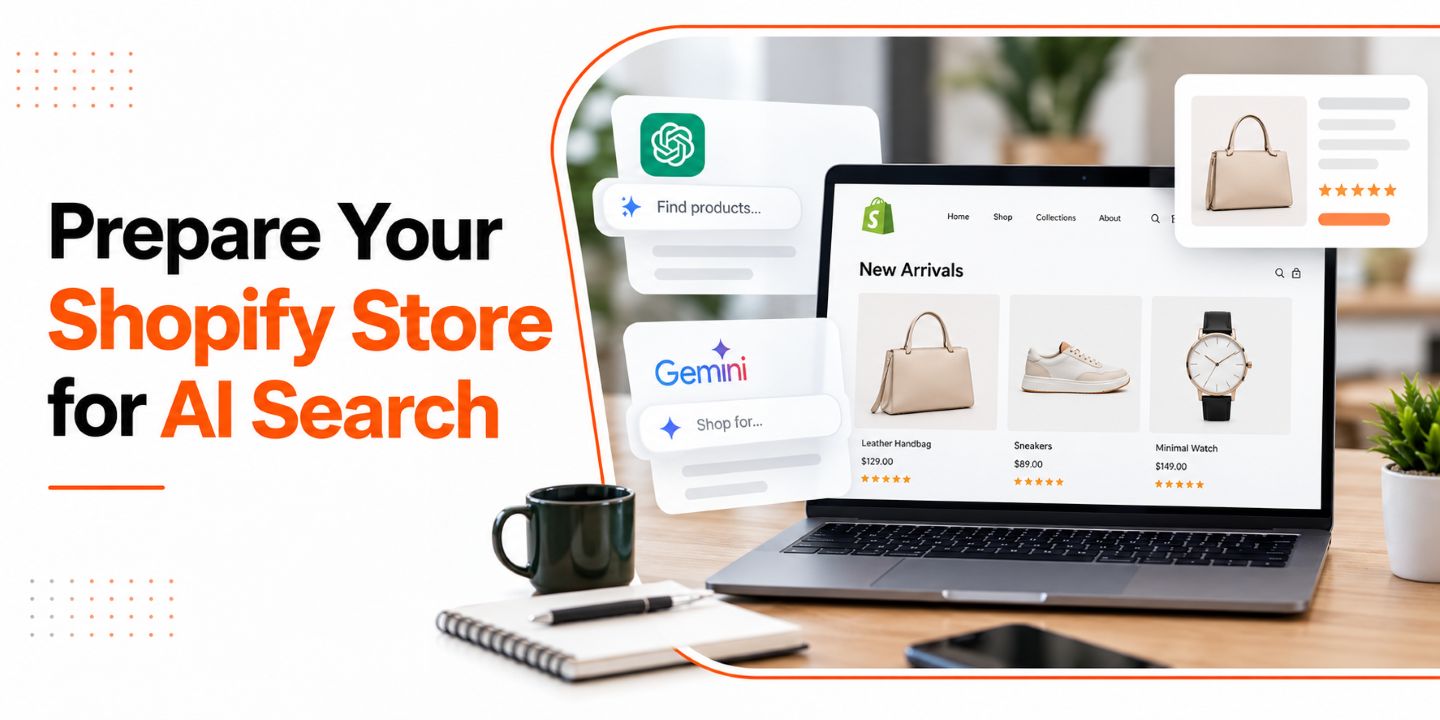
How to Prepare Your Shopify Store for Shopping Through ChatGPT Gemini and AI Search

Frequently Asked Questions

Start with accurate product titles, detailed descriptions, structured specifications, high-quality images, current pricing and inventory, and clear shipping and return policies. Your product information should answer the kinds of conversational questions shoppers naturally ask.

Eligible Shopify products can be made discoverable through Shopify Catalog. Your catalog data should be complete and accurate so AI shopping experiences can properly understand your products.

Keep your Google & YouTube sales channel and product data properly configured. Pay particular attention to titles, descriptions, images, GTINs, variants, availability, shipping information and returns.

Yes. AI shopping does not replace technical SEO. Crawlability, XML sitemaps, canonical URLs, internal linking, structured data, indexability and accurate product information remain important foundations.

Useful signals include specific product titles, descriptions, specifications, price, availability, images, shipping and return information, product categories and consistent variant data.

Metafields are useful for repeatable information such as dimensions, ingredients, materials, compatibility, care instructions and included accessories. They can also support templates, comparison tables, filtering and product-feed mapping.

Write descriptions around real buying decisions rather than keyword stuffing. Explain who the product is for, its use cases, important specifications, benefits, limitations, compatibility and other details a shopper may ask about conversationally.

Track AI-referred sessions alongside product-page conversion, add-to-cart rate, checkout completion, assisted conversions, revenue, returns and referral sources. This can help distinguish visibility problems from product-page or checkout friction.

AI Ecommerce Development

10 AI Shopping Agent Development Companies in India for Ecommerce Brands

Frequently Asked Questions

An AI shopping agent helps customers find and evaluate products through conversation. Depending on its integration level, it may search catalogs, recommend products, compare options, check variants or availability, answer product questions, and perform approved actions such as preparing a shopping cart.

There is no standard price because the scope varies significantly. A catalog-based recommendation assistant is much simpler than an agent connected to inventory, customer accounts, carts, ERP systems, and multiple ecommerce channels. Development cost should be estimated after defining the agent's data sources, actions, integrations, and security requirements.

Yes. An agent can be added to an existing ecommerce architecture when the required product and commerce information can be accessed safely. Integration may use ecommerce platform APIs, search services, middleware, product databases, PIM systems, or custom backend services.

Not necessarily. Conversational discovery and traditional search can work together. Search remains useful when customers know exactly what they want, while an AI assistant can be more useful for exploratory queries such as finding a product based on needs, preferences, budget, compatibility, or intended use.

Yes, provided the agent is connected to a reliable inventory source. The AI should retrieve current availability before recommending stock-sensitive products rather than depending on old product information stored in its conversational context.

They can when the ecommerce platform exposes suitable cart functionality and the agent has permission to use it. The application should validate products and variants before changing the cart and clearly control which actions the AI can perform.

Evaluate both AI and ecommerce engineering experience. Ask how the company handles product retrieval, hallucinations, live inventory, APIs, permissions, customer data, analytics, cart actions, failure handling, and integration with your current ecommerce platform.

No. Smaller brands can use conversational product discovery when their catalog or buying process benefits from guidance. Custom development becomes more relevant as catalogs, integrations, customer journeys, or transactional requirements become more complex.

Got a Project or Partnership in Mind?

    100% secure, no spam.