



Uncategorized

Headless Commerce vs Composable Commerce: Which Is Better for Ecommerce in 2026?

Frequently Asked Questions

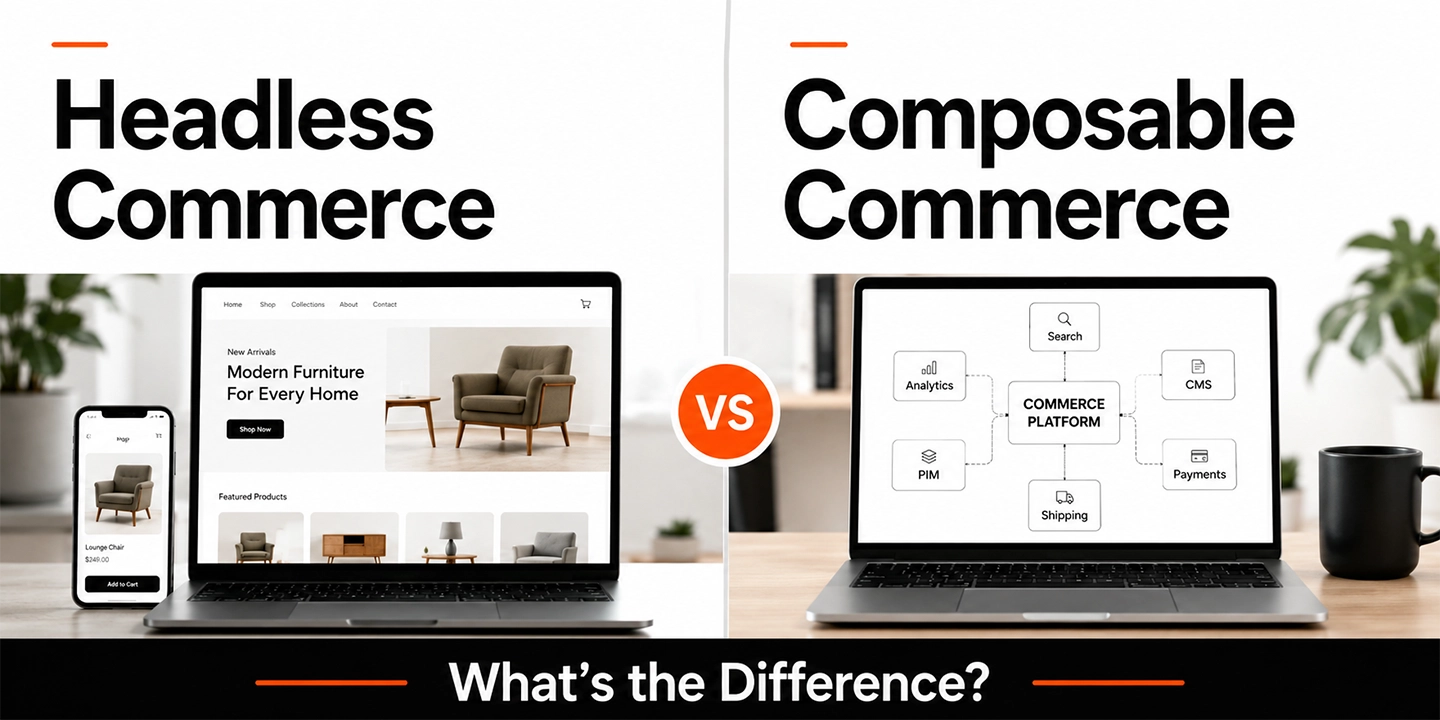
Headless commerce separates the frontend storefront from the commerce backend and connects them through APIs. Composable commerce takes modularity further by allowing several commerce capabilities, such as CMS, search, PIM or personalization, to be selected and managed independently. A headless storefront can therefore be part of a composable architecture without necessarily making the entire system composable.

Composable ecommerce architectures commonly use a headless experience layer because independent frontend and backend components support modularity. However, composability is a broader concept focused on assembling and replacing business capabilities independently. The important distinction is that headless primarily concerns presentation-layer separation, while composability applies across more of the technology stack.

Headless will often have a lower total implementation burden because a business may retain one commerce platform for most backend functions. Composable commerce can involve several vendors, integrations, monitoring systems and contracts. Actual cost depends on storefront complexity, integrations, migration requirements, hosting, internal skills and the number of independently managed services.

Either can work for enterprise ecommerce. Headless suits enterprises that need custom customer experiences while retaining a strong commerce core. Composable can be better when different capabilities genuinely require independent platforms or release cycles. Enterprise size alone is not a reason to choose composable commerce. Architecture should reflect operational complexity and technology ownership.

Yes, particularly when a B2B business needs a custom buyer portal or storefront while keeping backend capabilities such as company accounts, catalogs, pricing and ordering on an ecommerce platform. More complex B2B ecosystems involving ERP, CPQ, PIM and other specialized systems may justify a more composable architecture.

Headless gives development teams greater frontend control, which can support strong performance, but it does not automatically make an ecommerce site faster. Rendering strategy, API latency, caching, image delivery, JavaScript, CDN configuration and third-party services still matter. A poorly designed headless storefront can perform worse than a well-built traditional storefront.

Headless commerce can support excellent SEO when crawlability, rendering, canonical URLs, structured data, internal links, metadata and sitemaps are implemented correctly. The architecture itself does not provide an SEO advantage automatically. Search problems tend to appear when frontend implementations rely on poor rendering strategies or overlook basic technical SEO requirements.

Cost varies considerably according to architecture, storefront complexity, integrations, backend platform, CMS, migration and ongoing support requirements. A business should request an architecture-based estimate rather than relying on a generic fixed figure. Proposals should separate discovery, UX, frontend development, integrations, QA, deployment and post-launch support so the cost can be evaluated properly.

Look for proven experience across both frontend and backend commerce architecture. A qualified partner should understand APIs, ecommerce platforms, React or Next.js, CMS integration, checkout, payments, ERP systems, DevOps, SEO and QA. More importantly, they should explain why headless is appropriate for your requirements instead of recommending it automatically.

Uncategorized

How Shopify POS & Unified Data are Transforming Indian Retail in 2026

Frequently Asked Questions

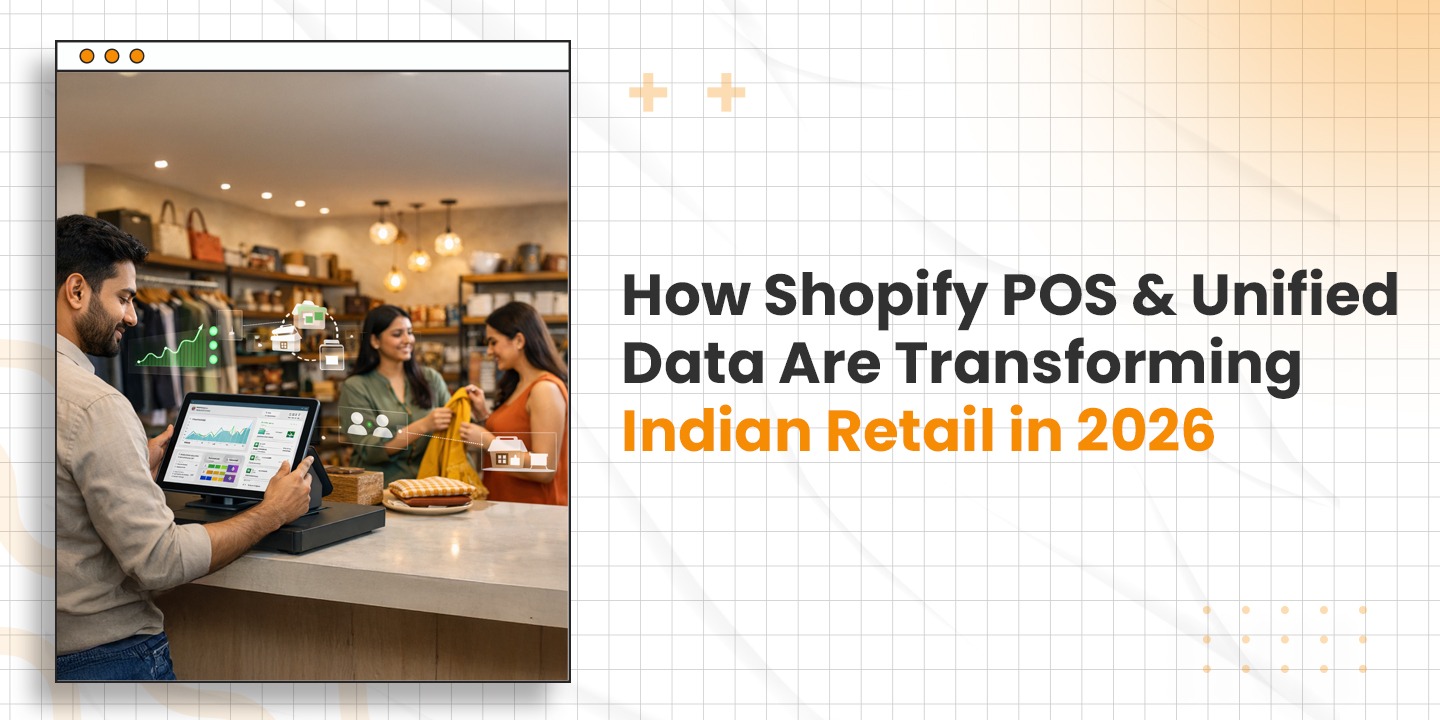
Shopify POS is a point-of-sale system that unifies in-store and online sales in one platform. It works on tablets, smartphones, or computers, automatically syncing inventory, customer data, and sales across all channels. It supports Indian payment methods,s including UPI, digital wallets, cards, and cash, making it ideal for the diverse Indian market.

Shopify POS Lite is included with standard plans starting at ₹2,000-3,000/month, while POS Pro costs an additional ₹7,500/location monthly. Custom development by Shopify developers ranges from ₹50,000 to ₹5,00,000 depending on integration complexity, customizations, and business requirements.

Yes, Shopify POS includes offline mode for areas with unreliable connectivity. It can process sales and accept payments even when offline. All data automatically syncs once the internet connection is restored, ensuring no sales are lost. This is especially valuable for retailers in tier-2 and tier-3 cities.

Unified data ensures all transactions are recorded in one system, simplifying GST compliance. When configured by a Shopify web design agency, the system automatically calculates GST based on product categories, customer locations, and transaction types. It provides accurate records for GST returns and simplifies audit processes across all sales channels.

Professional Shopify web development services can integrate Shopify POS with Tally and Zoho Books (accounting), Delhivery and Blue Dart (shipping), Razorpay and PayU (payments), local CRM platforms, and inventory management systems. These integrations ensure seamless operations within your existing business ecosystem.

A basic single-location setup takes 2-4 weeks. Multi-location businesses with custom integrations and complex workflows typically need 2-4 months. Experienced Shopify developers can provide realistic timelines based on your location count, integration requirements, and staff training needs.

No, Shopify POS is user-friendly. Most retail staff learn basic operations within a few hours, while comprehensive training on advanced features takes 1-2 days. Reputable Shopify web design companies include training in their implementation services, with support materials available in local languages.

Yes, Shopify POS runs on cloud infrastructure that auto-scales for high transaction volumes. During peak periods like Diwali or Dussehra, the system maintains performance with real-time inventory updates, preventing overselling. Many Indian retailers successfully process thousands of daily transactions during festival seasons without issues.

Shopify provides 24/7 support via phone, email, and chat. Shopify web development services providers typically offer ongoing support packages including maintenance, troubleshooting, updates, and optimization. This is valuable for handling local integration updates, regulatory changes, and seasonal modifications.

Got a Project or Partnership in Mind?

    100% secure, no spam.