




The store has a dependable ecommerce back end, but its front end has become limiting. Marketing requires richer content. The international team requires region-specific experiences. B2B clients require their own portal. Developers require more freedom in launching the front end.
Then someone proposes headless commerce.
Next, a suggestion comes up for composable commerce.
Both solutions sound new. Both promise flexibility. Both revolve around APIs. This is precisely what organizations risk doing: solving the wrong problems with both solutions.
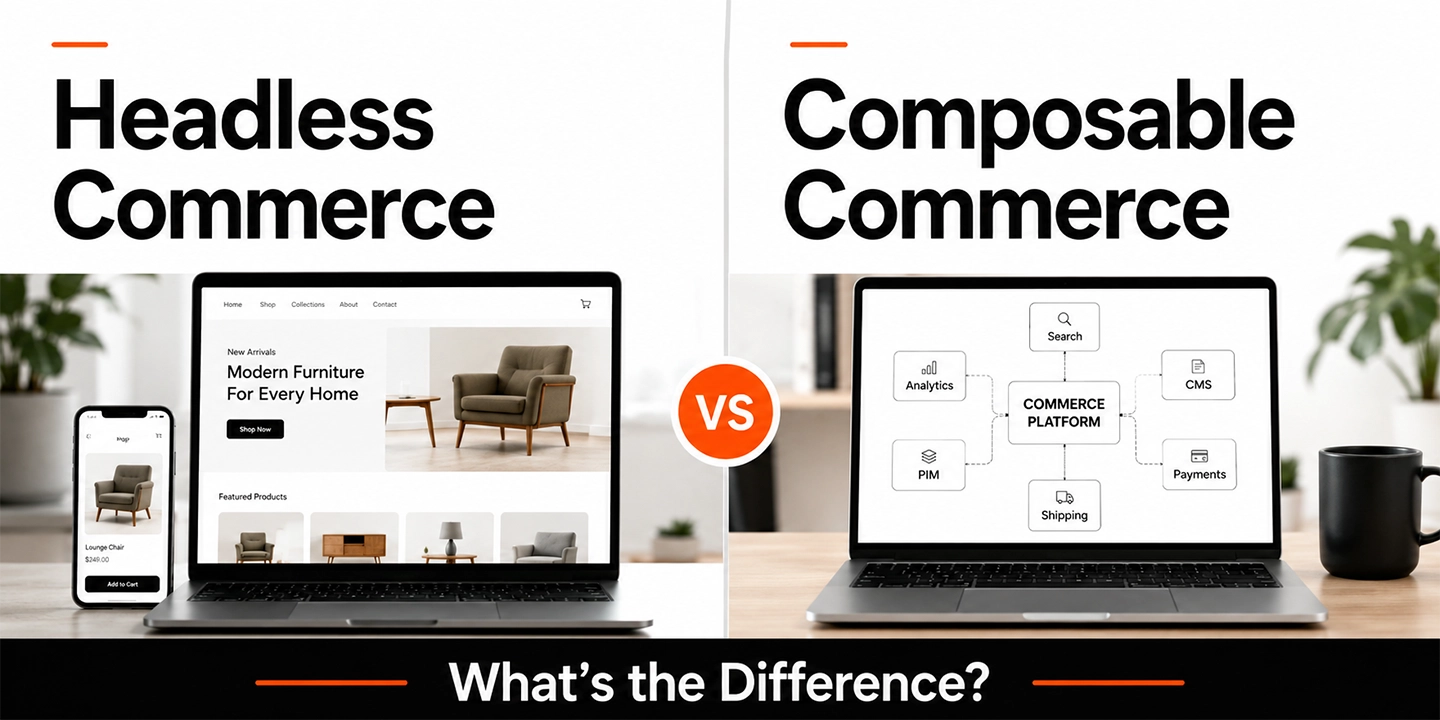
While headless commerce is primarily a separation of the front end from the commerce back end, composable commerce takes this further by enabling different capabilities of business, such as search, CMS, checkout, promotions or personalization, to function as individually chosen components.
Neither of them is necessarily better.
In many cases, headless commerce works just fine. In some other cases, composable architecture will enable an organization to remove certain constraints of its platform. In a surprising number of cases, both aren’t even necessary.
Here’s how to choose between the two.
What Is Headless Commerce?
The term “headless commerce” refers to an architecture of the ecommerce solution where the frontend presentation layer is decoupled from the backend commerce solution. The storefront interacts with the commerce engine via the API, which allows companies to create custom web or mobile experiences without losing the backend features like products, customers, carts, orders and payments.
Imagine a classic ecommerce solution as a restaurant where the kitchen and the dining room are connected in one building.
This concept is separated by headless commerce.
The backend keeps handling all the commerce processes while the customer experience is built independently via technologies like React, Next.js, mobile app or even another CMS.
According to BigCommerce’s documentation, headless commerce solution is “a frontend that operates independently and leverages BigCommerce APIs for product information, carts, checkout and other commerce functionality.” (BigCommerce)
Simplified architecture can be something like this:
Next.js Storefront → APIs → Commerce Platform → Payments / ERP / CRM / Inventory
The only difference here is on the presentation layer.
You simply have stripped the platform from its built-in “head” and added yours instead.
What Is Composable Commerce?
Composable commerce is an architecture where different ecommerce capabilities could be picked, combined and changed independently.
Instead of building everything on one platform, a company will have to pick and combine various solutions for different domains: CMS, search, product information, promotions, checkout, payments, and personalization.
Think about the same restaurant again.
Now you do not only separate the dining room and the kitchen. You decide whether you want the kitchen, order, payment, delivery, and inventory management systems to come from different vendors.
It is quite a different architecture choice.
MACH Alliance describes composability as a set of independent capabilities that could be assembled, changed, and improved independently.
Composability can result in an architecture such as:
Custom Storefront
↓
CMS + Search + Commerce Engine + PIM + Personalization + Checkout + OMS
↓
ERP / CRM / Payments / Fulfillment
Each capability can come from a different provider.
It gives some freedom but also some responsibility.

Headless Commerce vs Composable Commerce: What’s the Real Difference?
The simplest distinction is this:
Headless changes how the frontend connects to commerce. Composable changes how much of the entire commerce stack can be independently assembled.
| Area | Headless Commerce | Composable Commerce |
| Frontend separated from backend | Yes | Usually yes |
| Commerce backend | Often remains one primary platform | May be split across multiple services |
| Custom storefront | Core characteristic | Common characteristic |
| Independent components | Optional | Central to the approach |
| Number of vendors | Usually lower | Can be much higher |
| Integration complexity | Medium to high | High |
| Architecture flexibility | High | Very high |
| Maintenance effort | Moderate to high | High |
| Internal technical ownership | Important | Critical |
| Best fit | Businesses needing experience-layer freedom | Businesses needing control across several commerce capabilities |
It is for that reason that simply buying “headless” does not equate to adopting composable commerce out-of-the-box.
You could have a customized storefront built using Next.js while still having catalog, promotion, customer account management, cart, checkout and order management functionalities within one commerce solution.
And this is headless.
However, when you switch the search functionality to a different search vendor, migrate your content to another CMS, install a PIM solution, add another personalization solution and orchestrate them all independently, then your architecture is much more composable.
The difference between headless and composable commerce as stated by Shopify is the same.
Is MACH the Same as Composable Commerce?
Not exactly.
MACH traditionally refers to four architectural principles:
- Microservices
- API-first
- Cloud-native SaaS
- Headless
These principles support modular systems, but “MACH” and “composable commerce” should not be used as interchangeable marketing labels.
The important business idea behind composability is that capabilities have defined boundaries and can change without forcing a rebuild of everything around them.
That sounds attractive. In practice, the business also needs architecture governance, monitoring, documentation and people who understand how the pieces fit together.
Modularity reduces some dependencies while creating others.
Why Do Businesses Choose Headless Commerce?
A company normally regards as headless when the frontend is now the bottleneck instead of the commerce engine.
Take a case where there is a manufacturer who is currently using an ecommerce platform that takes care of the following aspects:
- Catalog management
- Pricing
- Promotions
- Customer accounts
- Checkout process
- Order management
- Payments
These features could be performing well.
What the company needs is something else – namely, another user experience for its B2B customers, yet another storefront for the consumer base as well as a rich content regionally oriented website.
In such a scenario, replacing the whole commerce engine becomes redundant because the business has no need for that.
Headless ecommerce allows companies to retain their commerce engine while making modifications to the frontend.
This makes sense when a business needs custom storefronts, mobile apps, content-rich commerce, regional experiences or better control over frontend development.
When choosing among headless ecommerce solutions in India, companies must first ask themselves:
What specific bottleneck do we intend to eliminate?
Why Do Businesses Choose Composable Commerce?
Composable commerce is all the more intriguing in case where there are constraints present in multiple sections of the ecommerce platform.
Take for example a company that operates in ten different countries.
In such a case, it might be required to have a dedicated CMS to deal with global content, a PIM for handling its extensive product portfolio, advanced enterprise search, local payment processors, a separate order management solution and custom promotion rules.
At this stage, insisting on implementing every single requirement within one ecommerce platform might lead to more compromises than convenience.
The beauty of composable architecture is that it allows the business to use better-suited solutions in those areas where there is a material difference.
That brings us to the most critical part of this discussion – materially differentiate.
Which Costs More: Headless or Composable Commerce?
The composable commerce approach will necessarily be more costly in terms of implementation and maintenance since more systems will need to be integrated, managed and tested. Headless implementations can be costly too but they tend to use one commerce platform as the core engine for operation, which limits the number of components needed to implement.
The headless implementation tends to incur costs for development, hosting, API integration, CMS integration, testing and monitoring of the front end.
In the case of a composable architecture, one may incur those costs and add additional contracts for such services as search, PIM, CMS, personalization and checkout among others.
There are other costs that are normally not considered:
API versioning, monitoring, integration, data synchronization, security assessment, release management and vendor support.
Composable architecture will give the company the opportunity to replace the services on its own.
However, this does not imply that the entire system becomes simpler to operate.
Which Is Faster to Build?
Headless commerce is generally easier to implement than a full-stack composable commerce system if the enterprise is able to reuse their current backend. Implementation of a composable architecture can take longer because the multiple services, data pipelines and integrations need to be created and validated prior to achieving a reliable customer experience.
The schedule is still highly dependent on the size of the project.
For example, a smaller headless commerce project might include the following components:
Commerce backend → custom frontend → CMS → checkout
A larger composable system might include the following components:
Frontend → CMS → PIM → Search → Commerce → Promotions → Personalization → Checkout → OMS → ERP
Every arrow in the diagram means an integration.
And each integration needs testing.
This fact should not be underestimated during the architectural design process.
Which Architecture Is Easier to Maintain?
Headless wins on this point if the commerce platform is responsible for most of the backend functionality.
There are two primary layers that need maintenance – the customized frontend and the commerce platform.
Composable approach shares the burden amongst multiple services.
This means one needs to know about:
- The ownership of the data
- How a failure in a particular service impacts other services
- Monitoring of APIs
- The ownership of incidents
- The impact of deployment on other connected systems
- Data consistency and integrity
- What will happen after deprecating a certain API
One of the quirks about the composable approach to commerce is that the parts become easier to change, but the entire ecosystem becomes increasingly difficult to grasp.
It becomes more important to understand architectural diagrams in case of six different vendors being used.
Is Headless or Composable Better for Performance?
Neither headless nor composable architecture ensures faster store. Both architectures are capable of delivering great performance if implemented properly, and both are prone to becoming slow if frontend rendering, APIs, caching, data retrieval or any other external service is poorly implemented.
Headless provides better control over the processes such as rendering, caching, CDN delivery, and frontend logic.
This could be good.
However, poor implementation of React or Next.js storefront could make it slow as well.
A new issue that arises in the case of composable architecture is that of network dependency.
If rendering a product page involves calls to commerce, CMS, pricing, search and personalization services, decisions related to caching and orchestration start to matter.
Do not purchase an architecture just because someone included “faster performance” on a slide.
What About SEO?
Both strategies have potential to be effective SEO-wise.
Requirements like:
Crawlable by server-side rendering or in any other way
- Metadata
- Canonical urls
- Structured data
- Internal links
- Redirects
- XML sitemaps
- Pagination
- Product availability
- Page speed
SEO troubles with headless approach usually arise due to implementation mistakes, not headless commerce itself.
Over-reliance on client-side JavaScript and lack of proper rendering and canonicalization can cause avoidable search problems for the store built in this way.
This is one more reason why companies looking into headless ecommerce development in India need to make sure their development partner knows how to do SEO as well as React or API development.
It does not matter how technically advanced the storefront is, if search engines do not understand it.
Headless vs Composable Commerce for B2B
Headless commerce can be enough for B2B companies that require custom buyer experience, but use the existing commerce platform to manage accounts, catalogs, pricing, orders, and checkout functionality. Composable commerce becomes a necessity when a number of specialized applications are needed to perform B2B processes that cannot be managed by the existing commerce platform alone.
Requirements for B2B can become quite complex very quickly:
Specific customer catalogs, pricing negotiations, account hierarchies, approvals, credit limits, ERP availability, purchase orders, and quote processing might all come into play.
In case your commerce platform already does most of the above, there would be no need for doing it separately.
However, if you already have ERP, CPQ, PIM and ordering functionalities covered, composable commerce might become a better choice.
What About Multi-Storefront Ecommerce?
This is yet another place where organizations may move to composable architecture hastily.
In case Company A runs
US Store + UK Store + German Store + B2B Portal
With the backend that supports all the four channels, headless commerce might deliver various front-ends with the same commerce back-end.
Composable architecture becomes more reasonable in case those markets also demand completely different
- Catalog solutions
- Promotional tools
- Content management solutions
- Search services
- Fulfillment policies
- Checkout processes
It is the number of the business differences underneath, not the storefronts,
that drives the choice of architecture.
Headless vs Composable Commerce Decision Guide
| Business Situation | Likely Better Fit |
| Need a highly custom frontend | Headless |
| Existing commerce backend works well | Headless |
| Need multiple custom storefronts | Headless or composable |
| Need specialized services across several commerce functions | Composable |
| Mid-market business with a capable commerce platform | Often headless |
| Enterprise with many independent systems | Composable may fit |
| Small internal technical team | Traditional platform or carefully scoped headless |
| Need fast implementation | Headless usually |
| Need frequent replacement of individual services | Composable |
| Standard catalog and checkout | Traditional architecture may be enough |
This is directional, not a formula.
Architecture should follow requirements, not the other way around.
When Is Headless Commerce the Better Choice?
Headless commerce becomes an obvious choice if you have a well-functioning commerce backend, while the customer experience demands more flexibility.
This might refer to the companies with specific UX requirements, content-heavy storefront, regional storefronts, mobile apps, business-to-business buyer portals, and other unique frontend capabilities.
An experienced headless commerce provider in India should be able to advise you on whether it makes sense to build the headless solution based on the current issues you are facing.
Sometimes it will make sense.
Sometimes you can easily get what you need by using standard platform customization.
And the ability to say “you do not need headless” is rather an indicator of expertise and professionalism.
When Is Composable Commerce the Better Choice?
Composable Commerce starts making sense when there are multiple domains within the commerce stack that really do need to be independently controlled.
Some typical characteristics include:
- There are already multiple specialized solutions
- A single solution does not support all critical business functions
- There are distinct needs in different markets
- Enterprise teams have independent release schedules
- Replaceability of the service is strategically important
- The internal architecture and DevOps sophistication is high
It is tough to be composable when the organization wants enterprise-level flexibility but not technical ownership at the enterprise level.
Someone still has to own the system.
When Should You Choose Neither?
This may well be the most critical part of the entire article.
An average ecommerce architecture will remain the optimal choice even in 2026.
In case you have an uncomplicated product catalog, basic checkout procedure, a minimum of integrations, and no special frontend requirements – a modern SaaS ecommerce system may meet all your needs.
Choosing a headless architecture means having to create a custom frontend.
A shift to composable means creating multiple new services.
Neither adds value just by being there.
Instead of asking:
“What architecture is more modern?“
you should ask yourself:
“Why do we need this additional complexity right now?“
And if you don’t know the answer, don’t change anything yet.
Common Headless and Composable Commerce Mistakes
The common error here is selecting the architecture before writing the requirements, and the team decides that they need a headless approach, and find arguments to prove that.
The next problem is the misunderstanding of integration tasks. Just because there is an API available doesn’t mean that no work is required. Authentication, error handling, rate limit, webhooks, mapping and retry logic will be necessary.
Vendor sprawl can also affect the composable project. If you select the best of breed solution for each task, the organization will have a lot of different contracts to manage.
SEO is another field that should not be forgotten. The decision about the frontend architecture impacts the rendering, URLS, metadata, structured data and crawling.
The last advice is to try to avoid the rebuilding of the whole technology stack at once unless it is necessary.
How to Choose a Headless Ecommerce Development Company in India
Choosing a headless ecommerce development agency in India should go beyond the comparison of the front-end portfolio.
A quality partner would know the entire commerce process:
Storefront → APIs → Commerce → Checkout → Payments → Orders → ERP / CRM / Fulfillment
When assessing headless commerce development services in India, make sure they know their way around architecture, APIs, React or Next.js, authentication, checkout, CMS integrations, ERP integration, CI/CD, monitoring, technical SEO, and QA.
Also, find out what they will NOT build from scratch.
A development agency looking to rewrite everything standard about the platform architecture might just be overcomplicating the process.
Good headless commerce solutions in India would cut down unnecessary constraints and leave the stable platform functionality intact where it is still needed.
Headless or Composable: Which Should You Choose in 2026?
No silver bullet exists.
Go with headless commerce if your top priority is increased control over the customer experience, but with the same good ecommerce backend.
Go with composable commerce if you require flexibility on several commerce fronts and you have the technological maturity to run a distributed stack.
Go with a standard platform architecture if the current capabilities serve your needs.
A good commerce architecture does not necessarily mean having lots of services, lots of APIs or many architecture diagrams.
It is the architecture that offers your business sufficient freedom but without overbuilding the technology you cannot manage properly.
When going for headless or composable commerce, do the architectural assessment prior to choosing vendors. Figure out what the real constraints are, then pick the pieces of the commerce stack to change.
Conclusion
While headless and composable commerce both provide flexibility, they cater to different business requirements.
Headless commerce would be the preferred option in case one needs a tailor-made storefront but still wants an effective commerce backend. Composable commerce would be suitable for businesses that require independence in terms of using different services including CMS, Search, PIM, checkout, or personalization.
By 2026, the selection should be based on the business requirements and not on the level of sophistication of the architecture.