




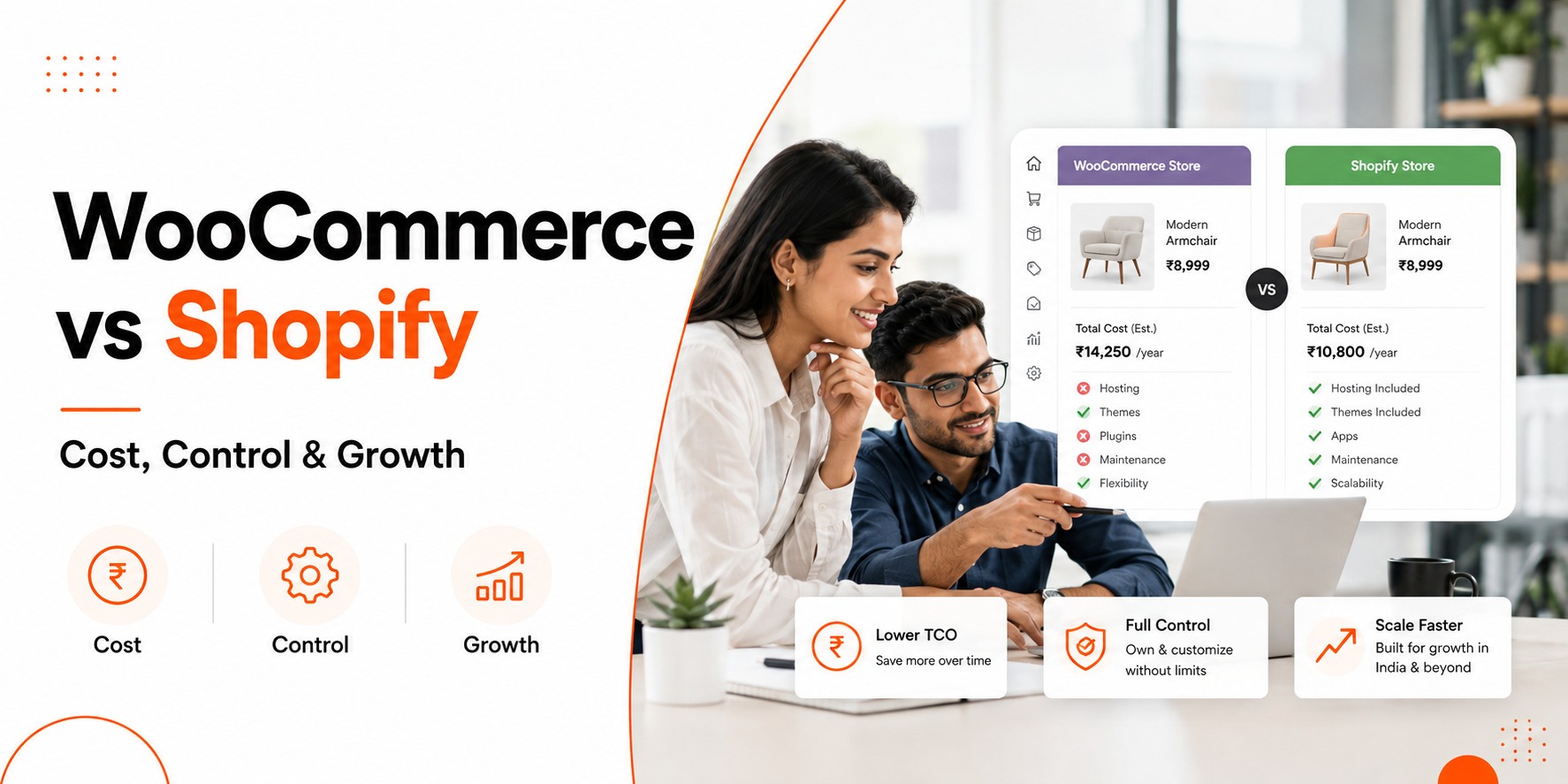
Deciding between Shopify and WooCommerce goes beyond the look of the online store. It impacts how much the business spends, how fast it launches, who controls its tech, and how easy it becomes to add new elements.
Shopify is a hosted ecommerce solution that comes with hosting services, security, and infrastructure. On the other hand, WooCommerce is an open-source WordPress plugin that allows the businesses to control their hosting services, codes, and other technical aspects.
For Indian businesses, the decision-making process must consider factors like UPI, COD payments, local payment gateways, GST operations, shipping solutions, integration with marketplaces, and technical assistance.
Both platforms do not suit all businesses as each one has its own advantages and disadvantages.
Shopify vs WooCommerce at a Glance
| Comparison Area | Shopify | WooCommerce |
| Platform type | Hosted ecommerce platform | Open-source WordPress plugin |
| Hosting | Included | Purchased separately |
| Core platform cost | Monthly subscription | Free |
| Setup difficulty | Easier | Requires more configuration |
| Customization | Themes, apps, APIs, and custom code | Themes, plugins, APIs, database, and code |
| Maintenance | Mostly managed by Shopify | Managed by the business or development team |
| Technical ownership | Shopify controls the infrastructure | Business controls hosting, code, and data |
| Transaction fee | May apply with an external payment provider | No additional WooCommerce platform fee |
| Scalability | Infrastructure managed by Shopify | Depends on hosting and implementation |
| Best suited for | Speed, simplicity, and managed operations | Control, flexibility, and complex customization |
What Is Shopify?
Shopify is a software-as-a-service ecommerce platform. Businesses pay a subscription to access the platform, storefront, checkout, administration panel, hosting, SSL, and other commerce features.
The merchant can manage products, collections, customers, orders, promotions, content, and applications through a centralized dashboard.
Because Shopify handles the underlying infrastructure, the business does not need to configure servers, maintain the ecommerce core, or manage routine platform updates.
This makes Shopify attractive to startups, direct-to-consumer brands, retailers, and non-technical teams that want to launch quickly.
A professional Shopify development company in India can customize the theme, configure products, integrate third-party systems, set up payments, and prepare the store for launch while Shopify continues to manage the core platform.
What Is WooCommerce?
WooCommerce is a free and open-source ecommerce plugin built for WordPress. The business chooses its hosting provider and controls its website files, code, database, themes, and plugins.
WooCommerce states that merchants retain ownership of their store content and data. Store owners can also choose their preferred hosting environment based on cost, performance, and technical requirements.
The core WooCommerce plugin is free, but running a production store still involves expenses such as hosting, domain registration, premium plugins, design, development, security, backups, and maintenance.
WooCommerce is commonly considered by businesses that already use WordPress, depend heavily on content marketing, or require functionality that does not fit comfortably within a hosted platform.
Shopify vs WooCommerce Cost Comparison
The table below combines current official platform pricing with indicative Indian development budgets. Development, theme, and maintenance figures are broad market estimates rather than fixed platform charges.
| Cost Component | Shopify | WooCommerce |
| Core platform | Basic: ₹1,499/month with annual billing | Free |
| Mid-level option | Grow: ₹5,599/month with annual billing | No fixed platform plan |
| Advanced option | Advanced: ₹22,680/month with annual billing | No fixed platform plan |
| Enterprise option | Plus starts at ₹1,75,000/month | Custom infrastructure and development |
| Annual basic platform cost | ₹17,988 | ₹0 |
| Hosting | Included | Official estimate: $25–$350/month |
| Domain | Around ₹800–₹1,500/year | Around ₹800–₹1,500/year |
| SSL | Included | Often included with hosting |
| Premium theme | Approximately ₹8,000–₹35,000+ | Approximately ₹3,000–₹15,000+ |
| Apps or extensions | ₹0–₹60,000+ per year | Official extensions commonly cost $29–$299/year each |
| External gateway platform fee | Basic 2%, Grow 1%, Advanced 0.6% | No additional WooCommerce platform fee |
| Payment processing | Charged separately by the gateway | Charged separately by the gateway |
| Basic design and setup | Approximately ₹30,000–₹80,000 | Approximately ₹40,000–₹1,00,000 |
| Custom store development | Approximately ₹80,000–₹3,00,000+ | Approximately ₹1,00,000–₹4,00,000+ |
| Annual technical support | Approximately ₹12,000–₹60,000+ | Approximately ₹24,000–₹1,20,000+ |
| Indicative first-year basic-store cost | ₹50,000–₹1,50,000 | ₹50,000–₹1,75,000 |
| Indicative first-year custom-store cost | ₹1,50,000–₹5,00,000+ | ₹1,75,000–₹6,00,000+ |
Shopify currently lists annual-billing prices of ₹1,499 per month for Basic, ₹5,599 for Grow, and ₹22,680 for Advanced. Its monthly billing prices are higher. Shopify Plus starts at ₹1,75,000 per month.
Shopify also lists third-party payment-provider fees of 2% on Basic, 1% on Grow, and 0.6% on Advanced. These are separate from the payment-processing charges collected by the chosen gateway.
WooCommerce has no monthly core-platform subscription and does not add its own transaction charge. Its official pricing guidance estimates hosting at $25–$350 per month for most stores and extensions at $29–$299 per year each.
The main difference is predictability. Shopify bundles infrastructure into a recurring subscription. WooCommerce allows greater control over spending, but its total cost depends on the hosting, plugins, custom development, and maintenance selected by the business.
Setup and Time to Launch
Shopify is generally faster to set up.
The merchant can create an account, select a theme, upload products, connect a domain, configure shipping, and activate payments without setting up a server or installing a content-management system.
A standard Shopify store can therefore move from planning to launch relatively quickly, provided its design and business rules are not heavily customized.
Businesses may work with a Shopify website developer in India when they need custom sections, advanced product templates, app integration, migration, or storefront optimization.
WooCommerce requires more initial technical decisions, including:
- Hosting provider and server plan
- WordPress installation
- Theme and page-building approach
- Security and backup setup
- Required plugins
- Caching and performance tools
- Staging and deployment process
This setup takes longer, but it also gives the business more control over how the store is built.
Design and Customization
Shopify Design Flexibility
Shopify provides free and paid themes with configurable sections, typography, colours, navigation, product layouts, and promotional content.
An experienced Shopify website designer in India can make deeper changes using Liquid, CSS, JavaScript, metafields, theme settings, and APIs.
Shopify works well for businesses that need a polished and mobile-friendly storefront without developing every ecommerce component from scratch.
Its limitations appear when a business needs major changes to platform-controlled functionality. Some requirements may need a custom app, an external service, or a higher Shopify plan.
A capable Shopify website design company in India should identify these limitations before development begins instead of promising that every requirement can be handled through theme code.
WooCommerce Design Flexibility
WooCommerce provides more structural freedom.
Developers can modify templates, checkout logic, customer accounts, product behaviour, database interactions, and plugin functionality. Businesses can also create completely custom WordPress themes and plugins.
This makes WooCommerce suitable for unusual product types, advanced price rules, memberships, bookings, subscriptions, learning platforms, and content-led commerce.
However, flexibility does not guarantee quality. Excessive plugins, heavy page builders, and poorly written customizations can make a WooCommerce store slow and difficult to maintain.
Businesses with complex requirements should work with an experienced WooCommerce development company in India rather than attempting to combine many unrelated plugins.
Ownership and Technical Control
WooCommerce gives the business greater technical ownership.
The merchant controls the hosting environment, database, website files, source code, and deployment process. WooCommerce describes its platform as open source and states that the merchant owns the site, code, and data.
Shopify allows merchants to manage and export store data, customize theme code, and connect systems through APIs. However, Shopify controls the core platform and hosting infrastructure.
For many businesses, this is not a disadvantage. They would rather avoid responsibility for servers, updates, and infrastructure.
WooCommerce becomes more attractive when the business requires:
- Direct database access
- Custom hosting or deployment policies
- Complex checkout rules
- Advanced ERP integration
- Full source-code control
- Custom product calculations
- Specialized customer-account workflows
- Greater freedom over plugins and infrastructure
Payment Gateways, UPI, and Cash on Delivery
Both platforms can support payment methods commonly used in India, depending on the selected payment provider and available integration.
Shopify merchants using an external payment provider may pay Shopify’s third-party transaction fee in addition to the gateway’s processing charge. Shopify does not charge these third-party transaction fees for manual payment methods such as cash on delivery and bank transfers.
WooCommerce allows businesses to integrate compatible gateways through plugins, APIs, or custom development without paying an additional platform transaction fee.
Before launch, Indian merchants should test:
- UPI payments
- Debit and credit cards
- Cash on delivery
- Failed transactions
- Refunds and partial refunds
- Payment webhooks
- Order-status updates
- Settlement and reconciliation reports
A listed plugin or Shopify app should not be treated as proof that every payment scenario works correctly.
Store Management and Maintenance
Shopify is usually easier for non-technical teams.
The merchant manages products, customers, orders, discounts, reports, and applications through a consistent administration panel. The core platform, hosting, and infrastructure are maintained by Shopify.
Growing businesses can also use Shopify store management services in India for catalogue updates, collection management, promotions, app configuration, content changes, and operational support.
WooCommerce requires more technical ownership. The business or its agency must manage:
- WordPress updates
- WooCommerce updates
- Theme and plugin compatibility
- Security patches
- Backups
- Server resources
- Performance monitoring
- Staging and production deployments
Businesses without an internal technical team may need to hire a WooCommerce developer in India for ongoing maintenance and troubleshooting.
Performance and Scalability
Shopify handles infrastructure scaling as part of its hosted platform. This reduces the operational burden during traffic spikes, product launches, and festive sales.
Shopify stores can still become slow if they use oversized images, excessive tracking scripts, poorly optimized theme code, or too many storefront apps.
WooCommerce performance depends on the complete technical stack:
- Hosting quality
- Server configuration
- Database health
- Theme structure
- Plugin selection
- Caching
- CDN configuration
- Image optimization
- Development quality
WooCommerce can support growing stores, but scalability must be planned. Choosing cheap hosting and installing many plugins is not a sustainable growth strategy.
A business expecting significant traffic should engage a provider offering reliable WooCommerce development services in India with hosting and performance experience.
SEO and Content Marketing
WooCommerce has a natural advantage for businesses already using WordPress as their primary content platform.
Products, articles, guides, landing pages, and other marketing content can be managed within the same system. This makes WooCommerce suitable for brands that rely strongly on blogging and organic search.
Shopify includes the core SEO features required by most ecommerce businesses, including editable titles, descriptions, redirects, sitemaps, canonical tags, and blogging.
Neither platform guarantees better rankings. Search performance depends on technical quality, useful content, site structure, speed, internal linking, and authority.
Which Platform Should an Indian Business Choose?
Choose Shopify When
Shopify is generally the better choice when:
- The business needs to launch quickly
- The internal team is not technical
- Predictable platform management is important
- Standard ecommerce workflows are sufficient
- Managed hosting and security are preferred
- The store expects frequent catalogue and campaign updates
- The business wants to reduce infrastructure responsibility
Businesses can use Shopify website development services in India to achieve a customized storefront without taking ownership of server maintenance.
Choose WooCommerce When
WooCommerce may be more appropriate when:
- Full code and database control are required
- The business already operates on WordPress
- Content marketing is central to customer acquisition
- Product, pricing, or checkout rules are complex
- Custom hosting is required
- The business has technical resources
- Long-term platform ownership is a priority
For a highly customized store, it is better to hire a WooCommerce expert developer in India than to rely on multiple plugins with overlapping functionality.
Final Verdict
Shopify is stronger in speed, convenience, managed infrastructure, and operational simplicity.
WooCommerce is stronger in ownership, hosting freedom, customization, and technical control.
For many Indian startups and direct-to-consumer brands, Shopify is the safer starting point. It provides a predictable foundation and reduces the need for server management. A reliable Shopify ecommerce development company in India can customize the store while keeping the underlying platform manageable.
WooCommerce is better suited to businesses that already depend on WordPress or require deep customization. In such cases, implementation quality is critical. Working with a skilled WooCommerce development agency in India can prevent performance, security, and plugin-maintenance problems.
The correct choice is not the platform with the most features. It is the platform that creates the least operational friction while supporting the company’s future growth.