




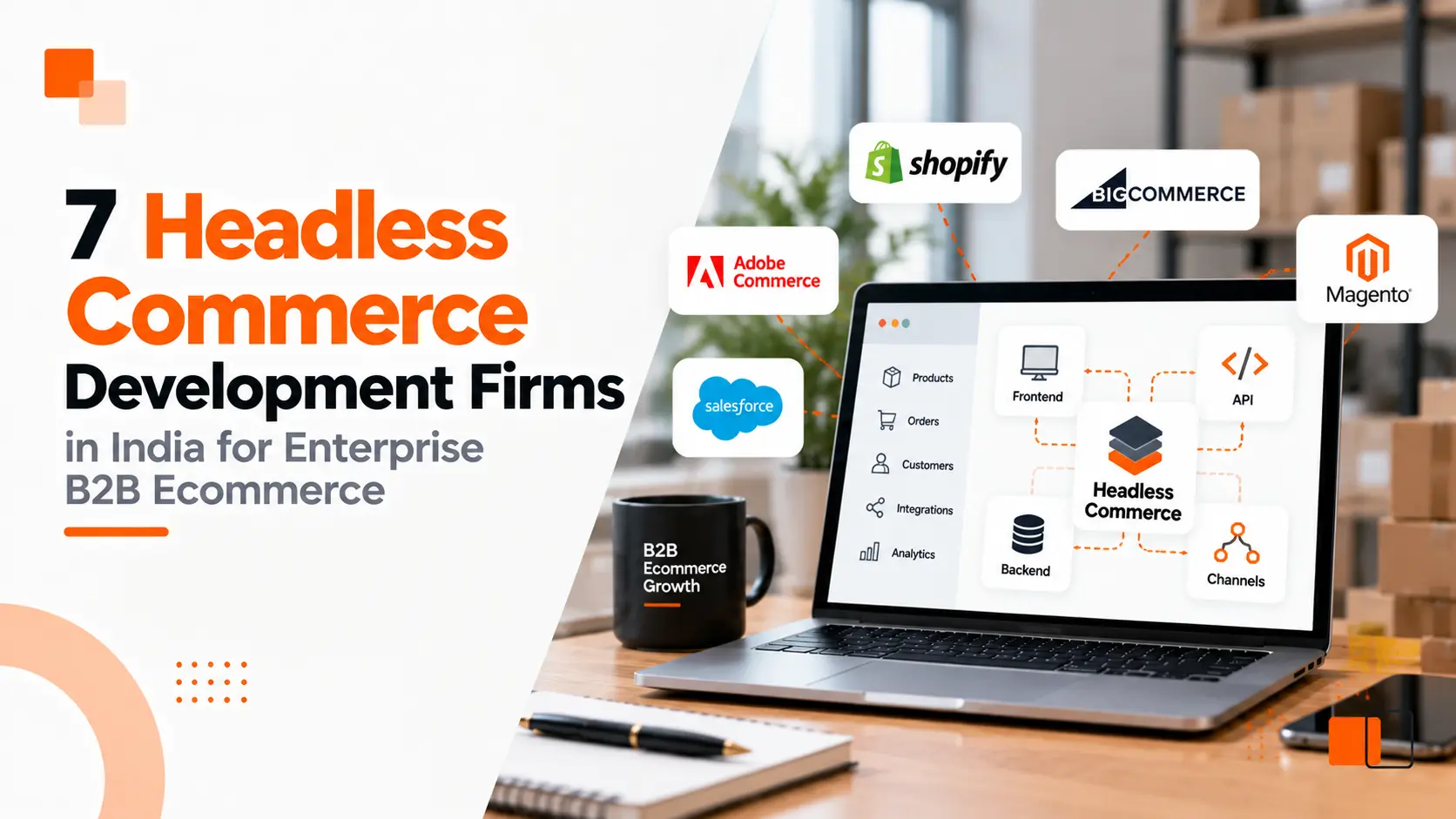
Enterprise B2B ecommerce has requirements that go beyond a conventional online store. Manufacturers, wholesalers, and distributors may need customer-specific pricing, large product catalogues, account-based purchasing, bulk ordering, and integrations with enterprise resource planning (ERP), product information management (PIM), and customer relationship management (CRM) systems.
A traditional ecommerce platform can support many of these requirements. However, businesses seeking greater control over their digital experiences or needing to serve multiple channels may consider a headless architecture.
Headless commerce separates the customer-facing storefront from the underlying commerce backend. This allows developers to build custom frontend experiences while connecting to commerce functionality through APIs. The approach offers flexibility, but it can also introduce additional development, integration, testing, and maintenance responsibilities.
Choosing a development partner therefore requires more than comparing design portfolios. Enterprises need to evaluate architectural expertise, integration capabilities, B2B workflows, security, and long-term support.
This listicle covers seven firms to consider when researching headless commerce development in India, along with their relevant capabilities and the factors enterprise buyers should assess before selecting a partner.
What Should Enterprises Look for in a Headless Commerce Development Firm?
Before shortlisting providers, define the operational problems your new commerce architecture needs to solve.
- Enterprise architecture: The team should understand how the storefront, commerce engine, content management system, and business applications interact.
- B2B functionality: Consider company accounts, buyer permissions, negotiated pricing, customer-specific catalogues, quotes, and approval workflows.
- System integrations: ERP, CRM, PIM, inventory, payment, and order management systems may need to exchange data reliably.
- Frontend development: Evaluate the team’s ability to build responsive interfaces using suitable frameworks and API-driven architecture.
- Catalogue and ordering workflows: Large catalogues may require advanced search, bulk ordering, saved lists, and quick reorder functionality.
- Performance and reliability: Ask about caching, monitoring, testing, security, and handling integration failures.
- Migration and maintenance: Confirm how existing data, integrations, and business processes will be migrated and maintained.
Not every enterprise needs headless architecture. A conventional ecommerce implementation may remain the more practical option when existing platform features meet business requirements without significant limitations.
7 Headless Commerce Development Firms in India
The following companies are presented in the requested order for the first three entries. The remaining four were selected based on publicly described headless or enterprise ecommerce capabilities. This is an editorial shortlist, not a ranked assessment of delivery quality or a claim that every company specialises equally in B2B commerce.
1. DIT India
DIT India offers ecommerce development across platforms including Shopify, BigCommerce, Magento, and WooCommerce, alongside dedicated headless commerce services. Its published service information covers custom storefront experiences, frontend and backend integration, platform-specific implementations, and ongoing support.
For enterprise buyers, these capabilities may be relevant when an existing commerce platform needs a more flexible frontend or when multiple systems must work together. Businesses should discuss their specific B2B requirements, including account structures, customer-specific pricing, bulk ordering, and ERP or PIM connectivity, during the discovery phase.
Companies evaluating headless ecommerce solutions in india can review DIT India’s headless commerce services and ecommerce development services to understand its published offerings and assess whether they fit the proposed architecture.
Best suited for: Businesses evaluating custom storefronts, platform-based headless implementations, ecommerce integrations, and ongoing technical support.
2. 9eCommerce
9eCommerce provides ecommerce development across multiple platforms, including BigCommerce, Shopify, Magento, and WooCommerce. Its published services include custom development, platform migration, API integrations, and dedicated headless commerce services. The company also publishes material about enterprise ecommerce architecture and distributor-focused B2B ordering workflows.
These capabilities may be relevant to businesses planning to connect storefront experiences with product, inventory, and operational systems. Enterprise teams should clarify how the proposed solution will support account-specific pricing, large catalogues, buyer permissions, order workflows, and existing business applications.
Organisations researching a headless commerce company in india can explore 9eCommerce’s headless commerce architecture article and ecommerce services before discussing their requirements.
Best suited for: Businesses comparing multi-platform ecommerce development, API integrations, migration, and custom commerce architecture.
3. DIT Interactive
DIT Interactive publishes dedicated headless commerce services for platforms including BigCommerce and Shopify. Its service information covers custom frontend development, API connectivity, integrations, custom applications, and maintenance and support. The company also describes work involving different digital commerce platforms and customer experiences.
For enterprise B2B projects, these capabilities may be relevant when a business needs a custom storefront connected to an existing commerce backend. Buyers should verify the proposed approach to company accounts, pricing rules, complex ordering, ERP connectivity, and security before confirming project scope.
Businesses comparing a headless ecommerce development company in india can review DIT Interactive’s headless commerce services and ask for a project proposal that maps the architecture to their operational needs.
Best suited for: Businesses evaluating custom frontend experiences, platform-based headless development, integrations, and ongoing technical support.
4. Webkul
Webkul offers headless commerce development using frontend technologies and frameworks such as React, Next.js, Vue, Shopify Hydrogen, and Adobe Commerce PWA Studio. Its published services also cover API-based integrations and connections with systems such as PIM, ERP, and CRM.
Webkul is particularly relevant to investigate for B2B projects because it also publishes dedicated wholesale ecommerce services. These include custom pricing, quoting, catalogue management, customer accounts, and ERP and CRM integration. Its website describes B2B marketplace projects and workflows for business buyers. <Cite refs={[“turn605943search2″,”turn605943search3”]}/>
For an enterprise, the important next step is to determine whether the required B2B features are available through an existing solution or need custom development, and how they would fit the chosen headless architecture.
Best suited for: Businesses evaluating multi-platform headless development, B2B functionality, marketplace capabilities, and enterprise system integrations.
5. Successive Digital
Successive Digital is a digital transformation and consulting firm. Its Shopify Partner Directory profile lists headless commerce among its services and describes work spanning enterprise commerce strategy, implementation, optimisation, and support. The profile also identifies B2B among its industry categories.
These capabilities may be relevant to enterprises planning a broader commerce modernisation project rather than a standalone storefront redesign. Buyers should assess the team’s experience with their chosen commerce platform, frontend architecture, integration landscape, and business processes.
Before shortlisting the company, ask for examples of relevant enterprise implementations and clarify its approach to B2B pricing, account hierarchies, order workflows, data migration, and post-launch ownership. Its suitability will depend on the project’s technology stack and the depth of the required implementation.
Best suited for: Enterprises evaluating digital transformation, commerce modernisation, headless implementations, and ongoing optimisation.
6. Delhi Digital Co.
Delhi Digital Co. appears in Shopify’s official Partner Directory, where it describes custom Shopify development and headless commerce services. Its listed capabilities include store development, custom applications and integrations, migration, and checkout-related work.
The company may be worth evaluating when an enterprise is considering a Shopify-based headless storefront and needs custom frontend experiences or additional integrations. However, the available partner information does not by itself establish specialist expertise in every complex B2B workflow.
Enterprise buyers should confirm the team’s experience with company accounts, negotiated pricing, multiple buyer roles, bulk orders, and connections to ERP or PIM systems. Ask for relevant case studies and a technical proposal before assuming the solution will meet the full enterprise scope.
Best suited for: Businesses considering Shopify headless development, custom storefronts, migration, and integrations, subject to validation of B2B requirements.
7. 18th DigiTech
18th DigiTech is listed in Shopify’s official Partner Directory. Its profile describes digital commerce services for B2B and B2C brands, including enterprise-oriented Shopify projects. Headless commerce is included among its listed services, alongside store development, migration, theme customisation, and ongoing management.
For an enterprise buyer, this makes the company worth considering when assessing Shopify-based commerce modernisation. The suitability of a specific project will depend on the required architecture, integrations, catalogue complexity, and B2B workflows.
Before selecting the provider, ask how it would handle custom pricing, company account permissions, bulk ordering, ERP connectivity, and long-term support. Request examples relevant to the planned scope and verify which features are included in the proposed implementation.
Best suited for: Businesses evaluating Shopify-based commerce development, headless storefronts, and enterprise-oriented ecommerce projects.
Quick Comparison of Headless Commerce Development Firms
| Company | Published capabilities to evaluate | Potential enterprise B2B fit | |
| DIT India | Headless commerce, Shopify, BigCommerce, custom ecommerce, integrations | Custom storefronts and platform integrations | |
| 9eCommerce | Headless services, multi-platform development, APIs, migration | Ecommerce architecture and distributor workflows | |
| DIT Interactive | Headless BigCommerce and Shopify, frontend, custom apps, integrations | Custom storefronts and connected commerce systems | |
| Webkul | Headless frameworks, B2B commerce, marketplaces, ERP/CRM integrations | Wholesale workflows, complex integrations, marketplace requirements | |
| Successive Digital | Enterprise commerce consulting, headless commerce, implementation | Commerce modernisation and B2B project evaluation | |
| Delhi Digital Co. | Shopify headless, custom development, integrations, migration | Shopify-based projects; validate advanced B2B scope | |
| 18th DigiTech | Shopify development, headless commerce, B2B/B2C projects | Shopify-based enterprise projects; validate required workflows |
Important: This table compares publicly described services, not independently verified delivery results. It does not mean every company has proven experience with every enterprise B2B feature. Confirm relevant projects, platform expertise, and technical scope directly with each firm.
How to Choose the Right Development Partner for Enterprise B2B Ecommerce
Selecting a partner should start with business requirements, not a preferred technology or framework. Use the following criteria to assess shortlisted firms.
1. Confirm Whether Headless Architecture Is Necessary
Identify the limitations of your existing platform. If the main requirements can be met with existing themes, extensions, and integrations, a conventional architecture may be simpler to operate.
Headless is worth evaluating when the business needs substantial frontend flexibility, multiple customer touchpoints, or a more modular integration strategy. Compare the expected benefits with the added development and maintenance responsibilities.
2. Map Your B2B Workflows
Document how customers currently place and manage orders. Enterprise buyers may need:
- Company accounts with multiple users and roles.
- Customer-specific catalogues and negotiated pricing.
- Quote requests and approval processes.
- Bulk ordering and SKU-based quick ordering.
- Purchase order workflows and repeat ordering.
- Account-specific payment and delivery arrangements.
Ask each provider to demonstrate how these workflows would be implemented and identify which requirements need custom development.
3. Evaluate Integration Architecture
List the systems that must exchange data with the commerce platform, including ERP, CRM, PIM, inventory, and order management systems.
Ask how data will flow between them, which system owns each data field, how synchronisation failures will be handled, and how APIs will be secured. A technically sound architecture should include monitoring, error handling, testing, and clear ownership of integrations.
4. Assess Performance, Security, and Maintainability
A custom frontend is only one component of an enterprise commerce system. Ask about performance testing, caching, accessibility, deployment processes, monitoring, backups, and security practices.
Also establish who will maintain the frontend, backend integrations, APIs, and infrastructure after launch. A flexible architecture still requires clear technical ownership and ongoing operational support.
5. Compare Total Cost of Ownership
Compare proposals across discovery, architecture, design, development, licences, hosting, integrations, data migration, testing, training, and post-launch support.
The lowest initial development quote may not represent the lowest long-term cost. Ask each company to identify assumptions, dependencies, exclusions, and likely ongoing responsibilities so the proposals can be compared fairly.
Enterprise Partner Selection Checklist
Before signing a contract, confirm that you have:
- Documented business and technical requirements.
- Reviewed relevant headless commerce projects.
- Confirmed B2B workflow and integration capabilities.
- Agreed on architecture, technology choices, and data ownership.
- Defined testing, security, and acceptance criteria.
- Established migration, launch, and rollback plans.
- Clarified maintenance, support, and future enhancement costs.
Conclusion
Choosing a headless commerce development partner for enterprise B2B ecommerce requires a clear understanding of your architecture, buyer workflows, integrations, and long-term operational needs. The right provider should be able to explain how its proposed solution will support your specific requirements rather than simply recommend a newer technology.
DIT India, 9eCommerce, DIT Interactive, Webkul, Successive Digital, Delhi Digital Co., and 18th DigiTech offer different capabilities worth evaluating. The best fit will depend on your existing platform, B2B complexity, integration requirements, internal technical resources, and budget.
If you are comparing headless ecommerce development services in india, headless commerce solutions in india, or a headless commerce development company in india, start with your business workflows and validate the provider’s experience against them. You can explore DIT India’s headless commerce services and ecommerce development services to discuss your requirements and assess an appropriate implementation approach.