



Ecommerce architecture selection may be considered one of the key decisions in a company’s activity. An ecommerce platform defines not only the overall user experience but also the technical characteristics of the web page as well as the capacity for future scaling and expansion.
For decades, a traditional ecommerce platform used to be the first option for companies wishing to go online with their business. It offers the most convenient way to manage an online store, providing a full range of functions for easy web site setup. But as times changed, more and more businesses opt for headless commerce.
There has been a rise in the number of headless commerce adoption cases among organizations in India and other countries worldwide, due to the necessity for better customer personalization, multichannel capabilities, as well as higher page loading speeds. Is headless commerce indeed the right solution for all businesses?
This article will help you understand how to compare headless commerce and traditional ecommerce as well as highlight their pros and cons.
Understanding Traditional Ecommerce
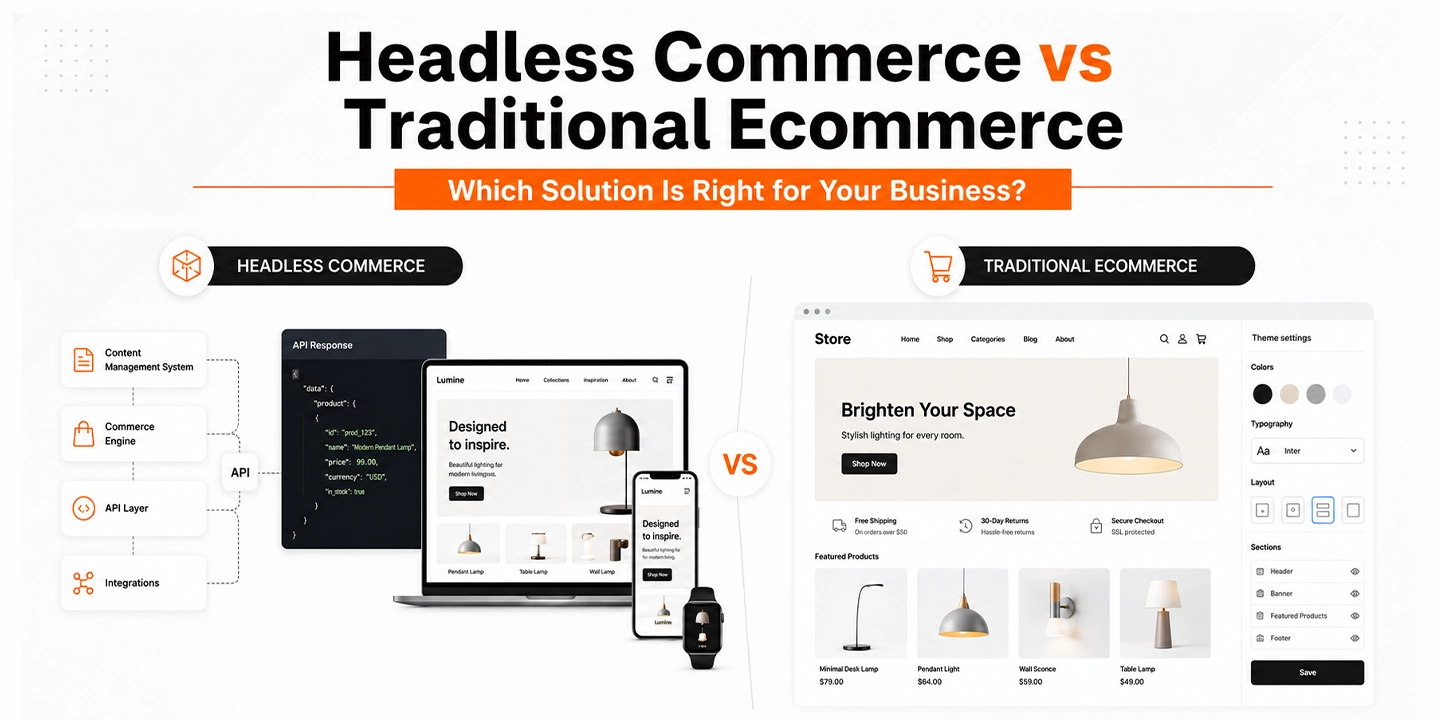
Traditional ecommerce represents an ecommerce architecture in which the front-end and back-end are tightly integrated into a unified system.
The front-end consists of all customer touchpoints, such as product listings, navigation, and check out process. The back-end takes care of managing products, inventories, orders, customer data, and company operations.
Traditional ecommerce solutions can be found in most popular ecommerce platforms.
How Traditional Ecommerce Works
In a traditional ecommerce platform:
- The storefront and backend are connected.
- Changes to the customer experience are often limited by platform capabilities.
- Most functionality comes from built-in features, themes, or plugins.
- Businesses manage everything from a single dashboard.
This architecture works well for companies looking for a straightforward and cost-effective ecommerce solution.
Benefits of Traditional Ecommerce
Faster Launch Times
Traditional ecommerce platforms offer ready-made themes, templates, and features that make launching an online store relatively simple.
Lower Initial Investment
Since most functionality is included within the platform, businesses typically spend less on development and implementation.
Easier Management
Store owners can manage products, orders, customers, and content from one centralized system.
Large Ecosystem of Extensions
Many traditional platforms offer thousands of plugins and integrations that extend functionality without requiring custom development.
Limitations of Traditional Ecommerce
While traditional ecommerce remains popular, it has certain limitations.
Limited Flexibility
Businesses looking for highly customized customer experiences may find themselves restricted by platform architecture.
Performance Challenges
As websites become more feature-rich, maintaining optimal performance can become more difficult.
Scalability Constraints
Expanding across multiple channels or integrating advanced technologies often requires significant customization.
What Is Headless Commerce?
Headless commerce disconnects the frontend experience from the backend ecommerce system.
The connection between the two is not made using an integrated solution, but rather by utilizing APIs for the communication between the two systems. Companies can design their own storefronts without sacrificing ecommerce capabilities within the backend.
With changing times in digital commerce, headless commerce solutions have gained popularity among Indian businesses.
How Headless Commerce Works
In a headless architecture:
- The frontend and backend operate independently.
- APIs connect both layers.
- Businesses can create unique customer experiences across multiple channels.
- Changes to the frontend can be made without affecting backend operations.
This flexibility is one of the primary reasons why headless commerce is becoming increasingly popular among growing brands.
Headless Commerce vs Traditional Ecommerce: Key Differences
| Feature | Traditional Ecommerce | Headless Commerce |
| Architecture | Frontend and backend are connected | Frontend and backend are separate |
| Customization | Limited by platform capabilities | Extensive customization options |
| Website Performance | Depends on platform limitations | Optimized using modern frontend technologies |
| Scalability | Moderate | Highly scalable |
| Omnichannel Support | Limited | Excellent |
| Development Flexibility | Restricted | Highly flexible |
| Time to Market | Faster | Longer development timeline |
| Initial Cost | Lower | Higher upfront investment |
| Innovation Potential | Moderate | High |
Why Businesses Are Moving Toward Headless Commerce
Consumers today expect consistency in their purchasing process irrespective of whether they encounter a brand through social media, via their mobile device, or even via desktops for checkout.
Classic e-commerce systems are well-equipped to manage some aspects of this process, however, headless commerce offers more scope for such a process.
Enhanced Customer Experience
One of the most significant benefits of the headless commerce approach is the possibility of creating unique and exciting customer experiences.
There are no restrictions imposed by using predefined templates or other platform limitations anymore. Companies can now create stores according to their own standards.
Faster Website Performance
The page speed is crucial in determining customer satisfaction and conversions.
With the modern frontend techniques in headless commerce, there is often better page speed, navigation and user experience on mobile devices.
Greater Agility
It becomes easier to make changes to the storefront, introduce marketing campaigns and test experiences without affecting backend operations.
Omnichannel Commerce
Headless commerce enables brands to deliver consistent experiences across:
- Ecommerce websites
- Mobile applications
- Marketplaces
- Social commerce platforms
- Smart devices
This flexibility has increased demand for headless commerce services in India among businesses looking to expand their digital presence.
When Traditional Ecommerce Is the Right Choice
Despite the advantages of headless commerce, traditional ecommerce remains the ideal choice for many businesses.
Startups and Small Businesses
Companies with limited budgets often benefit from the simplicity and affordability of traditional platforms.
Faster Store Launches
Businesses that need to launch quickly can take advantage of pre-built themes and built-in functionality.
Standard Ecommerce Requirements
If your business only requires basic ecommerce functionality, a traditional platform may provide everything you need.
Limited Technical Resources
Traditional ecommerce platforms require less ongoing development support compared to headless solutions.
When Headless Commerce Makes More Sense
Certain business scenarios are particularly well-suited for headless architecture.
Growing Ecommerce Brands
As businesses grow, they often need more flexibility than traditional platforms can provide.
Complex Customer Journeys
Brands focused on personalization and customer engagement benefit significantly from headless commerce.
Multi-Channel Businesses
Organizations selling across multiple channels can maintain a unified customer experience through a headless architecture.
Enterprise-Level Scalability
Large businesses often require advanced integrations, customization, and performance optimization.
Many organizations partner with a specialized headless commerce development company in India to build scalable ecommerce ecosystems that support long-term growth.
Industries Benefiting from Headless Commerce
Fashion and Apparel
Fashion brands often require immersive shopping experiences, advanced content management, and personalized recommendations.
Electronics and Technology
Complex product catalogs and detailed customer journeys make headless commerce particularly valuable.
Furniture and Home Décor
Interactive product displays and customization features are easier to implement with headless architecture.
B2B Ecommerce
B2B businesses frequently need custom workflows, account-specific pricing, and advanced integrations.
The Role of Professional Headless Commerce Development
Successfully implementing a headless architecture requires careful planning and technical expertise.
Working with an experienced headless ecommerce development company in India can help businesses avoid common challenges and maximize the value of their investment.
Professional development teams typically assist with:
Strategy and Architecture Planning
Defining the right technology stack and implementation roadmap.
Custom Frontend Development
Building fast, responsive, and user-friendly storefronts.
API Integration
Connecting ecommerce platforms with ERP systems, CRMs, payment gateways, and other business tools.
Platform Migration
Transitioning from traditional ecommerce platforms to modern headless architectures.
Performance Optimization
Improving speed, user experience, and conversion rates.
These services are often included as part of comprehensive headless ecommerce development services in India designed to support businesses at every stage of growth.
Why More Businesses Are Exploring Headless Commerce
As customer expectations keep changing, there is an increased need for businesses to have ecommerce solutions that are dynamic enough to handle changes in the marketplace.
Even though conventional ecommerce continues to be a viable approach, those companies with innovation at their core and looking for scalable systems tend to go for headless commerce.
The flexibility offered by such a system not only allows you to introduce new features easily but also offers customization options which result in competitive advantages.
This is driving companies to invest in headless commerce development services in India.
How to Choose the Right Solution
When evaluating traditional ecommerce versus headless commerce, consider the following questions:
What Are Your Growth Plans?
Rapidly growing businesses often benefit from the scalability of headless commerce.
How Important Is Customization?
If customer experience is a key differentiator, headless commerce may be worth the investment.
What Is Your Budget?
Traditional ecommerce generally requires a lower upfront investment, while headless commerce delivers greater long-term flexibility.
Do You Need Omnichannel Capabilities?
Businesses selling across multiple channels often gain significant advantages from a headless approach.
What Technical Resources Are Available?
Headless commerce typically requires ongoing development expertise and maintenance.
Final Verdict: Which Solution Is Right for Your Business?
It is difficult to give an answer universally regarding headless commerce or conventional ecommerce as both have advantages and disadvantages.
The best approach here is to use traditional ecommerce where the need is for fast implementation and low investment, along with ease in maintenance.
In comparison, headless commerce is a good fit for those looking to expand their business and focus on innovations as well as providing an excellent customer experience.
With the demand for digital commerce continuing to rise in India, many businesses now see the need to adopt headless commerce solutions to remain competitive and offer more.
DIT India specializes in helping businesses in building scalable and future ready ecommerce eco-systems by providing world class headless commerce development services in India.
Whether you need complete headless ecommerce solutions in India or you need to migrate to headless commerce from conventional ecommerce solutions or need a reliable headless commerce development company in India, we can cater to all your needs.