



Ecommerce platforms that have been used traditionally serve all purposes for many online businesses. This includes the management of products, checkout process, payments, marketing campaigns, customer accounts, and ready-to-use themes.
However, some companies eventually come to a stage when a regular storefront becomes a limitation. They require a completely new customer experience, higher speed of content distribution, several storefronts per region, mobile apps, complicated integrations, or better control over the way commerce is delivered through digital channels.
This is the moment headless commerce steps into play.
Headless commerce does not replace the traditional ecommerce platform but allows separating the storefront from the backend.
What Is Headless Commerce?
With a traditional ecommerce system, the front end and back end are interrelated.
The front end involves all the things the customer uses:
- Homepage
- Navigation
- Product page
- Search
- Cart
- Content page
Customer account
While the back end involves the following elements:
- Products
- Stocks
- Pricing
- Customers
- Order
- Discounts
- Payment
- Fulfilment
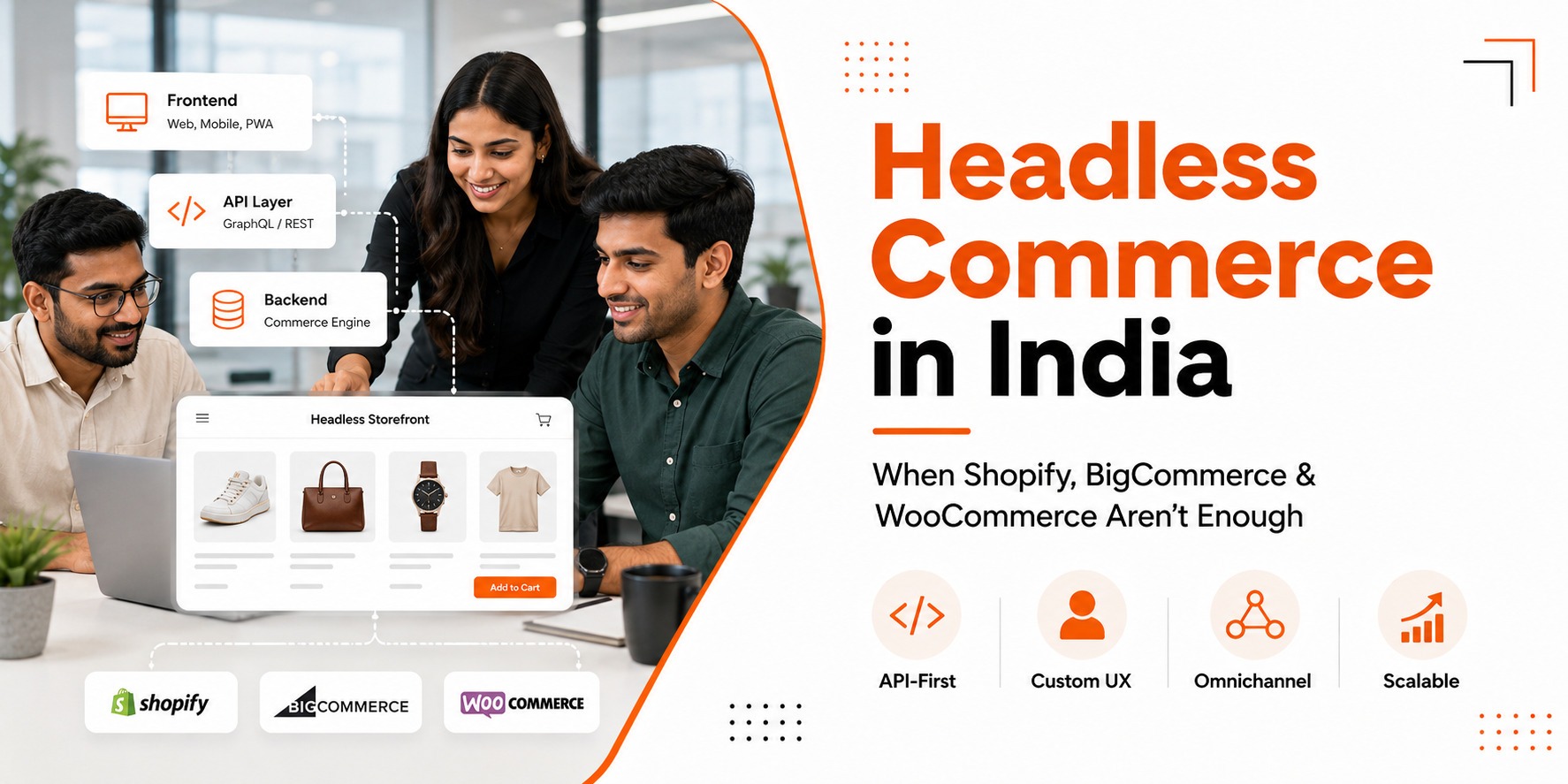
When using a headless model, the ecommerce platform still handles commerce activities, but there is an additional front end that interacts with it through API.
The front end can be built with the help of Next.js, React, Vue, Nuxt, or any other relevant frameworks. In addition, businesses can hook the same back end to mobile app, kiosk, market place, etc.
It gives more flexibility, but at the same time brings additional responsibility for development and maintenance.
When Does a Standard Ecommerce Store Become Restrictive?
In many cases, a regular theme-based store might be the best solution for small and mid-size organizations. Such stores can be launched quicker, require fewer resources for maintenance, and are easier to control by internal staff.
Otherwise, headless commerce should be used only in special cases.
Common signs include:
The Customer Experience Cannot Be Built Properly
A brand might need a very interactive storefront, a complicated product configuration process, personalized pages, high-quality content, or a unique path through the site that can be hard to create using a normal theme.
Themes can be customized extensively, but too much customization may end up making the code weak and upgrades difficult.
Content and Commerce Need to Work Together
There are some companies that generate an abundance of editorial content, guides, video, case studies, look books or education material along with their products.
An individual content management system will help marketers manage this content independently while the ecommerce platform continues to handle the transactions.
Multiple Storefronts Share One Commerce Backend
A company may operate:
- Separate regional websites
- Different brand storefronts
- B2B and B2C experiences
- Mobile apps
- Dealer or distributor portals
- In-store digital experiences
Headless architecture can allow these experiences to use the same product, pricing, inventory, and order systems while presenting different interfaces.
Existing Systems Require Deeper Integration
Businesses may need to connect ecommerce with:
- Enterprise resource planning systems
- Product information management platforms
- Warehouse systems
- Customer relationship management tools
- Subscription platforms
- Loyalty programs
- Custom pricing engines
- Order management systems
A headless approach can create a cleaner integration layer when the business has several systems exchanging information.
Performance Is a Strategic Requirement
An advanced frontend can offer more control over rendering pages, caching, delivering code, and image optimization.
Nevertheless, a headless approach does not necessarily guarantee a fast website. Incorrectly written frontend code, too many scripts, poorly optimized API calls, and bad hosting can result in a slow storefront.
Speed comes from a well-planned, properly designed, tested, and monitored storefront.
When Shopify May Need a Headless Storefront
Shopify already offers a solid hosted environment, rich app ecosystem, integrated checkout process, and manageable themes. In most cases, customization of a Shopify theme will be the best choice for your brand.
The headless approach makes sense when you need to implement a storefront experience that is too complex for your Shopify theme structure.
Shopify offers Storefront API that allows developers to build custom storefronts for websites, apps, and other sales channels. The API covers commerce functionality, such as product retrieval and collections, cart management, and checkout process. Additionally, Shopify offers Hydrogen as an official tool for headless storefront development.
It might be the right solution when a business requires:
- A unique customer journey
- A content-driven storefront
- Multiple frontend experiences based on one Shopify backend
- Enhanced product discovery
- Custom mobile and web applications
- Better frontend performance
In any case, it means that some features implemented by the theme have to be implemented separately.
When BigCommerce May Need a Headless Storefront
BigCommerce is usually recommended for companies with large catalogs, multiple storefronts, business-to-business demands, and complex integrations.
APIs available with BigCommerce allow the company to have a separate frontend and the platform takes care of products, customers, carts, orders, and all other commerce processes. BigCommerce is capable of providing headless commerce in different situations of multiple storefronts and business-to-business scenarios.
A headless approach may be ideal when the company requires:
- Diverse experiences for B2C and B2B customers
- Regional storefronts
- Different structure of the catalog
- Customized account portal
- Integration with enterprise applications
- Frontend development not within the theme
The main issue here is that of aligning all storefronts, platform APIs, checkout, search, customer accounts, and integration applications into one experience.
When WooCommerce May Need a Headless Storefront
Flexibility of WooCommerce stems from its implementation through WordPress platform and access to an extensive plugins and development ecosystem.
For content-driven companies, the conventional combination of WordPress and WooCommerce may be sufficient. The need for headless comes when the front end needs a different framework or a unique customer experience across several digital channels using the same commerce data.
WooCommerce provides APIs which can be used for customized storefront interaction. In addition to this, Store API allows customers to create customer-facing features like products and cart using token-based cart for the headless approach.
The key consideration for companies adopting this strategy will have to do with the compatibility of plugins.
Key Benefits of Headless Commerce
Choosing headless architecture can provide meaningful advantages when the business genuinely needs them.
Greater Frontend Freedom
Designers and developers are not limited by the structure of a standard ecommerce theme. They can create a customer experience around specific business requirements.
Better Support for Multiple Channels
The same commerce backend can serve websites, applications, kiosks, portals, and other interfaces through APIs.
Independent Frontend Development
The storefront can be updated without rebuilding the commerce backend. Backend platform changes can also be managed without redesigning the entire customer interface.
Flexible Content Management
Businesses can use a dedicated CMS for landing pages, articles, campaigns, and regional content while keeping commerce data in the ecommerce platform.
Stronger Integration Possibilities
Headless architecture can simplify how the frontend communicates with search tools, recommendation engines, product systems, and other services.
These benefits explain why growing brands often explore headless ecommerce solutions in India when their existing storefront can no longer support their roadmap.
The Real Costs and Risks
Headless commerce is sometimes promoted as a straightforward upgrade. In reality, it is a more complex architecture.
Before moving forward, businesses should understand the additional responsibilities.
Higher Initial Development Cost
A custom frontend must be planned, designed, developed, integrated, tested, and deployed. Features that come ready-made in a theme may require separate work.
Ongoing Maintenance
The business must maintain the frontend framework, hosting, API integrations, dependencies, security updates, analytics, and platform changes.
More Complicated App Integration
Some ecommerce apps rely on theme code or platform-specific storefront features. They may require custom API integration or may not support a headless store at all.
Preview and Content Management Challenges
Marketing teams often expect visual editing and instant previews. A headless CMS can provide these capabilities, but only when the preview workflow is deliberately implemented.
Greater Testing Requirements
Product browsing, search, login, cart, discounts, checkout, analytics, customer accounts, and regional behaviour must be tested across the full architecture.
A reliable headless ecommerce development company in India should explain these costs before recommending the approach. Headless is useful when it solves a real limitation, not when it is selected only because it sounds modern.
What a Practical Headless Architecture Includes
A typical project may contain several connected layers.
Commerce Backend
The ecommerce platform manages products, pricing, inventory, customers, carts, orders, discounts, and checkout.
Custom Frontend
A framework such as Next.js or another suitable technology delivers the customer-facing experience.
Content Management System
A headless CMS may manage campaign pages, banners, articles, navigation, landing pages, and reusable content blocks.
Search and Product Discovery
Large catalogues may require a dedicated search platform for autocomplete, filtering, ranking, recommendations, and merchandising.
Integration Layer
Middleware may connect the ecommerce platform with ERP, PIM, CRM, warehouse, taxation, payment, or fulfilment systems.
Hosting and Delivery
The frontend requires hosting, deployment pipelines, caching, monitoring, backups, and performance management.
A good architecture does not use every available technology. It uses the smallest dependable set of systems required to meet the business goals.
How to Decide Whether Headless Is Worth It
Before requesting headless commerce development services in India, ask the following questions:
What Specific Problem Are We Solving?
The answer should be measurable and clear. Examples include slow content releases, restricted design, multiple storefronts, complex integrations, or an inability to support mobile and web experiences from one backend.
Can the Existing Theme Be Improved Instead?
A theme rebuild, performance audit, app cleanup, or better integration may solve the issue at a much lower cost.
Does the Business Have the Right Team?
Headless projects need ongoing technical ownership. A business without internal developers will need dependable long-term support from its implementation partner.
Which Existing Features Must Be Rebuilt?
Prepare a list covering search, cart, checkout, subscriptions, reviews, loyalty, customer accounts, analytics, internationalization, and marketing tools.
How Will Content Teams Work?
Marketers should be able to create and preview content without waiting for developers for routine updates.
What Is the Total Cost Over Three Years?
Include development, hosting, maintenance, monitoring, integrations, licenses, support, upgrades, and future feature work.
These questions help prevent a technically impressive project from becoming an operational burden.
Choosing a Headless Commerce Partner in India
The proper partner should not advise on headless architecture until gaining knowledge about the business.
An experienced headless commerce provider in India should consider:
- Limitations of the existing platform
- Requirements of the business and customers
- Complexity of the catalogue
- Region and multilingual requirements
- Current integrations
- Workflow for content
- Checkout requirements
- Performance requirements
- Security and compliance
- Team skillset
- Maintenance budget
Request from the provider an architecture plan, scope of integration, approach to testing and deployment, support and ownership.
The key question is not, “Can you build a headless store?” It is, “Can you run and evolve this architecture after launch?”
Final Thoughts
A headless commerce solution is beneficial to an enterprise if it has outgrown the constraints of a basic storefront. It offers possibilities of creating custom user experiences, rich content experiences, multi-channel capability, regional storefronts, and system integration.
However, it is not inherently superior to an ordinary ecommerce solution.
To most enterprises, an optimized theme, better app integration, and better integrations will work best and will save time and money compared to a headless approach. Enterprises should consider headless commerce only when the business benefits are worth the extra cost.
Indian enterprises that are considering headless commerce solutions should start with discovery and architecture before developing. DIT India facilitates brand evaluation, design, development, integration, and maintenance of headless commerce experiences based on business needs.