


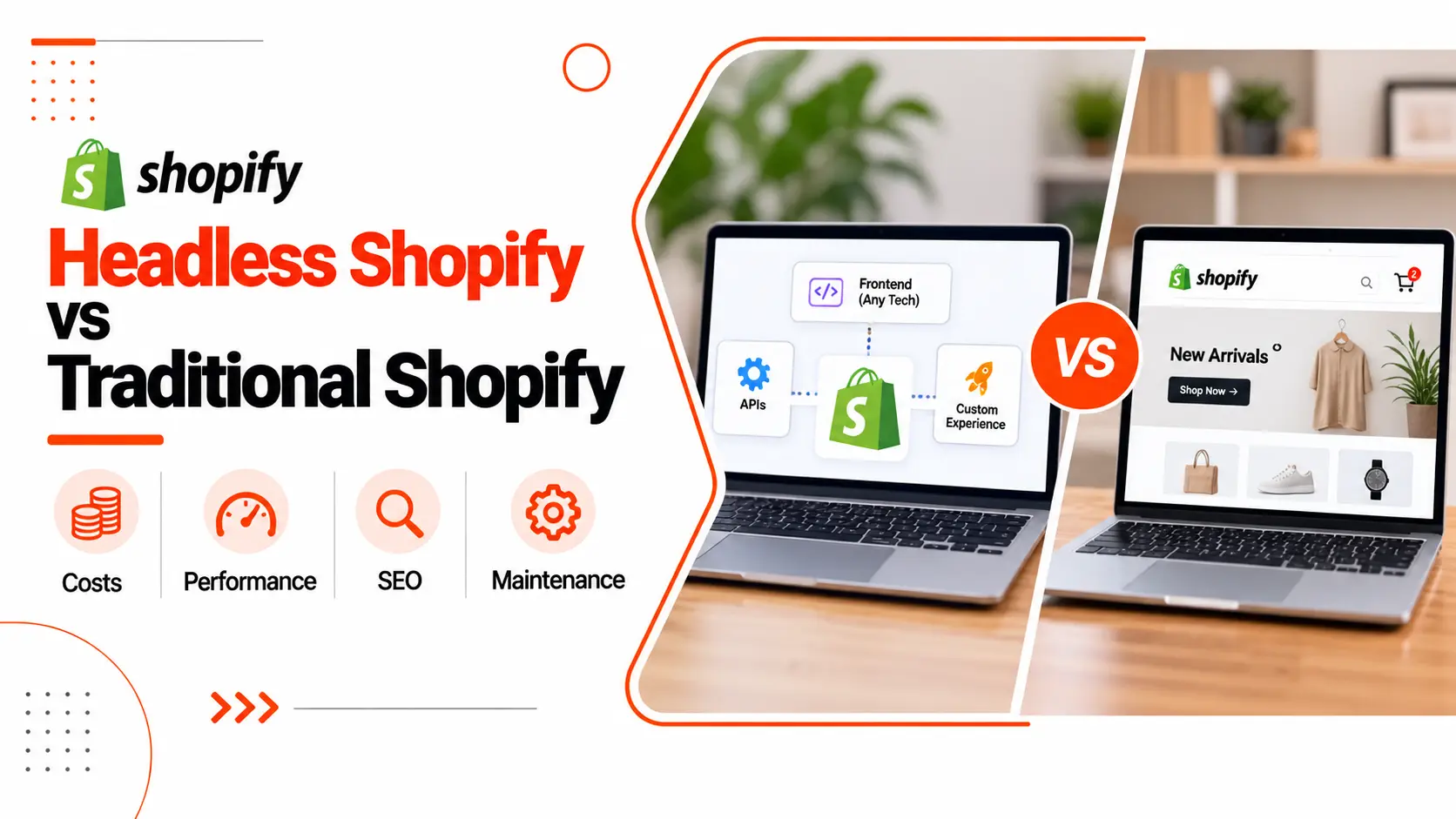
Choosing between headless Shopify and traditional Shopify is an important decision for ecommerce businesses planning to launch, redesign, or scale their online stores. Both approaches use Shopify’s commerce platform, but they differ in how the customer-facing website is built, customized, and maintained.
Traditional Shopify uses a theme-based storefront that merchants can manage through Shopify’s admin and theme editor. Headless Shopify separates the storefront frontend from the commerce backend, giving developers more control over the customer experience but introducing additional technical responsibilities.
For most businesses with standard ecommerce requirements, traditional Shopify is a practical starting point. Headless Shopify is worth considering when custom experiences, integrations, or frontend requirements justify the additional development and maintenance investment. Neither approach automatically guarantees better performance, SEO rankings, or sales.
This guide compares headless Shopify vs traditional Shopify across costs, performance, SEO, flexibility, and maintenance to help Indian ecommerce brands make an informed decision.
What Is Traditional Shopify?
Traditional Shopify is the standard theme-based approach to building a Shopify online store. The storefront is developed using a Shopify theme, while products, collections, inventory, orders, payments, and other commerce operations are managed through Shopify.
Businesses can customize their storefront with themes, theme code, compatible apps, and supported Shopify features. The theme editor allows merchants to manage many design elements without requiring a developer for every change.
Key benefits of traditional Shopify
- Faster implementation: Businesses can start with an existing theme and customize it to match their brand.
- Simpler management: Product updates, orders, collections, and store settings are managed through Shopify.
- Theme and app ecosystem: Merchants can use compatible apps and themes to extend functionality.
- Lower technical complexity: Most standard storefront requirements do not need a separate frontend application.
- More straightforward maintenance: The store generally has fewer independently managed technical components than a custom headless setup.
Traditional Shopify is not limited to basic websites. A carefully designed and optimized theme can support substantial catalogs, custom sections, product variants, promotions, and complex business needs.
Its main limitation is that businesses must work within the capabilities of Shopify’s theme architecture and supported customization options. If the required customer experience is highly specialized, a theme-based implementation may need extensive customization or an alternative architecture.
What Is Headless Shopify?
Headless Shopify separates the frontend, which customers interact with, from the commerce backend that manages products, pricing, inventory, and other commerce data.
The frontend can be built using a framework such as React, with Shopify’s Storefront API connecting it to commerce functionality. Shopify’s official React-based Hydrogen framework is one option for building custom storefronts. Other supported approaches are possible depending on the technical requirements. Shopify explains these capabilities in its Storefront API documentation.
In a headless setup, Shopify continues to handle commerce operations, while developers have more control over how the storefront presents content and products.
Key benefits of headless Shopify
- Greater frontend flexibility: Developers can build custom layouts and customer journeys beyond standard theme structures.
- Custom integrations: The storefront can connect with selected content platforms, business systems, and other services through APIs.
- More control over rendering: Developers can select suitable rendering, caching, and frontend delivery strategies.
- Specialized experiences: Brands can build tailored shopping journeys across different digital touchpoints when the architecture supports them.
- Independent frontend development: The customer-facing experience can evolve separately from many backend operations.
However, headless does not remove Shopify’s platform constraints. Checkout, payments, customer functionality, and app compatibility must still be designed around Shopify’s supported capabilities.
It also requires a team that can develop, test, deploy, monitor, and maintain a separate frontend application.

Headless Shopify vs Traditional Shopify: Key Differences
| Factor | Traditional Shopify | Headless Shopify |
| Architecture | Theme-based storefront integrated with Shopify | Custom frontend connected to Shopify’s commerce backend |
| Initial cost | Usually lower for standard requirements | Often higher due to custom development and integration |
| Performance | Can be fast with a well-optimized theme | Offers more control, but depends on implementation |
| SEO | Established theme and Shopify SEO features simplify setup | Requires deliberate technical SEO implementation and testing |
| Design flexibility | Theme-based customization and supported extensions | Greater control over the frontend experience |
| App compatibility | Many theme-based apps can be integrated directly | Some apps need custom integration or alternatives |
| Content management | Shopify admin and theme tools support common needs | May require additional CMS or content workflows |
| Checkout | Uses Shopify’s supported checkout experience | Still relies on Shopify’s supported checkout capabilities |
| Maintenance | Generally simpler for standard stores | Requires frontend, API, dependency, and deployment maintenance |
| Time to launch | Often shorter | Often longer due to architecture and testing |
| Technical skills | Suitable for many small internal teams | Usually needs specialist frontend and integration expertise |
| Best fit | Most conventional ecommerce stores | Businesses with specific custom experience or integration needs |
These are general tendencies, not universal rules. A heavily customized traditional store may be more complex than a well-managed headless implementation, and a poorly engineered headless storefront can perform worse than a good Shopify theme.
Headless Shopify vs Traditional Shopify: Cost Comparison
Cost should be evaluated across the entire lifecycle of the store, not just the initial development quote.
Traditional Shopify often costs less to implement when a business can use an existing theme and compatible apps. A headless project usually involves additional work to design and develop the frontend, connect it to Shopify, configure content workflows, test integrations, and establish deployment processes.
What affects traditional Shopify development costs?
Common cost factors include:
- Theme selection, customization, and responsive design
- Product and collection templates
- App subscriptions and integrations
- Payment, shipping, and tax configuration
- Product catalog setup and data migration
- Testing, launch, and ongoing support
The cost can increase when a store needs bespoke functionality, extensive theme changes, or integrations with ERP, CRM, inventory, or other business systems.
What affects headless Shopify development costs?
Headless projects may require all the relevant commerce work above, plus:
- Custom frontend architecture and development
- Storefront API integration
- Frontend hosting and deployment infrastructure
- Content management tools or additional content workflows
- Caching, monitoring, and performance optimization
- Automated testing and release management
- Ongoing framework, dependency, and API maintenance
The final budget depends on the storefront’s complexity, integrations, design requirements, team structure, and long-term support needs. There is no single price that accurately represents every headless Shopify project.
Which approach offers better value?
Consider a business launching a new Indian D2C store with a standard catalog, familiar checkout flow, and a small team. A customized Shopify theme may meet its requirements without the added expense of a separate frontend.
Now consider a brand with complex product discovery, multiple content experiences, specialized integrations, and a dedicated technical team. Headless may provide enough business value to justify the extra investment.
Compare both approaches using a total cost of ownership estimate that includes development, subscriptions, infrastructure, maintenance, testing, and future changes. The best option is the one that meets business requirements at a sustainable cost.
Performance: Which Shopify Architecture Is Faster?
Website performance affects usability, product discovery, and the overall shopping experience. However, choosing a headless architecture does not automatically make a store faster.
A traditional Shopify storefront can perform well when its theme is lightweight, images are optimized, third-party scripts are controlled, and pages are designed for mobile users.
Headless Shopify provides developers with greater control over the frontend. They can select rendering methods, optimize how assets load, and implement caching strategies. Those advantages depend on the quality of the implementation.
Performance factors to evaluate
- JavaScript and page weight
Excessive JavaScript, large libraries, animations, and unnecessary scripts can delay page interactions. A custom frontend should include only the functionality it needs.
- Image optimization
Product images should use appropriate dimensions, efficient formats, and responsive loading. Large unoptimized images can slow either architecture.
- Rendering and caching
Server-side rendering, static generation, and effective caching can help deliver content efficiently. The appropriate approach depends on how frequently product prices, availability, personalization, and other data change.
- API response times
Headless storefronts depend on API requests to retrieve commerce data. Poorly planned queries, repeated requests, or inadequate caching can introduce delays.
- Third-party apps and scripts
Marketing tags, reviews, personalization tools, and other integrations can affect performance regardless of the architecture.
How should performance be measured?
Use Google PageSpeed Insights to evaluate important landing pages, product pages, collection pages, and mobile experiences. Review Core Web Vitals and real-user data where available, alongside practical testing of product selection, cart interactions, and checkout.
Compare equivalent pages and similar user journeys before and after changes. Do not assume that a higher laboratory score automatically means more sales.
SEO: Is Headless Shopify Better for Search Rankings?
Neither headless Shopify nor traditional Shopify automatically ranks better in search results. Both can support effective SEO when pages are accessible, content is useful, technical elements are implemented correctly, and the site provides a good user experience.
Traditional Shopify offers a comparatively straightforward starting point for common SEO tasks, including editable page titles, meta descriptions, product information, and established URL structures.
Headless Shopify offers greater frontend control, but the development team must ensure that search engines can discover, render, and understand important content.
Technical SEO considerations for headless Shopify
Crawlability and rendering: Product names, descriptions, prices, and other important content should be available in a search-engine-accessible rendered page. Client-side JavaScript alone can introduce additional rendering considerations.
Metadata: Product, collection, category, and content pages need accurate titles, meta descriptions, and appropriate indexing directives.
Canonical URLs: Canonical tags should identify the preferred URL for each indexable page and help manage duplicate or similar content.
XML sitemaps and robots directives: Make sure the appropriate pages can be crawled and included in the sitemap, while unneeded or restricted URLs are handled correctly.
Structured data: Implement valid, relevant structured data for products and other eligible content. Validate it instead of assuming the frontend automatically provides the correct markup.
Internal links: Important products, collections, and content should be discoverable through crawlable links, not only through interactive elements that search engines may not interpret as expected.
Redirects and migrations: If moving from traditional Shopify to headless, preserve useful URLs where possible. Map changed URLs to relevant destinations, update internal links, and monitor indexing after launch.
Mobile experience and performance: Ensure that content and functionality work across devices, and monitor Core Web Vitals without treating them as a guarantee of rankings.
Google’s JavaScript SEO documentation explains how Google processes JavaScript pages and why rendering and crawlability matter.
What does this mean for Indian ecommerce brands?
A business targeting searches such as product categories, branded products, and location-relevant commercial terms does not need headless architecture solely for SEO. A well-structured traditional Shopify store can meet many SEO requirements.
Headless may be appropriate when the business needs greater control over the frontend and has the technical resources to implement and maintain SEO correctly. Before choosing it, evaluate whether the expected business benefits outweigh the additional complexity.
Design Flexibility, Content Management, and Integrations
Traditional Shopify is a strong choice when a business can achieve its desired shopping experience using themes, sections, supported customizations, and compatible apps. It lets many teams update store content and merchandising without managing a separate frontend application.
Headless becomes more attractive when the standard storefront structure cannot comfortably support a required experience. Examples may include highly customized product discovery, content-led commerce, unusual navigation patterns, or integrations that require a tailored frontend.
Content management needs particular attention. Shopify can remain the commerce backend in a headless setup, but the business may also need a separate CMS or custom workflow for editorial pages and content components.
App compatibility must be assessed individually. Some Shopify apps depend on theme code or storefront scripts, while others provide APIs or supported integration methods. A headless migration may therefore require replacements or custom development.
Before selecting an architecture, document the required features, identify the integrations they depend on, and confirm how each will work in the proposed setup.
Maintenance and Long-Term Ownership
Maintenance is one of the most important differences between the two approaches.
A traditional Shopify store generally allows merchants to manage products, orders, and many storefront changes through Shopify’s admin. Theme updates, app compatibility, custom code, and integrations still require attention, but the overall technical setup can be relatively straightforward.
A headless storefront introduces additional responsibilities because the frontend is developed and deployed separately.
Traditional Shopify maintenance
Typical tasks include:
- Updating theme customizations and compatible apps
- Checking storefront functionality after changes
- Monitoring speed and mobile usability
- Reviewing integrations and checkout-related issues
- Keeping content, products, and policies accurate
- Testing important customer journeys regularly
Headless Shopify maintenance
In addition to commerce operations, teams may need to:
- Maintain frontend framework dependencies
- Monitor API compatibility and requests
- Manage hosting, deployment, and rollback procedures
- Test rendering, metadata, internal links, and structured data
- Monitor frontend errors and performance
- Maintain automated tests and release workflows
- Document architecture and integration dependencies
Headless is not inherently harder to maintain in every situation. A disciplined team can build a reliable architecture, but it requires appropriate ownership, documentation, and ongoing technical support.
For businesses without an in-house engineering team, maintenance availability should be considered before committing to headless development.
Which Option Is Better for Your Business?
The right architecture depends on your current requirements, future plans, budget, and available technical resources.
Choose traditional Shopify when:
- You want to launch quickly with a manageable budget.
- Your store follows a conventional ecommerce shopping journey.
- An existing theme can meet most design requirements.
- You depend on compatible Shopify apps for key features.
- Your team needs straightforward content and store management.
- You do not have a dedicated frontend engineering team.
Consider headless Shopify when:
- Your storefront needs a highly customized user experience.
- The standard theme architecture creates significant limitations.
- You need specialized frontend integrations or content workflows.
- You have a clear business case for the additional investment.
- Your team or development partner can maintain the frontend and integrations.
- You are prepared to test technical SEO, performance, and customer journeys continuously.
A practical decision checklist
Before choosing, answer these questions:
- Can a Shopify theme meet the business requirements with reasonable customization?
- Which specific requirements cannot be handled effectively with the traditional approach?
- Will headless provide measurable business value beyond visual novelty?
- Have development, infrastructure, testing, and ongoing maintenance costs been estimated?
- Are the required apps, integrations, and checkout workflows compatible with the planned architecture?
- Who will own technical SEO, monitoring, updates, and troubleshooting after launch?
If the benefits are uncertain, start by evaluating how far a well-built traditional Shopify store can go. Architecture should solve a business problem, not create an unnecessary layer of complexity.
How to Choose a Shopify or Headless Commerce Development Partner in India
If you are evaluating headless ecommerce solutions in India, look for a partner who can explain both the benefits and the trade-offs of the architecture. The right team should assess business requirements before recommending a technology stack.
Consider the following criteria:
- Shopify expertise: Experience with themes, Shopify’s commerce capabilities, APIs, and supported integrations.
- Frontend engineering: Relevant experience with modern frontend frameworks and rendering strategies for headless projects.
- Technical SEO: Ability to implement and test metadata, canonical tags, redirects, structured data, crawlability, and rendering.
- Performance optimization: A clear process for testing page speed, mobile experience, and real-user performance.
- Integration experience: Knowledge of relevant payment, inventory, CRM, ERP, CMS, and marketing systems.
- Quality assurance: Testing for product selection, cart behaviour, checkout, tracking, and responsive layouts.
- Maintenance and documentation: A realistic plan for updates, monitoring, incident handling, and knowledge transfer.
- Transparent estimates: Clear scope, deliverables, assumptions, dependencies, and ongoing costs.
A Shopify development company in India should be able to compare options objectively instead of recommending a custom build for every project. Ask potential partners to explain why a particular architecture fits your requirements and how its long-term costs will be managed.
How DIT India Can Help
DIT India provides Shopify website design and development services covering custom theme design, platform migrations, app and API integrations, consultation, and maintenance. Its service page also describes headless commerce services for businesses evaluating a custom storefront approach.
For broader project requirements, explore DIT India’s ecommerce development services, which include ecommerce design, integrations, custom development, and maintenance support.
A suitable project should begin with discovery and requirements planning. This helps identify whether theme customization is sufficient or whether a headless architecture is justified by the required customer experience, integrations, and long-term goals.
Before development begins, define the scope, technical approach, performance and SEO requirements, testing plan, and ongoing support expectations. This creates a clearer basis for comparing costs and evaluating the outcome.
Final Verdict: Headless Shopify vs Traditional Shopify
Traditional Shopify and headless Shopify can both support successful ecommerce businesses. The difference is how much control the business needs over the storefront and how much technical complexity it is prepared to manage.
Traditional Shopify is usually a sensible starting point for brands that need a reliable, manageable store with familiar ecommerce features. Headless Shopify can be valuable when a business has specific frontend, integration, or content requirements that justify the additional development and maintenance investment.
Neither approach guarantees better speed, higher rankings, or increased conversions. Those outcomes depend on implementation quality, content, customer experience, technical decisions, and ongoing measurement.
Choose the simplest architecture that meets your business requirements today while leaving a practical path for future growth. If you are comparing Shopify development options in India, evaluate the actual requirements, total cost of ownership, SEO responsibilities, and maintenance plan before making the decision.