



BigCommerceEcommerceShopifyWooCommerce

Top AI Solutions for Automating Shopify, WooCommerce, and BigCommerce

Frequently Asked Questions

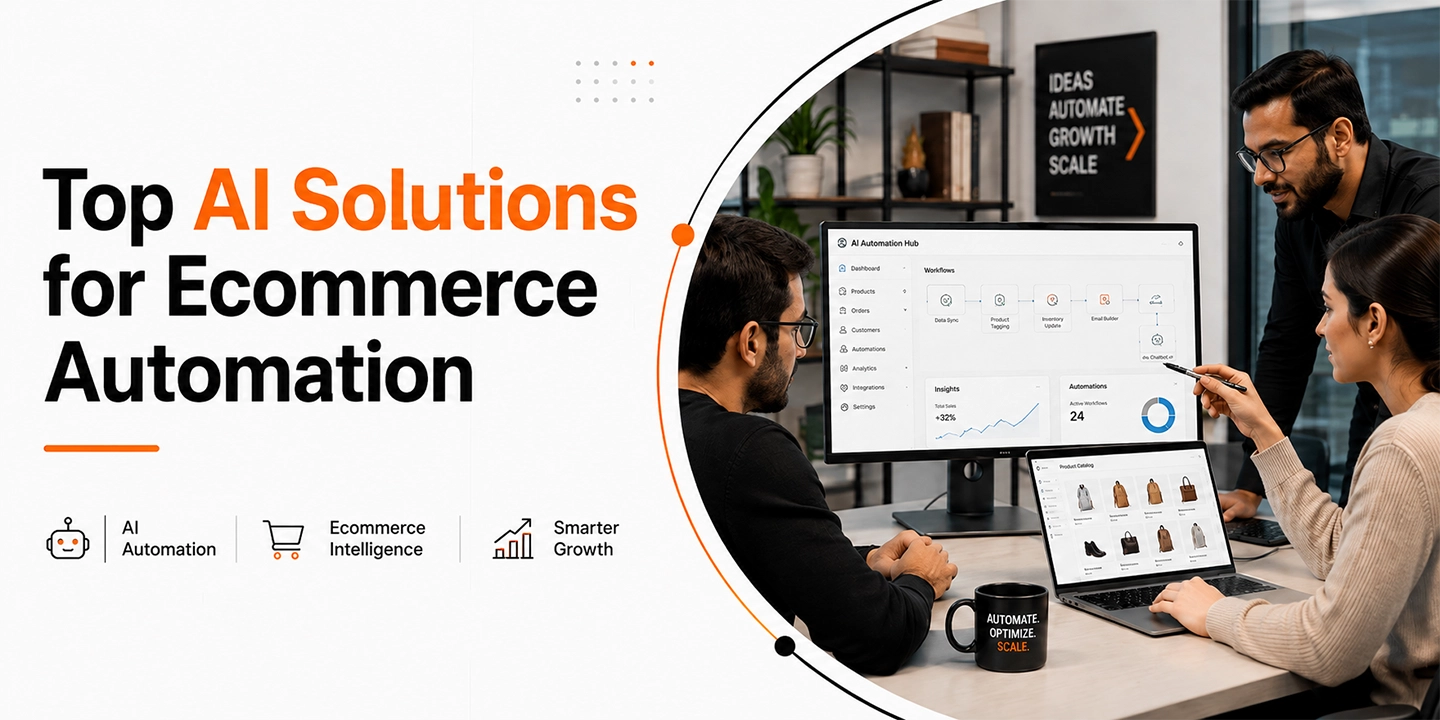
AI ecommerce automation combines artificial intelligence with ecommerce data, APIs and workflows to complete repetitive tasks or assist employees with decisions. Common examples include support, product categorization, recommendations, reporting and inventory analysis.

Yes. Shopify businesses can use native automation, apps, APIs, webhooks and custom development for AI-powered customer support, product management, marketing, reporting, inventory and operational workflows.

Yes. WooCommerce can combine WordPress plugins, APIs and custom development with AI services. Its flexible architecture makes it suitable for businesses requiring highly customized workflows.

Yes. BigCommerce supports API-driven integrations that can connect ecommerce operations with AI models, ERP systems, CRMs, warehouses and other business applications.

There is no single best option. Shopify provides a strong managed ecosystem, WooCommerce offers extensive customization and BigCommerce works well for complex and API-driven commerce environments.

Both. Traditional automation is better for predictable conditions. AI is more useful when a task requires interpretation, classification, summarization or reasoning.

Not always. Native platform tools and automation applications may solve many common problems. Custom development becomes more useful when workflows involve several systems, proprietary data or complex business rules.

Large refunds, major discounts, price changes, supplier purchase orders, fraud decisions, credit decisions and legal issues should generally retain human approval.

Start with a repetitive and measurable process with relatively low risk. Product tagging, support classification, reporting, review analysis and inventory notifications can all be useful starting points.

Businesses may choose an AI automation company in India when they require custom ecommerce integrations, AI agents, workflow development, API integrations, ERP or CRM connections and ongoing technical support without creating a large internal automation engineering team.
Ecommerce

Top AI Ecommerce Development Companies in India for Enterprise Brands

Frequently Asked Questions

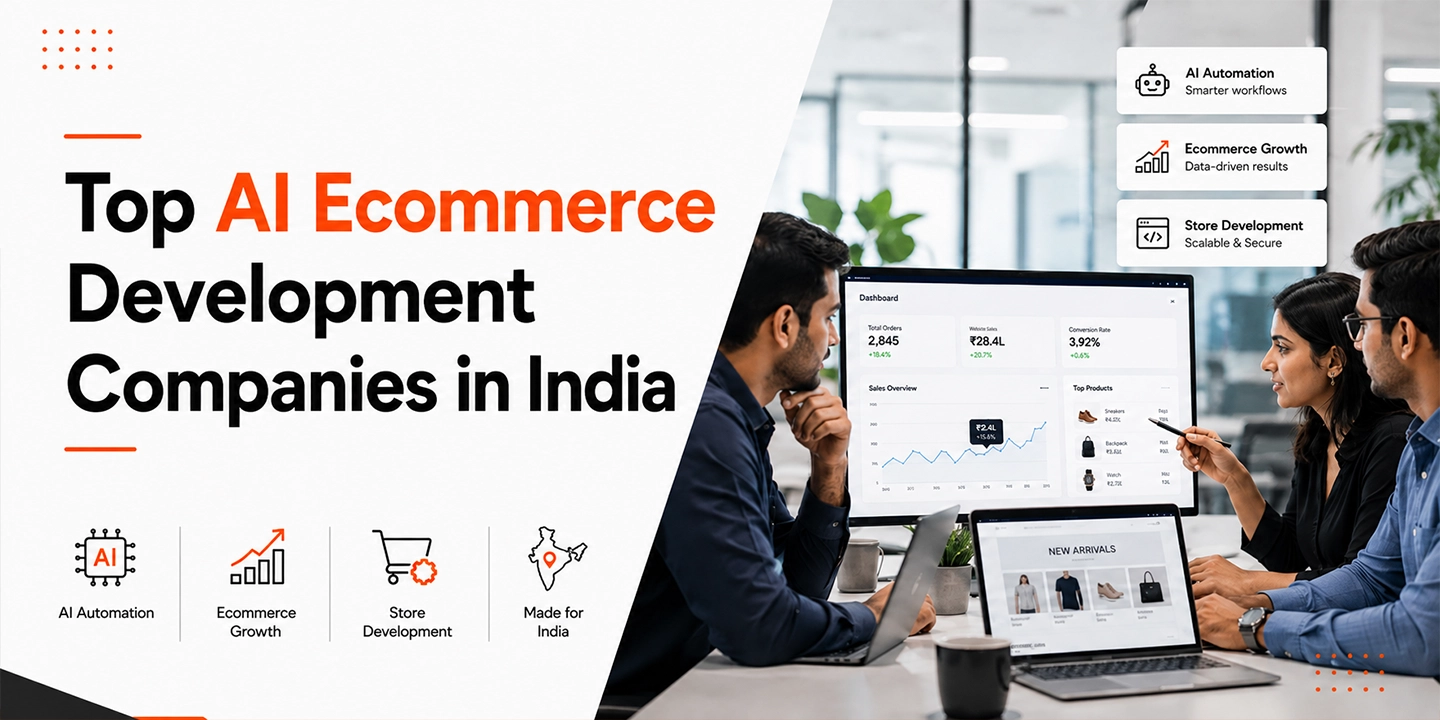
AI ecommerce development companies in India build and integrate artificial intelligence solutions for ecommerce businesses. Their services may include AI-powered search, product recommendations, personalization, customer support automation, predictive analytics, catalog automation, and integrations with ERP, CRM, PIM, and other business systems.

AI can help enterprise ecommerce businesses improve product discovery, personalize customer experiences, automate repetitive operations, analyze customer behavior, forecast demand, optimize inventory, support customer service, and improve merchandising decisions.

Look for experience with ecommerce platforms, AI and machine learning, enterprise integrations, APIs, automation, data security, scalability, testing, and ongoing technical support. The company should also understand your business processes rather than focusing only on AI technology.

Yes. AI solutions can be integrated with Shopify, BigCommerce, Magento, WooCommerce, and other ecommerce platforms through APIs, applications, middleware, webhooks, or custom development. The implementation depends on the platform and the specific business requirement.

Common AI ecommerce solutions include product recommendations, intelligent search, chatbots, AI agents, customer segmentation, personalized shopping experiences, demand forecasting, inventory analysis, product tagging, catalog enrichment, review analysis, and workflow automation.

Yes. AI ecommerce solutions can connect with ERP, CRM, PIM, WMS, OMS, marketing platforms, and other business systems when suitable APIs or integration methods are available. These integrations can help AI access product, customer, inventory, and order data.

The cost of AI ecommerce development in India depends on the project scope, ecommerce platform, AI functionality, data requirements, integrations, custom development, security, infrastructure, testing, and ongoing support. Enterprise projects are usually estimated after the business requirements and technical architecture are clearly defined.

WooCommerce

10 WooCommerce Experts in India for Furniture & Home Decor Brands

Frequently Asked Questions

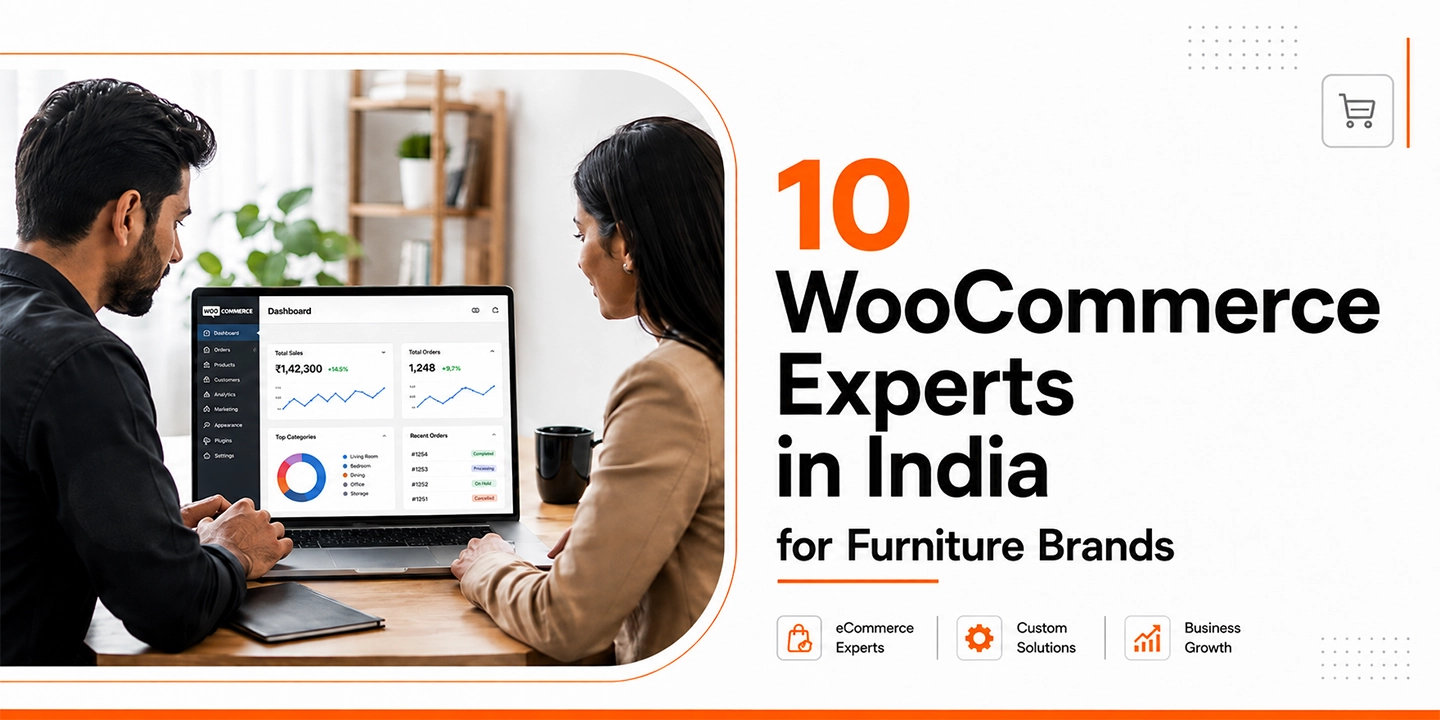
Businesses can consider DIT India, DIT Interactive, 9eCommerce, BrainSpate, Webkul, Elsner Technologies, WPWeb Infotech, KrishaWeb, EmizenTech, and Brainpulse. Their capabilities vary across custom development, ecommerce design, plugins, integrations, migrations, and ongoing support.

Yes. WooCommerce can support product variations, different materials, colours, sizes, product galleries, filters, payment methods, and custom shipping rules. More complex furniture stores may require custom development for configurators, advanced search, ERP integration, or delivery calculations.

Yes, but the store needs proper product structure, hosting, caching, image handling, database performance, and filtering. Large catalogues should be tested carefully to ensure category pages, product search, and filters remain fast.

Yes. Standard variations can support options such as colour, size, material, or finish. More advanced furniture configuration, such as modular products or multiple dependent options, may require a custom product configurator.

Yes. Standard shipping rules can be combined with custom functionality for location, weight, delivery zone, or product type. More complicated freight calculations may require carrier integration or custom development.

Yes, when the external software provides APIs or another supported integration method. Products, inventory, customers, orders, fulfilment data, pricing, and other information can potentially be synchronized between systems.

A custom design is not always necessary. It becomes more valuable when a store requires unique product presentation, unusual filtering, custom configurators, room-based shopping, specialist mobile UX, or functionality that standard WooCommerce themes cannot provide effectively.

Review their WooCommerce experience, relevant ecommerce projects, custom development skills, plugin knowledge, integrations, product variation experience, performance work, mobile UX, QA process, communication, maintenance support, and source-code ownership.

Uncategorized

Headless Commerce vs Composable Commerce: Which Is Better for Ecommerce in 2026?

Frequently Asked Questions

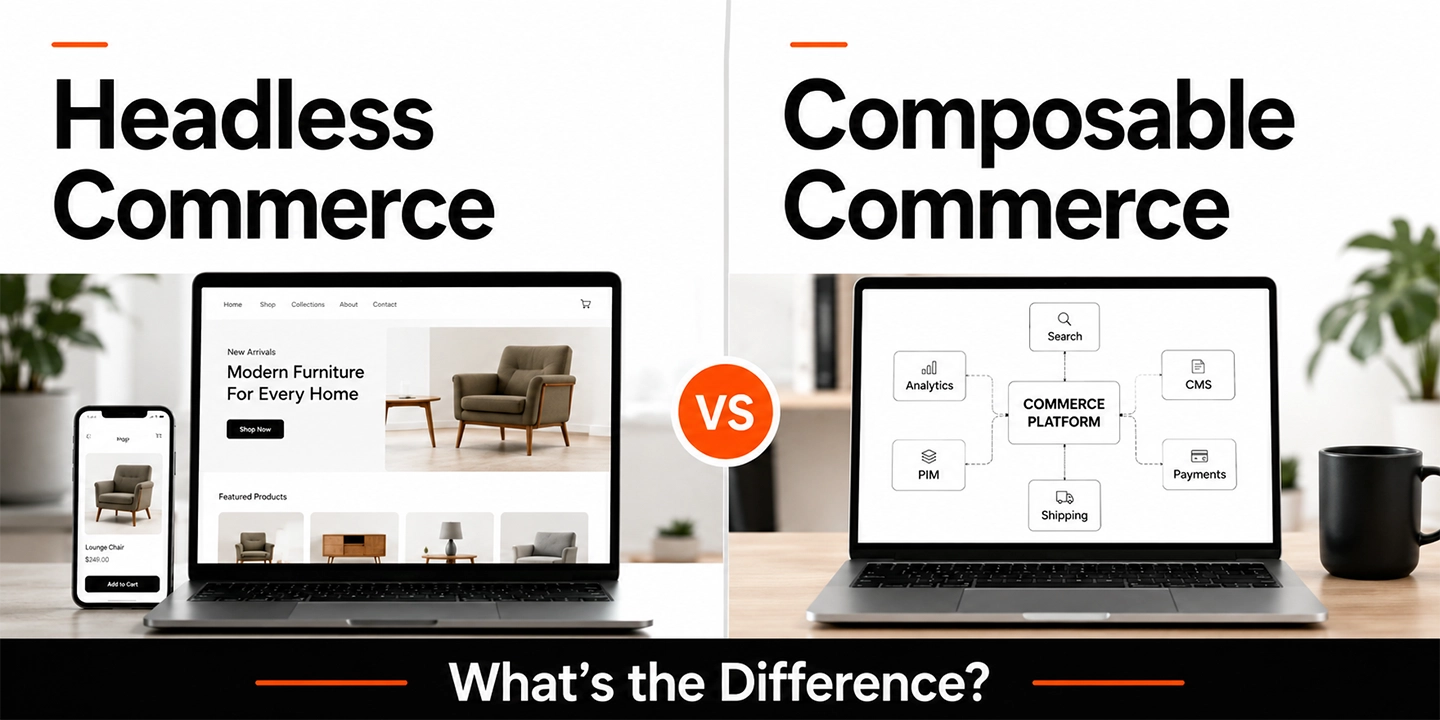
Headless commerce separates the frontend storefront from the commerce backend and connects them through APIs. Composable commerce takes modularity further by allowing several commerce capabilities, such as CMS, search, PIM or personalization, to be selected and managed independently. A headless storefront can therefore be part of a composable architecture without necessarily making the entire system composable.

Composable ecommerce architectures commonly use a headless experience layer because independent frontend and backend components support modularity. However, composability is a broader concept focused on assembling and replacing business capabilities independently. The important distinction is that headless primarily concerns presentation-layer separation, while composability applies across more of the technology stack.

Headless will often have a lower total implementation burden because a business may retain one commerce platform for most backend functions. Composable commerce can involve several vendors, integrations, monitoring systems and contracts. Actual cost depends on storefront complexity, integrations, migration requirements, hosting, internal skills and the number of independently managed services.

Either can work for enterprise ecommerce. Headless suits enterprises that need custom customer experiences while retaining a strong commerce core. Composable can be better when different capabilities genuinely require independent platforms or release cycles. Enterprise size alone is not a reason to choose composable commerce. Architecture should reflect operational complexity and technology ownership.

Yes, particularly when a B2B business needs a custom buyer portal or storefront while keeping backend capabilities such as company accounts, catalogs, pricing and ordering on an ecommerce platform. More complex B2B ecosystems involving ERP, CPQ, PIM and other specialized systems may justify a more composable architecture.

Headless gives development teams greater frontend control, which can support strong performance, but it does not automatically make an ecommerce site faster. Rendering strategy, API latency, caching, image delivery, JavaScript, CDN configuration and third-party services still matter. A poorly designed headless storefront can perform worse than a well-built traditional storefront.

Headless commerce can support excellent SEO when crawlability, rendering, canonical URLs, structured data, internal links, metadata and sitemaps are implemented correctly. The architecture itself does not provide an SEO advantage automatically. Search problems tend to appear when frontend implementations rely on poor rendering strategies or overlook basic technical SEO requirements.

Cost varies considerably according to architecture, storefront complexity, integrations, backend platform, CMS, migration and ongoing support requirements. A business should request an architecture-based estimate rather than relying on a generic fixed figure. Proposals should separate discovery, UX, frontend development, integrations, QA, deployment and post-launch support so the cost can be evaluated properly.

Look for proven experience across both frontend and backend commerce architecture. A qualified partner should understand APIs, ecommerce platforms, React or Next.js, CMS integration, checkout, payments, ERP systems, DevOps, SEO and QA. More importantly, they should explain why headless is appropriate for your requirements instead of recommending it automatically.

Got a Project or Partnership in Mind?

    100% secure, no spam.