



EcommerceSEO

AI Search Optimization for Ecommerce: The New SEO Playbook for 2026

Shoppers increasingly ask AI systems for product recommendations instead of scrolling search results, and that changes how ecommerce visibility works. This guide explains what AI Search Optimization actually means for ecommerce, how AI Overviews, AI Mode, ChatGPT, Gemini, and Perplexity discover and reference products differently than traditional search, and why strong SEO, clean product data, structured information, and real brand credibility remain the foundation, not a replacement, for AI-search visibility in 2026. AI Search Optimization for Ecommerce: The New SEO Playbook for 2026[...]
BigCommerceEcommerceShopifyWooCommerce

Top AI Solutions for Automating Shopify, WooCommerce, and BigCommerce

AI automation is helping Shopify, WooCommerce and BigCommerce businesses reduce repetitive work across customer support, catalog management, product discovery, inventory, marketing, reporting and operations. This guide explores practical ecommerce AI solutions, platform-specific automation opportunities, implementation approaches and areas where human approval is still important. Top AI Solutions for Automating Shopify, WooCommerce, and BigCommerce[...]
Ecommerce

Top AI Ecommerce Development Companies in India for Enterprise Brands

Compare leading AI ecommerce development companies in India for enterprise brands looking to implement AI-powered personalization, automation, product discovery, analytics, integrations, and intelligent ecommerce solutions. Top AI Ecommerce Development Companies in India for Enterprise Brands[...]
WooCommerce

10 WooCommerce Experts in India for Furniture & Home Decor Brands

Furniture and home decor brands often need more than a standard WooCommerce setup. This guide compares 10 WooCommerce experts in India for custom development, product variations, advanced filtering, integrations, shipping logic, performance, and ongoing support. 10 WooCommerce Experts in India for Furniture & Home Decor Brands[...]

Recommended

All Posts

Shopify

Top Shopify Developers in Ahmedabad for Health & Wellness Businesses in 2026

Frequently Asked Questions

These companies can be considered for analysis: DIT India, 9eCommerce, DIT Interactive, Green Cube Solutions, Kleverish, LapaOne, Stymeta, APPWRK, SocioLabs, and Tameta Tech. Some of them are located in Ahmedabad, and some offer their services to customers from Ahmedabad. Everything depends on your store’s size, the requirements for design and integration, etc.

Always start by considering the relevant experience of the Shopify developer when it comes to projects and technologies. Find out if they have worked on projects like custom themes, migrations, apps, subscription systems, third-party API integrations, mobile UI and UX design, and other businesses like yours.

A price is not fixed for any standard. The cost will depend on whether theme setup, customization, migration, custom application development, integration, subscription plans, Shopify Plus, B2B features, and maintenance are required. Request an estimate from agencies based on scope to be able to make an apples-to-apples comparison.

Basic installation on Shopify takes less than two weeks, but the installation of a custom storefront can take much more time. The migration process, custom app installation, connection to APIs, catalog creation, approval of the design, content creation, and testing affect the schedule. Request a schedule from the developer company with milestones, not only delivery dates.

Sure. Shopify is being used by companies involved in health, nutrition, beauty, personal care, and wellness. Shopify itself emphasizes that the health and wellness merchants are important among their ecommerce materials. The end result must incorporate all the aspects of complexity of the product, compliance, subscriptions, education, and claims.

Yes, Shopify sites have the capability to offer subscription services for the product. It is beneficial for supplements, skincare, vitamins, wellness, personal care, and so on. You should discuss this with your developer to learn about its working and integration with discounts, inventory, customer account management, and payment management.

Yes, provided that there are proper APIs available on ERP/CRM or a pre-existing connector for Shopify exists. The range of integration may involve customers, inventory, order management, fulfillment, products, or marketing information. However, complex integrations need to be considered early on due to potential impacts on architecture, schedule, testing, and support.

Shopify Plus could be the best choice for enterprises that have more sales volume, complicated automation, B2B demands, multiple locations, and sophisticated operations. One must not consider Shopify Plus based only on anticipated growth of their enterprise. Evaluate what Plus actually provides compared to its cost.

Certainly. Moving of goods, customers, order history, contents, URLs, and other store information from ecommerce solutions to Shopify is common practice for businesses. It is recommended to have a plan regarding redirects, SEO, integration, redesign, verification, and testing when moving a store. In more complicated cases, custom scripts may be needed.

Make sure to ask about relevant Shopify samples, the scope of work performed by you, who will run the project, the scope of custom functionality, testing of integration points, what happens during deployment, and after-launch support. Don’t forget to clarify what is not included in the quote since the answer to this question may save you from unpleasant surprises in the future.

Ecommerce

AI Automation for Ecommerce: 15 Tasks Businesses Can Automate in 2026

Frequently Asked Questions

AI automation for ecommerce combines artificial intelligence with workflow tools, APIs and business rules to complete repetitive commerce tasks. It can classify customer requests, analyse reviews, recommend products, prepare reports, update CRM records and coordinate work across ecommerce, ERP, warehouse and customer-support systems.

AI can support customer service, order tracking, catalog management, product tagging, recommendations, site search, cart recovery, segmentation, email workflows, inventory monitoring, forecasting, review analysis, returns, reporting and integrations between systems. The best tasks are repetitive and have clear data inputs and measurable outcomes.

AI can reduce costs by removing repetitive manual steps, decreasing support workload, speeding up catalog management, identifying problems earlier and reducing the time employees spend moving data between systems. Savings depend on transaction volume, workflow complexity and how much employee time the process currently consumes.

Yes. AI can answer FAQs, retrieve order status, explain policies, recommend products and classify support requests. The strongest systems connect AI with real customer, product and order data. Sensitive complaints, unusual refund cases and high-value customers should still have clear escalation paths to employees.

An AI agent is software that can interpret information, decide which permitted action to take and execute multiple workflow steps toward a goal. In ecommerce, an agent might analyse an order issue, retrieve shipping data, determine the likely problem, create a support case and notify the appropriate team.

Yes, but smaller businesses should start simply. Automating support FAQs, reporting, product content, inventory alerts or CRM updates may provide more value than building complicated autonomous agents. The goal should be to remove genuine operational friction rather than introducing AI into every process.

Costs vary widely. A simple workflow built with an existing automation platform can be relatively inexpensive, while custom automation involving AI models, ERP systems, multiple APIs, private data and monitoring can become a substantial software project. Cost should be compared with employee time saved, error reduction and potential revenue impact.

It depends on the workflow. Zapier is useful for many straightforward business automations, Make works well for visual multi-step workflows, and n8n can provide more control for technically complex automation. Data volume, hosting, custom code, API usage, security and maintenance should influence the choice.

Consider an agency when your automation crosses several systems or requires custom APIs, AI models, ecommerce expertise, security controls, monitoring or approval workflows. An experienced external team can also help businesses validate automation opportunities before committing to a larger internal AI engineering function.

Look for production ecommerce experience rather than AI demos alone. Companies like DIT India can be evaluated based on their experience with Shopify or BigCommerce APIs, workflow tools, ERP integrations, authentication, monitoring, failure handling, security, and documentation. A good AI automation company should clearly explain which processes are suitable for AI and which are safer to manage with standard rule-based automation.

Shopify

AI in Shopify: How Indian Brands Can Automate and Scale Their Stores

Frequently Asked Questions

Automation through AI in Shopify makes use of artificial intelligence in order to understand data from the store, comprehend the events that have taken place, suggest actions, or even execute tasks. Examples of automation in this case may be customer services, merchandising, product recommendations, etc.

Agent-Based Development in Shopify links AI agents to the data, APIs, apps, and business systems of Shopify so that they can accomplish multiple tasks according to a set of rules. Rather than producing text, the agent will analyze sales, look at the stock, detect any issues, prepare to act, and get approval from the worker.

In theory, there are various processes that could be automated, but full automation is not always a wise option. Issues such as price adjustment, issuing of refunds, payment processing, conflicts between customers and businesses, buying process, and decisions regarding the personal data of clients should be handled by people.

AI can help in sales through improvements in product discovery, search relevance, recommendations, customer service, segmentation, cart abandonment, merchandising, and retention marketing. AI typically produces the best results when it solves a particular customer or business issue, not just by implementing it due to its popularity.

Sure. Shopify offers features like APIs, apps, automation, customer and product data, analytics, and integrations that help achieve AI commerce. Indian brands can also integrate Shopify with local logistics, ERPs, WhatsApp channels, payments, CRMs, and even custom apps.

The cost of development depends greatly on scope. Setting up and configuring an existing AI app might need little development, but custom agents that incorporate such elements as Shopify API, ERP system, customers' data, workflow, dashboard, and even AI itself might result in rather large software development project.

Use the app if the functionality you need is common and there is a well-established product that takes care of it. Think about custom development if the process flow is specific to your company, integrates with several systems, uses proprietary information, needs unusual access rights, or may give you a competitive advantage.

AI visibility may be achieved through making available structured, useful, and indexed information about products, categories, policies, knowledge, the organization itself, and many others. This includes, but is not limited to, such things as structured product information, accurate prices and availability, technical specifications, FAQs, reviews, and third party information.

Review their knowledge on the use of Shopify APIs, apps, integrations, AI models, workflow automation, security, data processing, monitoring, and human verification. Also ask for concrete workflows that they have implemented to confirm their claims on their proficiency with AI systems.

Begin with something repetitive, measurable, and low risk. DIT India recommends starting with practical AI use cases such as customer support classification, weekly sales reporting, product categorization, product content assistance, inventory notifications, or review analysis. Measure time savings, accuracy improvements, and error reduction before using AI for more critical business decisions.

Headless Commerce

Headless Commerce Development in India: When Shopify, BigCommerce, or WooCommerce Is Not Enough

Frequently Asked Questions

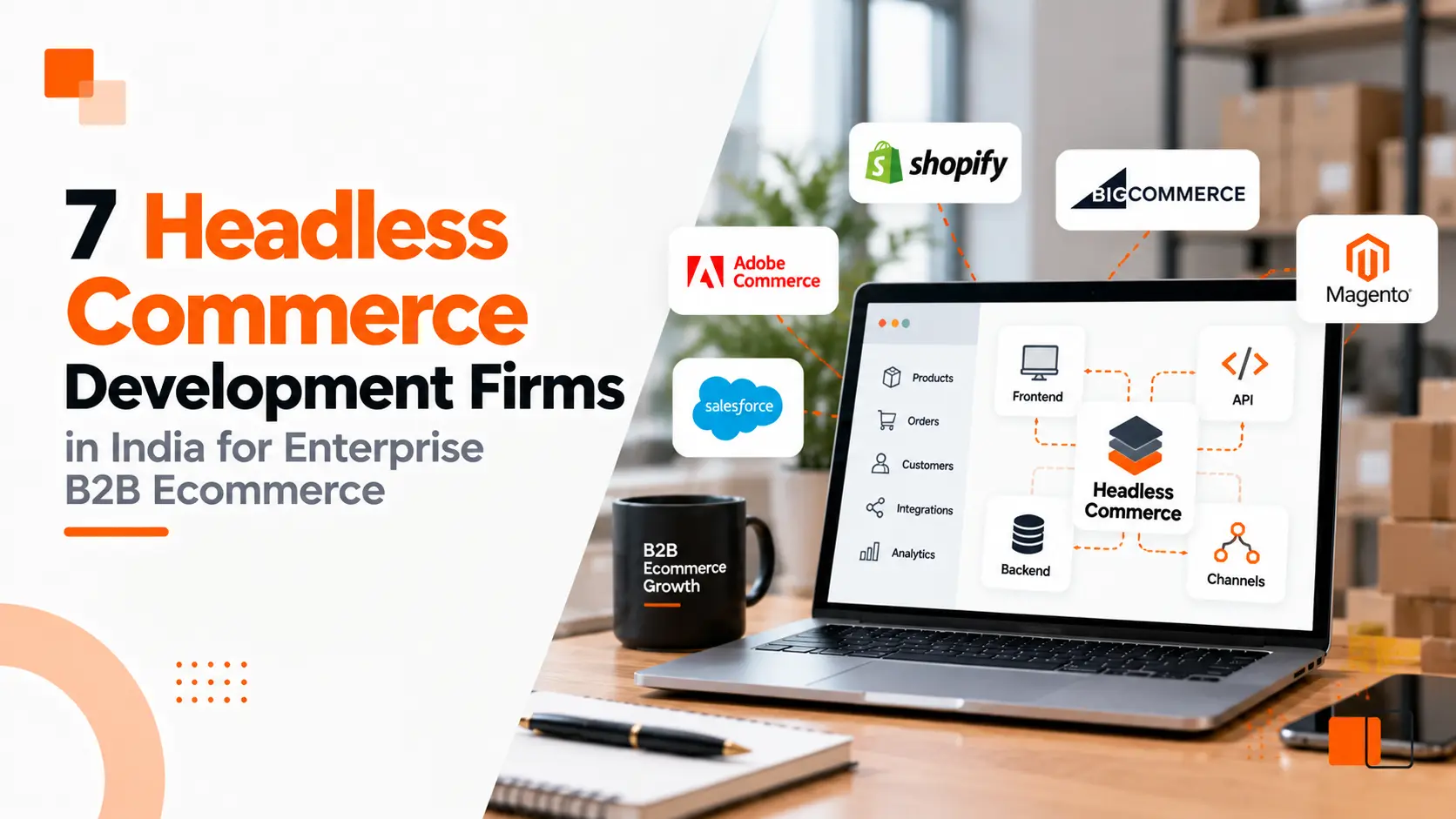
A headless solution separates the customer-facing storefront from the ecommerce backend. The frontend uses APIs to access products, carts, customers, and other commerce functions managed by the platform.

Not always. Headless is useful for advanced design, multiple channels, content-heavy experiences, and complex integrations. A traditional store is often cheaper, faster to launch, and easier to maintain.

The cost depends on the frontend design, platform, CMS, catalogue, checkout, integrations, search, regional setup, and support requirements. A discovery phase is usually needed before giving a dependable estimate.

A focused headless storefront may take a few months. Projects involving multiple regions, custom integrations, migration, account features, advanced search, and extensive testing generally require a longer timeline.

Yes, but the process requires careful planning. Product data, checkout, customer accounts, apps, SEO URLs, analytics, content, and integrations must be reviewed before replacing the existing storefront.

It can provide greater control over rendering, caching, and code delivery, but speed is not guaranteed. Performance still depends on frontend quality, API usage, hosting, scripts, images, and monitoring.

Not necessarily. A separate CMS is useful when marketers manage substantial editorial, campaign, or regional content. Stores with limited content may use the commerce platform or a simpler content setup.

Ongoing support usually covers frontend updates, API changes, hosting, monitoring, security, integrations, performance, analytics, testing, and new features. Headless stores need continuous technical ownership.

Got a Project or Partnership in Mind?

    100% secure, no spam.